Campfire Heat Radius Calculator
Estimate warm seating distance, hot core size, downwind heat reach, clearance radius, and firewood volume from real campsite variables.
Campfire Heat Radius Results
| Fire Class | Flame Bed | Comfort Radius | Clearance Radius |
|---|---|---|---|
| Small coffee fire | 1.5-2.0 ft | 3.5-4.5 ft | 10-12 ft |
| Two-chair fire | 2.0-2.8 ft | 4.5-5.8 ft | 10-13 ft |
| Family ring fire | 2.8-3.6 ft | 5.5-7.0 ft | 12-15 ft |
| Large group fire | 3.6-4.8 ft | 7.0-9.0 ft | 15-18 ft |
| Bonfire-style campfire | 4.8-6.0 ft | 9.0-12.0 ft | 18-25 ft |
| Wind Speed | Comfort Effect | Downwind Reach | Clearance Note |
|---|---|---|---|
| 0-3 mph | Nearly round heat zone | +0-5% | Base clearance usually fits |
| 4-7 mph | Warm side shifts downwind | +8-15% | Leave extra room for chairs |
| 8-12 mph | Upwind seats cool quickly | +18-30% | Increase spark clearance |
| 13-18 mph | Heat plume becomes uneven | +30-45% | Use conservative spacing |
| Over 18 mph | Open fire often unsuitable | +45% or more | Check restrictions first |
| Fuel | Typical Heat | Best Moisture | Radius Behavior |
|---|---|---|---|
| Softwood splits | Fast, bright flames | 15-20% | Quick warmth, shorter burn |
| Mixed firewood | Balanced camp heat | 15-20% | Stable seating radius |
| Dense hardwood | Long, steady heat | 15-20% | Stronger radiant comfort |
| Charcoal and coals | Low flame, hot center | Dry fuel | Small radius, strong core |
| Layout | Typical Fire | Seat Radius | Chair Ring Diameter |
|---|---|---|---|
| Solo mug and stool | 1.6 ft bed, 1.4 ft flame | 3.8-4.5 ft | 9-11 ft |
| Two camp chairs | 2.3 ft bed, 2.0 ft flame | 4.8-5.8 ft | 11-13 ft |
| Family of four to six | 3.0 ft bed, 2.6 ft flame | 5.8-7.0 ft | 13-16 ft |
| RV awning edge fire | 2.6 ft bed, 2.2 ft flame | 5.0-6.2 ft | 12-15 ft |
| Large campground circle | 4.2 ft bed, 3.3 ft flame | 7.5-9.5 ft | 18-22 ft |
It’s true; you might have a nice, hot fire. But if your chair is too far away it will be cold. And even though it looks like there is plenty of warmth coming off the blaze, your toes remains numb. Why? Because most people don’t understand the physics of radiant heat.
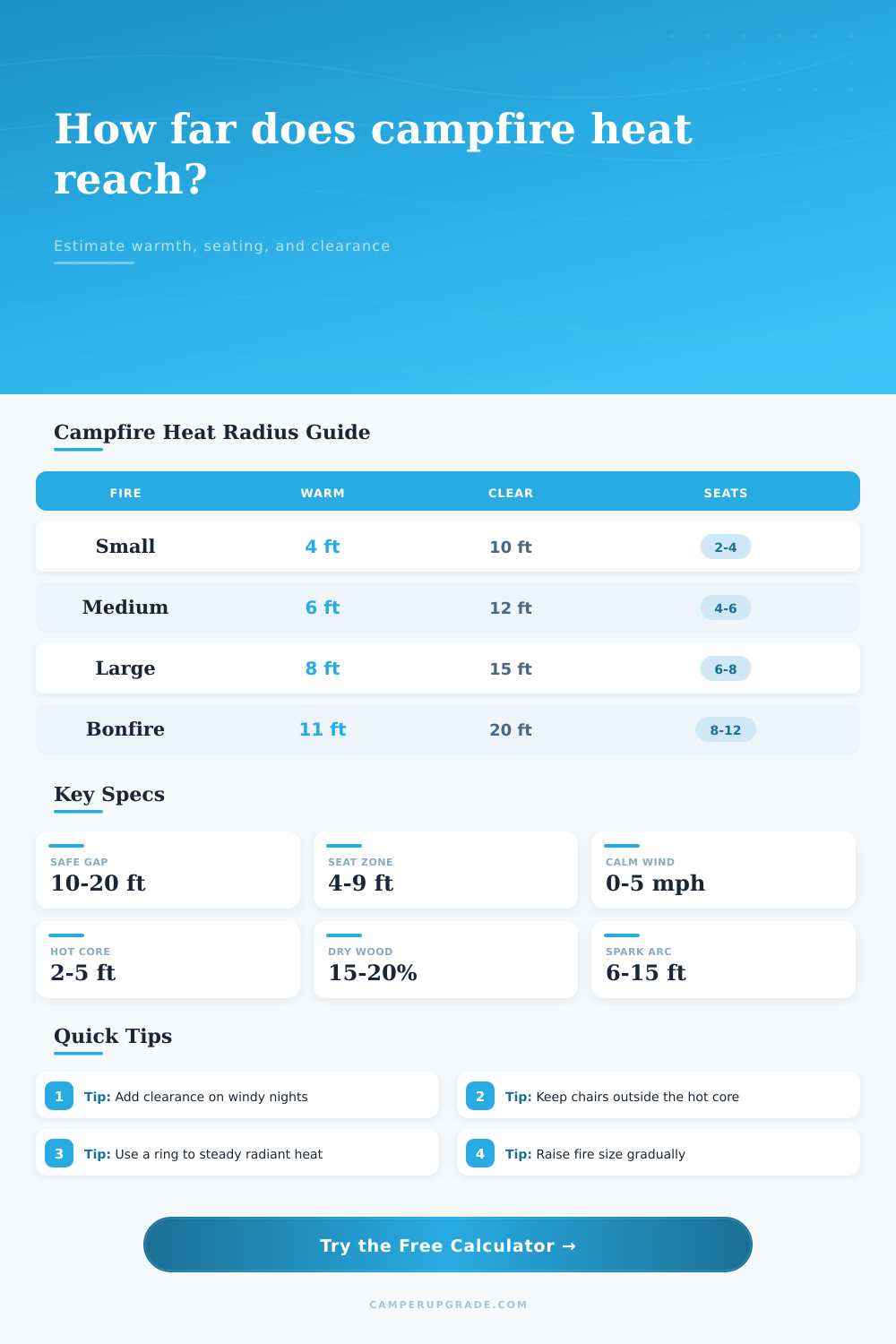
Stay warm by understanding the physics of fire. The size of the fires dictates how far that comfort zone extends. Small fires keep only those who are in their reach (four feet) warm. Large fires keeps those up to ten feet away warm.
How to Stay Warm by a Campfire
So how do you position seats? You do this by understanding that range. Sit too close: One half of your body is frozen, the other is roasted. Sit too far away: You just see it lit.
This tool will help you determine how far away to sit. Enter some variables: the flame diameter, height, and wind speed. It’ll tell you how far away to sit. No more guessing when setting up your camp.
Heat behaves different with wind. A soft gust will push that nice warm air right out of your lap. To deal with this, the wind change the size of the warm zone. If you are in a protected location, the heat radiates outward in every direction. If you’re on an exposed ridge, then leave a bit more distance between yourself and the fire. The farther apart you sit, the more it protect both you and the fire from spark showers. It also helps keep you comfortabley from being hit by the winds. Without wind, a ten-foot clearance will suffice. But with increased wind, you require additional space to ensure the fire remains secure.
The choice of fuel impacts the distribution of heat from the fire. Softwood will burn faster and brighter, but for a shorter time than hardwood. The latter produces a consistent center of radiant heat. Hardwood is better at transferring heat. In contrast, softwood burns faster and brighter but provides less sustained warmth.
Moisture content also matters. If your wood contains too much moisture, it won’t be used to give you heat but rather energy needed to boil water away. The result is a reduced effective radius of comfort and shorter burn time. Best is seasoned firewood with 15-20 percent moisture. It will push its heat farther out and burn cleaner. Too green/damp wood lack sufficient radiant power.
First, plan your campfire with safety in mind. The clearance radius are more than just a minimum distance; it is the clear space around the fire needed to prevent an accident. Keep all flammable items (including grass & dried leaves) out of the range of the fire. Be prepared for a surprise gust or spark, provide a safety buffer. Greater is better then less! For quick planning of small, medium, & large fires, refer to the safety grid below.
Campfires are easy to set up if you choose right. Arrange chairs so they’re out of the most intense heat from the flames. Heavy gear and sleeping bags should of be placed past the clearance zone. If the wind cooperates, move your chair downwind. After mastering flame geometry, you’ll never again fear a cold night’s sleep. You’ll always know right where the warmth lies. Your feet remain cozy while the fire burns bright. And there is no more confusion: evenings become comfortabley.