Campfire Grate Size Calculator
Size a campfire cooking grate from the fire ring opening, ledge overlap, cookware footprint, edge clearance, bar spacing, support style, material, and loaded cookware weight.
🏕Campfire Grate Presets
⚙Ring, Cookware, Clearance, and Load Inputs
The load card is a campsite sizing estimate based on simply supported round bars, material stress factors, span, bar count under the cookware, and the selected safety factor. It is not a certification for suspended or damaged grates.
📏Grate Material and Spec Comparison
🔥Grate Material Comparison Grid
Mild Steel Bar
StrongCommon for park-style grates; seasons black, can rust if stored wet, and handles repeated campfire heat well.
304 Stainless
CleanBetter corrosion resistance for food contact and wet camp storage, with slightly more thermal expansion than plain steel.
Cast Iron
StableHeavy and heat-retentive with good pan support, but brittle if dropped and slower to pack after cooking.
Expanded Steel
WideGood broad support for many pans, but thin sheets need a frame because unsupported spans flex quickly.
📋Campfire Grate Reference Tables
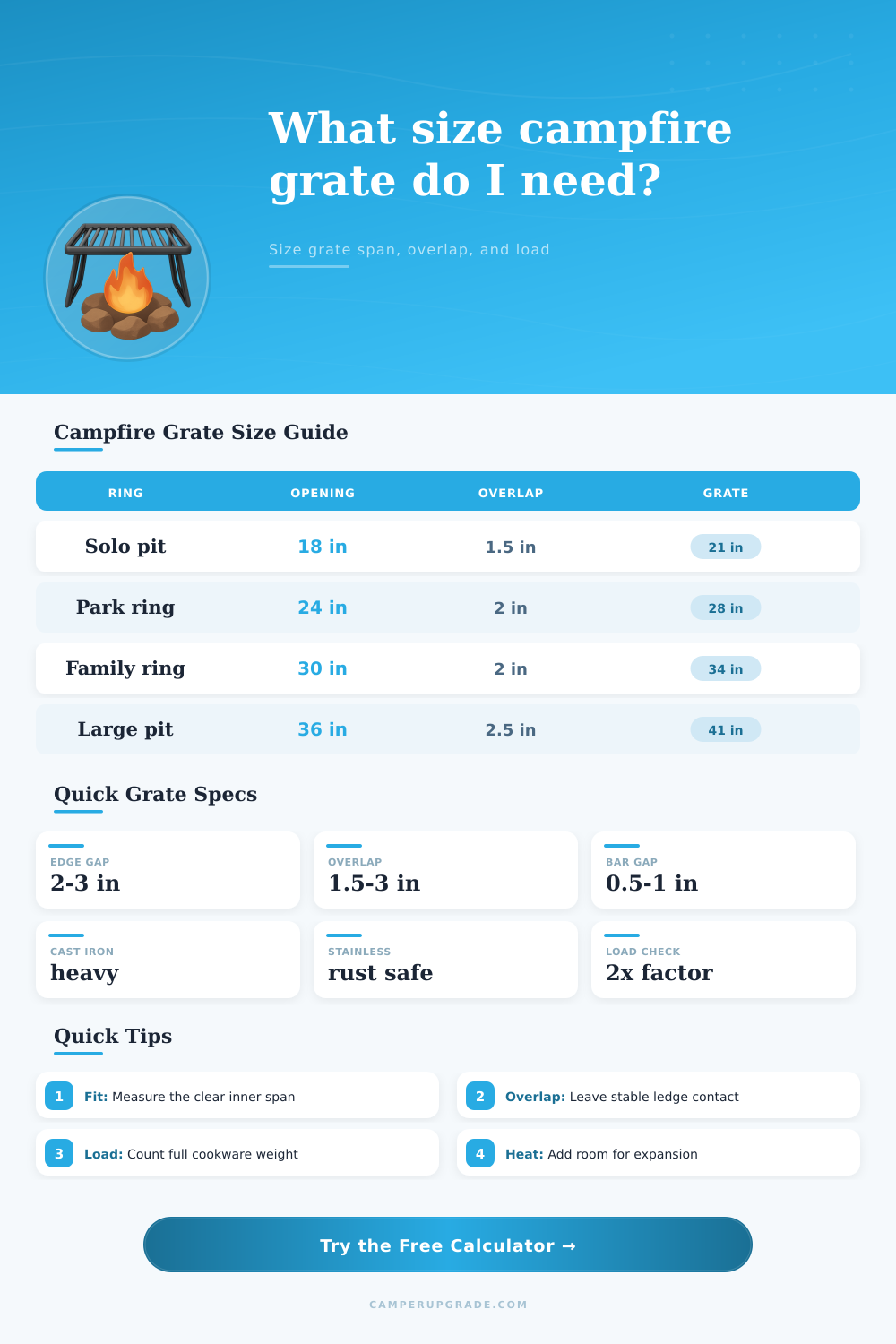
| Clear Ring Span | Overlap Each Side | Round Grate OD | Rect Grate Add |
|---|---|---|---|
| 18 in | 1.5 in | 21 in | +3 in |
| 24 in | 2 in | 28 in | +4 in |
| 30 in | 2 in | 34 in | +4 in |
| 36 in | 2.5 in | 41 in | +5 in |
| 42 in | 3 in | 48 in | +6 in |
| Cookware | Footprint | Useful Zone | Typical Load |
|---|---|---|---|
| 10 in skillet | 10-11 in | 15 in+ | 6-10 lb |
| 12 in Dutch oven | 13-14 in | 18 in+ | 25-35 lb |
| Camp kettle | 9-12 in | 15 in+ | 8-20 lb |
| Griddle | 18x10 in | 23x15 in | 15-30 lb |
| Stockpot | 14-16 in | 20 in+ | 45-80 lb |
| Bar Gap | Best For | Ash Drop | Small Pan Support |
|---|---|---|---|
| 0.25-0.5 in | Mugs, fish | Low | Excellent |
| 0.5-0.75 in | Mixed camp pans | Medium | Good |
| 0.75-1 in | Skillets, Dutch ovens | Good | Fair |
| 1-1.5 in | Large pots | High | Poor |
| 1.5 in+ | Firewood support | Very high | Not ideal |
| Material | Heat Behavior | Care | Good Use |
|---|---|---|---|
| Mild steel | Fast heat | Oil dry | Fire rings |
| 304 stainless | Expands more | Rinse dry | Wet camping |
| Cast iron | Holds heat | Season | Dutch ovens |
| Expanded steel | Can warp | Frame it | Large area |
| Titanium | Low mass | Avoid overload | Backpacking |
💡Grate Sizing Tips
A campfire grate are a piece of metal that sits over a fire, and it is meant to provide a surface for cooking. Therefore, a campfire grate must be able to support the weight of the cookware placed over it. Many peoples make mistakes when selecting a campfire grate because a campfire grate must be able to handle the weight and heat of the fire and the physics of the fire.
For instance, if a campfire grate isnt sized correct for the fire ring, the campfire grate may slip from the ring or it may bend under the weight of the cookware. Therefore, it is necessary to understand how to properly measure a campfire grate and to select the correct material for that campfire grate. To measure a campfire grate correctly, you must measure the fire rings clear span, not the outside diameter of the fire ring.
How to Measure and Choose a Safe Campfire Grate
If you measure the outside diameter, the campfire grate may be too larger to sit properly within the fire rings ledge. Furthermore, the portion of the campfire grate that overlaps the fire ring and the rocks must have enough space to ensure that the campfire grate does not slide when cooking or when exposed to the wind. If the overlap portion is too narrow, the campfire grate may slip off an fire ring ledge and create a dangerous situation.
The material used to create the campfire grate will have an effect on the campfire grates reaction to heat. For instance, mild steel is a common material for campfire grates because it can withstand heat, but it will rust if it is exposed to the rain. Furthermore, stainless steel are another common material.
Stainless steel is a clean material because it does not impart the metallic taste of oxidized metals into the food cooked on the campfire grate. However, stainless steel will expand when it is hot, and this expansion may cause the campfire grate to push against the supports beneath it. Thus, you must provide breathing room around the campfire grate supports to allow for this expansion.
The weight of the cookware will impact the strength that a campfire grate must have. For instance, cooking with a small skillet will require less strength in the campfire grate than cooking with a heavy pot or griddle. Furthermore, the bars of the campfire grate must be thick enough so that they can distribute the weight of the cookware without bending.
Therefore, a safety margin should of been provided for the cookware, and a double safety margin will provide enough strength for the campfire grate to remain stable when cooking. The spacing of the bars of the campfire grate must be correct so that the cookware does not slip and so that there is an appropriate airflow to the fire. If the gaps between the bars are too wide, small cooking utensils may slip through the gaps.
Furthermore, if the gaps between the bars are too narrow, the ash may become trapped beneath the grate, which will restrict the airflow to the coals underneath the campfire grate. If the fire do not have an adequate airflow to the coals, the fire will decrease in temperature. Thus, the gaps between the bars must be the proper size to allow the ash to fall through while keeping the cookware stable.
The support style for the fire ring will dictate the support that the campfire grate will have while cooking. For instance, if the fire ring has a continuous ledge of stones under which the campfire grate will rest, then the campfire grate will be stable. However, if the fire pit is portable, it may only have welded metal supports or three point supports of rocks under the campfire grate.
In these cases, the support for the campfire grate will be less than a fire ring built with a ledge of stone supports. Thus, the portion of the campfire grate that overlaps the stones or rocks must be wide enough to ensure that the campfire grate will not tip over due to an imbalance in the cookware. Furthermore, the cooking zone that the campfire grate provides must be large enough to ensure that the cookware does not extend beyond the fire rings edge.
Any cookware that rests on the metal rim of the fire ring may tilt. Thus, it is necessary to ensure that there is enough space between the cookware and the metal rim. Finally, you can consider the size of the fire rings clear span and the weight of the cookware and the properties of the metal when building a campfire grate.