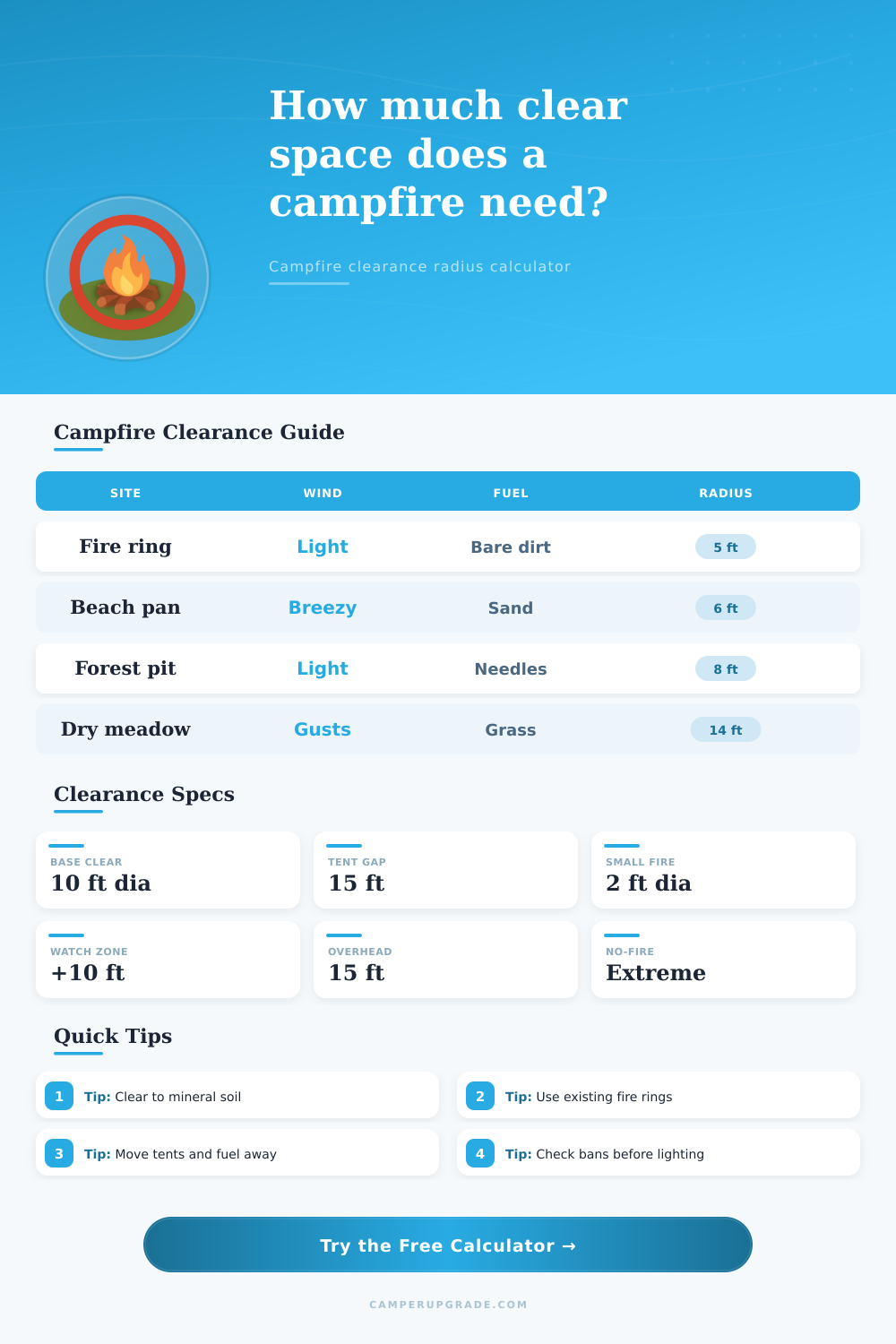
Campfire Safe Clearance Radius Calculator
Estimate how far to clear grass, leaves, gear, tents, and overhead hazards around a campfire based on fire size, wind, slope, fuel, and local fire danger.
This planner estimates a conservative clearance. Local fire restrictions, land-manager rules, posted bans, and campground instructions always override the result.
Campfire clearance estimate
| Reference item | Planning clearance | Use in calculator | Notes |
|---|---|---|---|
| Minimum cleared ground circle | 10 ft diameter | 5 ft radius floor | Clear leaves, grass, needles, and duff down to mineral soil where allowed. |
| Small contained campfire | 1.5-2.5 ft fire | Low fire size add | Keep flames modest; a larger flame column raises ember and overhead risk. |
| Tent, tarp, and awning setback | 15 ft minimum | Object move-back check | Use more distance in wind, dry fuels, or with synthetic shelters. |
| Fuel, woodpile, and loose gear | 15-25 ft | Gear shortfall check | Keep extra firewood outside the cleared ring, not stacked beside flames. |
| Overhead branches | Prefer open sky | Overhead risk flag | Low branches over flame or sparks are treated as a no-fire warning. |
| Condition | Typical add | Why it matters | Calculator response |
|---|---|---|---|
| Bare soil, gravel, sand, or snow | 0 ft | Less ground fuel for sparks to catch | Base radius still applies |
| Damp duff or sparse grass | 1-2 ft | Surface can dry while fire is burning | Small ground-fuel add |
| Dry needles, leaves, or grass | 4-5 ft | Fine fuels ignite and creep quickly | Larger cleared radius |
| Brush, slash, or deep duff | 8+ ft | Heavy fuel near the ring is hard to control | Strong warning and larger radius |
| Windy, gusty, or steep terrain | 3-8 ft | Embers move farther and flames lean uphill | Wind and slope penalties stack |
If you’re not clearing well back, a casual night around your fire could turn into a tough one after a wayward ember flares up. First ten minutes? Clear away any loose debris, grass and needles before dropping the matchs. A buffer zone is what this does.
The distance it carries mean how many feet of fire to watch, how fast the surface fuel will burn, and how far sparks fly. Nothing affects the situation as quickly than the wind does. If it’s calm at night, the fire burns within its area of cleared soil; if it blows steadily, embers will be carried far past that perimeter. Add to this slope (which sends flames upward and rolls embers downward) and now you’re cooking with gas.
How to Keep Your Campfire Safe
Input your ground-cover type, slope angle and wind speed into the calculator and it spits out the necessary radius you should of clear before lighting a match. It saves you from doing math yourself. And it gives you a radius to clear before you light anything.
Few variables is as important as the nature of the ground fuel. Dry grass will roughly double the size of the recommended area around it. Pine needles? Same deal. But bare mineral soil/gravel doesn’t need that much room at all. Why? Because those materials don’t provide the kind of easy-to-burn fuel a spark seeks.
For areas with low brush and/or heavy duff, go farther out and keep a closer eye on things. To see for yourself: Turn surface knob, then watch number jump up (indicating increased clearance).
Watch out for overhanging trees. They are annoying. A hanging tree branch can also act as a path for fire to climb. A spark that lands in the needles or bark of a low-hanging tree limb can quickly go up in flamess. The calculator will flag overhead branches and rate your risk accordingly; it might say, “Unsafe to burn an open fire.” If so, listen. Even if ground seems clean.
No matter what: Wood piles, tarps, tents, etc., cannot be in the Ember Zone. And the farther away from the flame, the better; the longer the flames get and the stronger the wind blows, the more distance you need. The calculator will compare your set up to those setback requirements and tell you where objects like tents and tarps needs to go to stay out of the ember zone.
It’s not a substitute for any applicable local fire restrictions, but it will give you the numbers in black-and-white so you can determine whether the spot would work or if you should bring a stove.
You know what those items are, like water and shovels, but you only realize how important they are when you don’t have them. That’s part of the tool; having something ready to respond quickly prevents problems from spreading. The same applies to adult supervision: one person standing over an unattended fire is not the same level of risk as a fire being watched until coals cool off.
This is not a substitute for your judgment, but does offers a fast method of evaluating these critical variables. When the result indicates too much risk (e.g., “high” label) or too big a move back required, don’t even bother or at least reduce the fire size. A simple test prior to sparking keeps the goodnight from turning into an unexpected trip to the emergency room.
Actualy, it saves you from a moddern disaster.