Campfire Charcoal Chimney Count Calculator
Estimate how many charcoal chimney loads to light for campfire cooking, fire-ring grilling, Dutch ovens, foil packets, coal-bed depth, refills, partial charcoal, and reserve.
🏕Camp Cooking Presets
📏Cooking Area
🔥Charcoal Load
📦Chimney and Reserve
This calculator estimates cooking charcoal for campfire-style cooking. Follow local fire rules and use charcoal only in allowed fire rings, grills, or pans.
Charcoal Chimney Plan
🧱Charcoal Density and Load Reference
📊Coal Bed Coverage by Depth
| Coal bed depth | Standard briquettes | Lump charcoal | Typical camp use |
|---|---|---|---|
| 0.75 in / 1.9 cm | 32 sq ft per 36 lb | 52 sq ft per 36 lb | Dutch oven ring, light top heat |
| 1.0 in / 2.5 cm | 24 sq ft per 36 lb | 39 sq ft per 36 lb | Light grilling or foil packets |
| 1.25 in / 3.2 cm | 19 sq ft per 36 lb | 31 sq ft per 36 lb | Medium camp grate heat |
| 1.5 in / 3.8 cm | 16 sq ft per 36 lb | 26 sq ft per 36 lb | Burgers, steaks, hot batches |
| 2.0 in / 5.1 cm | 12 sq ft per 36 lb | 20 sq ft per 36 lb | Heavy sear bed or large grate |
📦Chimney Load Conversion
| Chimney plan | Approx briquettes | Approx weight | Best planning use |
|---|---|---|---|
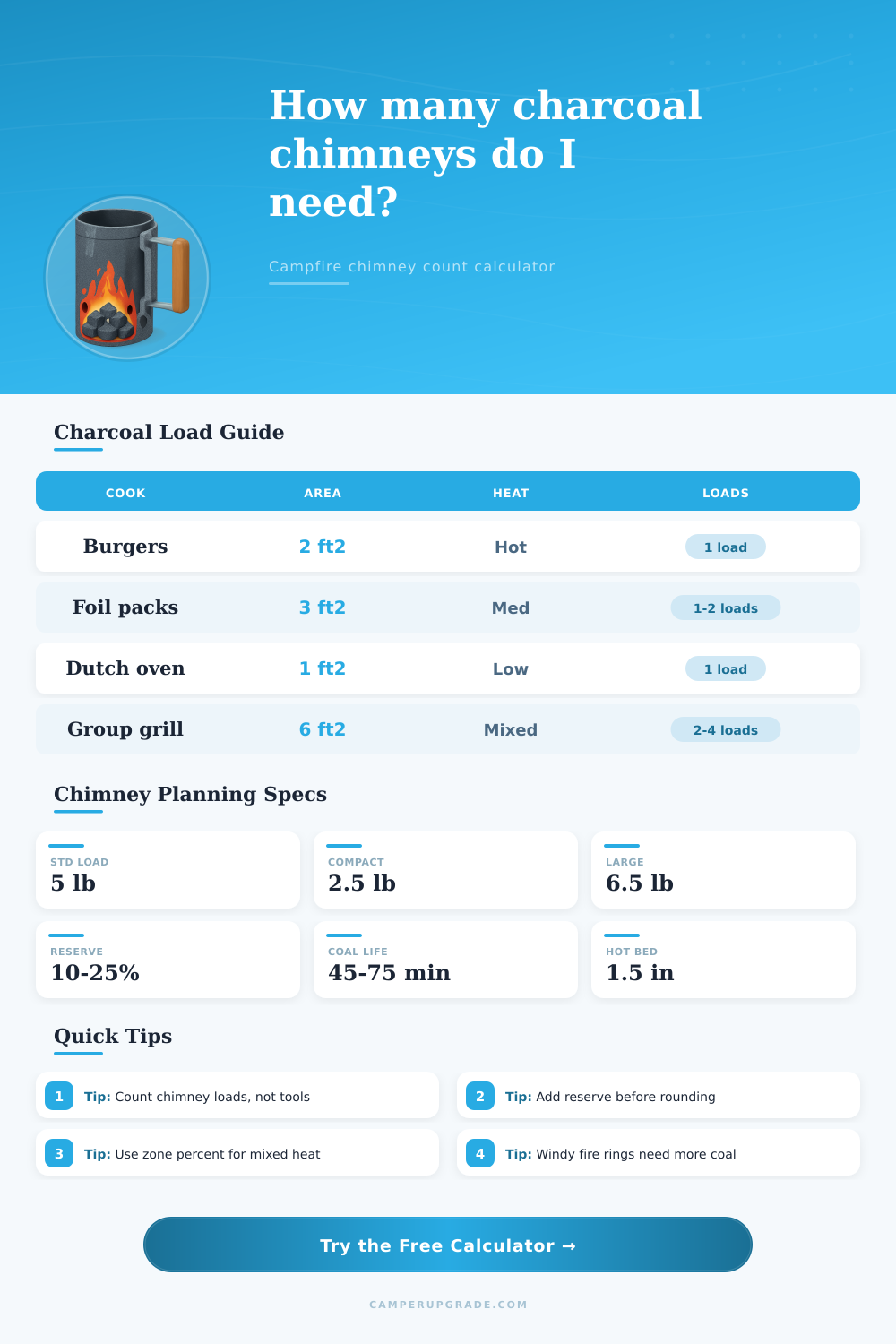
| Compact chimney | 40 to 50 pieces | 2.5 lb / 1.1 kg | Solo grill, small Dutch oven, short cook |
| Half standard chimney | 40 to 50 pieces | 2.5 lb / 1.1 kg | Top-up load, two-zone fire ring |
| Standard chimney | 80 to 100 pieces | 5.0 lb / 2.3 kg | Most campfire grate meals |
| Large chimney | 105 to 130 pieces | 6.5 lb / 2.9 kg | Group grate or long batch cooking |
🍲Common Camp Cooking Scenarios
| Scenario | Active area | Starting bed | Typical chimney loads |
|---|---|---|---|
| Two-person burger grate | 2.0 sq ft / 0.19 m² | 1.25 to 1.5 in | 1 standard load |
| Family foil packet dinner | 3.0 sq ft / 0.28 m² | 1.0 to 1.25 in | 1 to 2 standard loads |
| 12-inch Dutch oven | 0.8 sq ft / 0.07 m² | 0.75 to 1.0 in | 1 compact load |
| Large park fire-ring grate | 6.0 sq ft / 0.56 m² | 1.25 to 1.75 in | 2 to 4 standard loads |
💡Calculator Notes
With a campfire calculator that takes into account these changing factors, you’ll know just how much charcoal to light for feed your dinner party. No more guessing! Simply input things like wind conditions and grate size and let the calculator do the math for you.
Because there’s no one-size-fits-all number for cooking: Wind, cooking time and coal depth is all variables that work together. When one bed of coals burn out, this calculator calculates just how many additional briquette you’ll require. Most folks begin there: “How many briquettes for the first lighting?” If they’re using a Dutch oven or foil packets, they’ll need coals over them as well.
Why Use a Campfire Calculator
This method doesn’t work for most meal unless you’re doing just a few quick burgers on a small grate. If you use the calculator to select bed depth (the measurement from your grill’s grates to the bottom of the coals), which will vary based off what you’re going to cook, the next thing you know is how much charcoal that depth allows the grate to hold before you even start cooking. Steaks/kabobs need direct heat, so go deep; Dutch ovens are better than shallow. The tool will tell you how many charcoals just the first bed need, once you’ve made that choice.
The other variable most people forget to account for is impact of exposure and wind. Coals cool down much quicker when you’re cooking in the wind. What might have taken one chimney on a still evening now take two, or three if you’re in an exposed camp site. Exposure adjusts for those factors and doesn’t force you to remember and run separate calculations for each situation. It also shows why things cooked in covered pots require fewer charcoals as they continue to cook. Because the heat isn’t being radiated out into the night’s air, more of it remain in the system.
The other thing people miss is reserve. Halfway through their meal, they’re out of fuel, so they throw a bunch in and round up. That is still a waste. You can add a little cushion without buying too much by adding a tiny bit before you round up to full chimney loads. It would of been better to plan ahead. The beauty is that it doesn’t show up on the final number until after the calculator has added it to the overall total. It does not show up as an additional partial or full chimney. It takes “I wish I’d brought some more” from a vague concept to a clear action plan.
It can’t take into account that, in reality, this is not going to be a single meal for everyone: Half will want it now; the other half won’t want to eat until it’s nearly charred off the grill. To address that, you might decide to break up the cooking into two fires instead of just one lengthy effort. But at least with some numbers, you have an idea about how much charcoal it will cost to do things either way before you even fire up your first stick.
This type of planning will have you measuring your charcoal in terms of the meal rather than the bag. It will teach you about how much time it takes to get a meal up and down (and how deep for certain dishes). After you get used to the patterns, you’ll know the answer before you consult the calculator. That’s when it no longer surprises you; it only confirms your suspicions. Actualy, it will feel more naturaly comfortabley once you have practiced with moddern grills and dont worry about the math.