Campfire Boil Time Calculator
Estimate how long a campfire takes to bring water to a boil using water volume, starting temperature, altitude, pot material, lid use, wind, fire output, and real heat-transfer factors.
🏕Campfire Boil Presets
⚙Water, Pot, and Fire Inputs
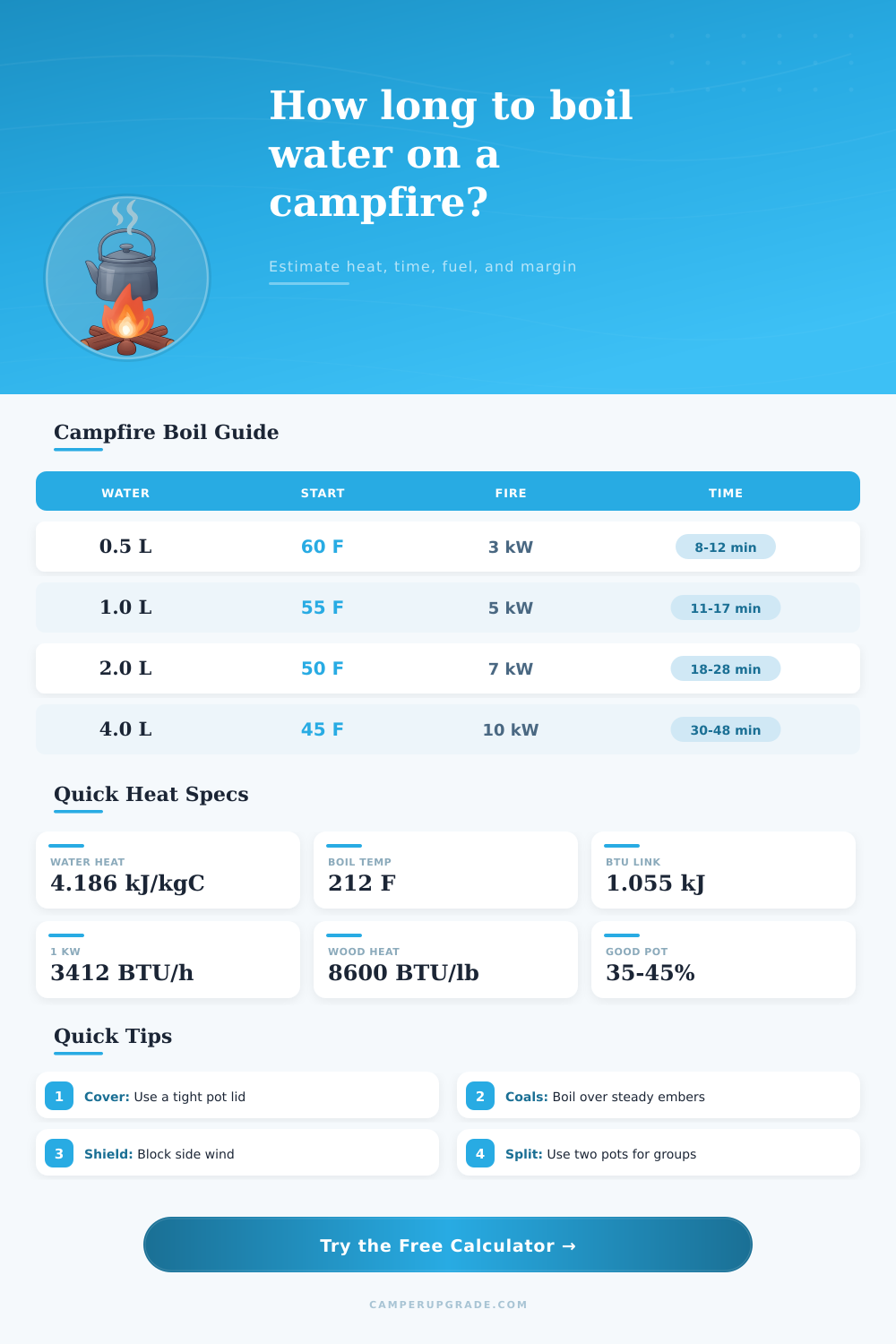
The calculator uses water specific heat of 4.186 kJ/kg°C, altitude-adjusted boiling point, pot heat capacity, fire output in kW, transfer efficiency, wind and lid loss factors, and a dry wood heat value near 8,600 BTU per pound.
🔥Pot and Fire Spec Comparison Grid
🍲Cookware and Fire Setups
Thin aluminum pot
0.42 kgFast response, moderate durability, efficient when covered and centered over coals.
Stainless camp pot
0.75 kgRugged but slower to heat, often needs more focused flame contact.
Cast iron kettle
2.8 kgHigh stored heat, slow start, stable once the fire is established.
Rocket wood fire
35-45%Focused path can beat a larger open flame with poor pot contact.
📊Campfire Boil Reference Tables
| Water | Metric | Heat 50F to Boil | Good Fire Time |
|---|---|---|---|
| 1 cup | 0.24 L | 72 kJ | 3-5 min |
| 1 pint | 0.47 L | 144 kJ | 5-8 min |
| 1 quart | 0.95 L | 288 kJ | 9-14 min |
| 2 quarts | 1.89 L | 575 kJ | 16-25 min |
| 1 gallon | 3.79 L | 1,150 kJ | 30-48 min |
| Fire Setup | Typical Output | Pot Transfer | Best Use |
|---|---|---|---|
| Twig flame | 2-3 kW | 18-28% | Small mug |
| Coal bed | 4-7 kW | 22-35% | Steady pot |
| Open flames | 6-12 kW | 15-30% | Wide kettle |
| Rocket fire | 4-8 kW | 35-45% | Fast boil |
| Wide grate | 5-10 kW | 14-24% | Group pot |
| Altitude | Boil Point | Change | Cooking Note |
|---|---|---|---|
| Sea level | 212F / 100C | baseline | Full heat |
| 2,000 ft | 208F / 98C | -4F | Slightly faster |
| 5,000 ft | 202F / 94C | -10F | Lower boil temp |
| 8,000 ft | 197F / 92C | -15F | Longer food cook |
| 10,000 ft | 194F / 90C | -18F | Sanitize longer |
| Pot Factor | Time Effect | Why It Matters | Field Fix |
|---|---|---|---|
| Tight lid | -15% to -25% | Less vapor loss | Keep covered |
| No lid | +20% to +40% | Steam escapes | Use foil |
| Gusty wind | +25% to +60% | Side cooling | Wind shield |
| Cast iron | +10% to +30% | Heavy pot mass | Preheat first |
| Focused flame | -10% to -25% | Better transfer | Lower grate |
💡Campfire Boil Tips
Boiling water over a campfire require an understanding of energy transfer and energy loss. Energy transfer is the process of move heat from the fire to the water in the pot. Energy loss is the process of heat escaping from the pot to the environments.
Many people assume that a large fire is the same then a hot fire. However, a large fire isnt necessarily a hot fire. A large fire can have many flame, but if those flames are not directed at the bottom of the pot, the heat will not be able to transfer to the water.
How to Boil Water Over a Campfire
To boil water effectively over a campfire, people must focus the fires heat on the bottom of the pot to allow the heat to reach the water. The material of the pot will affect the amount of heat that reaches the water. For instance, a thin titanium pot will allow heat to easily move through the metal to the water.
However, a cast iron pot will require more energy to heat the metal to transfer heat to the water. Due to the higher amount of energy required to heat the metal of a heavy cast iron pot, it will take longer to boil the water in such a pot than it will to boil the same amount of water in a thin titanium pot. Here, the pot act as a thermal bridge, which conducts heat from the fire to the water.
The thermal bridge, or the pot, must efficiently transfer the heat for the water to boiling in the least amount of time. If the thermal bridge is too thick or not conductive to heat, more time will be required to heat the water. The starting temperature of the water is another variable in the boiling of water over a campfire.
If the starting temperature of the water is much colder than the waters boiling point, such as water from a mountain creek, it will require the fire to provide more energy to heat the water to the boiling point. If the water starts at a lukewarm temperature, the fire will have to provide less energy to heat the water. Thus, the starting temperature of the water will impact the amount of work that the fire must perform to boil the water.
The altitude of the campfire will impact the boiling point of the water due to the change in air pressure at different altitudes. At high altitudes, the air pressure is lower. Due to this lower air pressure, the boiling point of the water will be lowered at high altitudes.
Thus, the water will boil at a lower temperature at high altitudes. Because the boiling point of the water is lower at high altitudes, it will take less energy for the water to reach its boiling point. However, because the water will be less hot at high altitudes, the cooking time of the food that is boiled will be more longer.
Additionally, if the purpose of boiling the water is to kill the bacteria in the water, the water must be boiled for a longer time at high altitudes because the less hot water will be less effective at killing those bacteria. Wind will introduce another variable into the boiling point of water over a campfire: energy loss. The wind will strip heat from the sides of the pot and may even push the flames away from the pot altogether.
To account for this energy loss due to the wind, a wind-shield may be used around the pot. Using a wind-shield will allow the fire to direct the heat of the flames onto the pot. Another factor that may be used to increase the rate of heating of the water is to use a lid on the pot.
When a lid does not cover the pot, the steam from boiling water will escape from the pot. That escaping steam represents energy from the water that is lost to the atmosphere. By placing a lid on the pot, that steam will be trapped, and the heat will be retained within the pot.
Using a lid is one of the easiest ways to retain the heat within the water so that it can quickly reach boiling point. Finally, because the burn of a campfire may not be even or consistent, it is recommended that an extra amount of time be allotted for boiling the water. Depending on the campfire, the logs in the fire may shift or ember may collapse into the fire.
These actions may change the amount of heat that is directed onto the pot. By providing an extra amount of time for boiling the water, the campfire plan will account for these variable and ensure that accurate time can be provided for boiling the water. You should of planned for alot of extra time.
It is actualy better to have too much time than not enough. To recieve the best results, you’re shouldnt ignore the wind. Making sure the pot sits stable on the grate is important too.
The cook should of checked the heat levels befor starting. It isnt always easy to manage the flames. One must be carefull with teh coals.
Even if the pot looks moddern, it might not work as well as a simple one. The cook can adjust the heat levels to prevent charring. Youll need to watch the water closely.
The pots size matters alot. If the pot is too small, it cant hold enough water. Its better to use a larger pot if you want to cook more.
The fire will keep the water hot, but you need to watch for any dissapears of heat. Use a lid to make sure the heat stays in. This will help the water reach boiling point fastly.
If you dont, the water will lose heat to the air. The temperature of the water will be different than you expect. The cook must be careful not to let the fire get too big.
You might need more furnitures to sit on while you wait. It is a luxurius experience to cook outside. Use a tripod to hold the pot if you have to.
This will help the pot stay level. The fire must be big enough to heat the pot. If the fire is too small, it wont work.
The cook will adjust the flames to keep the pot hot. This is how you boils water on a camp. It is a simple process, but it can be tricky.
Just follow these steps and youll be fine. The cook will make sure the water is ready. It is a good idea to have a plan.
The campfire will provide the heat you need. Just dont forget to watch the flames.