Fuse Size Calculator for Camper Wiring
Size 12V, 24V, and 48V DC fuses from real load current, wire gauge, run length, duty cycle, voltage drop, and common RV fuse families.
⚡ Camper Circuit Presets
🔧 Circuit Inputs
Fuse Sizing Results
🔌 Copper Wire Comparison Grid
📊 Fuse Family Reference
| Fuse family | Common camper use | Typical ratings | Best match |
|---|---|---|---|
| ATO/ATC blade | Branch circuits in 12V fuse blocks | 1A to 40A | Lights, pumps, fans, small electronics |
| MAXI blade | Medium-load DC circuits | 20A to 120A | Small inverters, compressor loads, feed taps |
| MIDI/AMI bolt-down | Compact high-current protection | 30A to 200A | DC-DC chargers, solar controller outputs |
| ANL / Class T style | Main battery and inverter feeds | 35A to 400A+ | Large inverters and battery bus protection |
📏 Wire Ampacity and Resistance Table
| Copper wire | Chassis amp reference | Ohms per 1000 ft | Common camper circuit |
|---|---|---|---|
| 18 AWG | 14A | 6.385 | Low-current LEDs, sensors |
| 16 AWG | 18A | 4.016 | Lights, USB panels, small fans |
| 14 AWG | 25A | 2.525 | Pumps, fridge branch runs |
| 12 AWG | 30A | 1.588 | Socket circuits, longer pump runs |
| 10 AWG | 40A | 0.999 | Solar output, small charger feeds |
| 8 AWG | 55A | 0.628 | DC-DC charger, subpanel feed |
| 6 AWG | 75A | 0.395 | Medium inverter and charger circuits |
| 4 AWG | 135A | 0.249 | High-output charger or inverter feed |
⚙ Voltage Drop Planning Table
| Target drop | 12V allowed | 24V allowed | Typical use |
|---|---|---|---|
| 3% | 0.36V | 0.72V | Fridge, charging, electronics, long runs |
| 5% | 0.60V | 1.20V | General branch circuits and pumps |
| 8% | 0.96V | 1.92V | Short intermittent motor loads |
| 10% | 1.20V | 2.40V | Tolerant lights or simple fans only |
🚙 Common Camper Circuit Examples
| Circuit | Typical running load | Common fuse | Usual wire range |
|---|---|---|---|
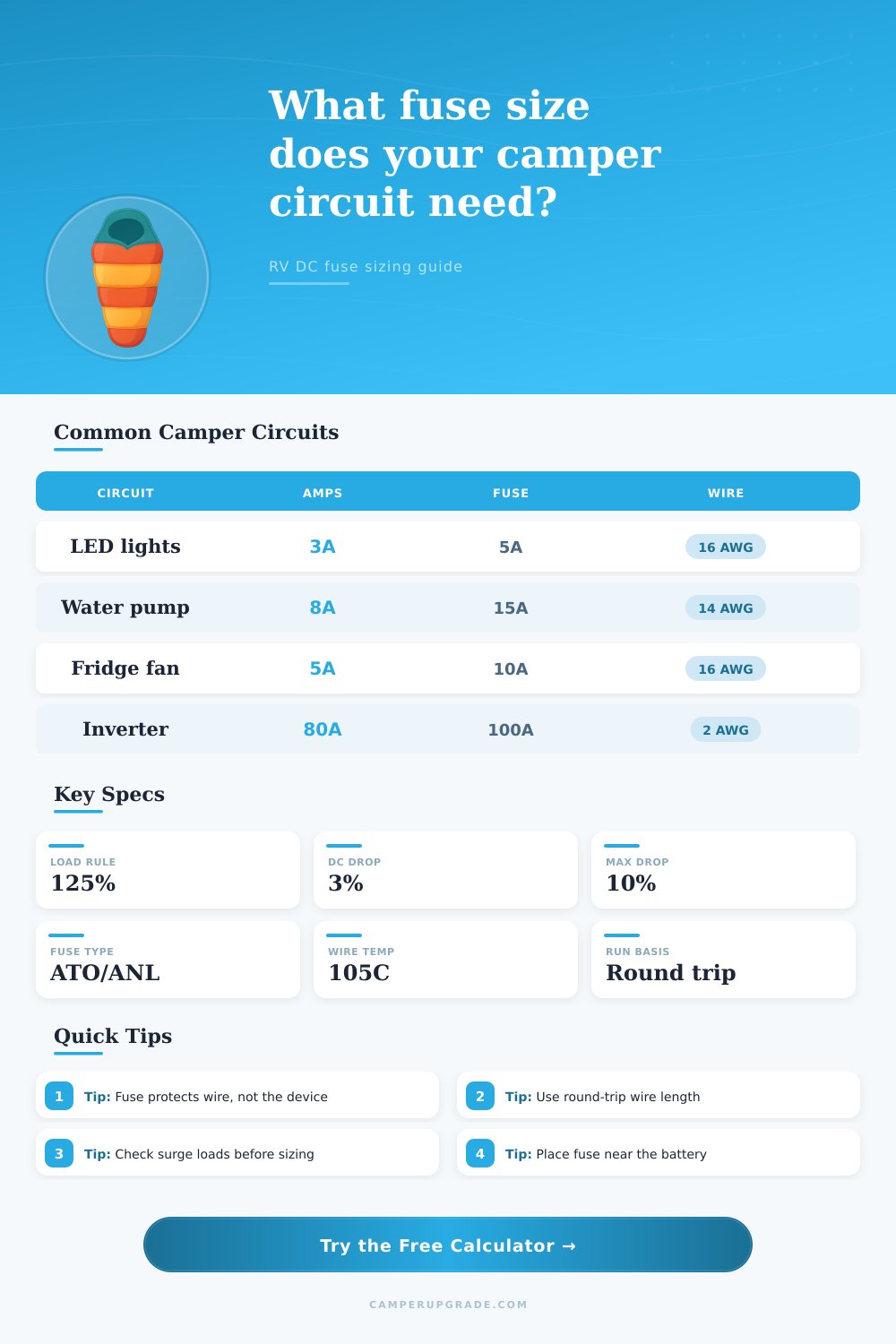
| LED cabin lights | 1A to 4A | 3A to 7.5A | 18 to 16 AWG |
| Fresh water pump | 5A to 10A | 10A to 15A | 14 to 12 AWG |
| 12V compressor fridge | 4A to 8A | 10A to 15A | 14 to 10 AWG |
| Roof vent fan | 2A to 5A | 5A to 10A | 16 to 14 AWG |
| Solar controller output | 20A to 40A | 30A to 50A | 10 to 6 AWG |
| DC-DC charger | 30A to 60A | 40A to 80A | 8 to 4 AWG |
| 1000W inverter at 12V | 85A to 100A | 125A to 150A | 2 to 1/0 AWG |
💡 Fuse Sizing Tips
You don’t need to guess at conversions or coefficients. Just plug in your rainfall and roof size into the calculator above and let it handle the math.
You installed a new light fixture on a camper. It use more than previous fixture did. The wire looks thin for the increased load. Do you plug it in? Panic sets in. That’s not all because that is the primary concern: no fire! But even if you could afford the fancy new compressor fridge, electricity doesn’t care.
How to Choose the Right Fuse and Wire
The fuse isn’t there to protect the appliance from surge; it’s there to prevent the wire from overheating. Most folks gets this part wrong initially. They look at the device and notice it draw eight amps. They grab a ten amp fuse and move on without considering the copper carrying that current. The wire is weakest link in the chain of a circuit. That means if you send too many amps down a wire that’s too small, the insulation won’t last until component blows.
With that in mind, the tool allow you to choose not only the amps of your load, but also the gauge of wire used. It’ll compare the maximum safe current capacity of that piece of copper against what it thinks you need. This is why duty cycle is important. When a motor starts, it may draw thirty amps for a half-second, then settle back down to five amps while running. You can blow fuses based on surge but that leaves you with exposed wiring while it’s running continuously. The tool has an option to switch between continuous (on longer than three hours) and intermittent loads.
Confined areas heats up. RV wiring also suffers from voltage drop. As with any circuit, DC runs drop voltage across a distance, as in, a pipe. Even a fifteen-foot run doesn’t sound long but it’s still a distance for electricity to have to travel, and return. For round-trip calcs, it automatically double it. It then confirms that the size of wire you select won’t cause your voltage to be outside acceptable ranges for sensitive electronics. Too low voltage, and now your USB ports no longer charge phones or your fridge is running inefficiently.
The reference table on page explains this clearly. It shows exactly how much resistance you will add by choosing a thinner, cheaper cable for a long run. Performance also suffers from heat. You can’t throw all your wires into one dark compartment under the floor with them bunched up tight and expect them to breathe. That’s why there is a reduction factor in the tool for that environment. Maybe your wire is rated for 20 amps in open air, but it won’t perform anywhere near that value when you bundle it up in loom and then jam it next to other bundles of cable. Not taking that into account is what causes fires at campgrounds in the summertime.
The selection of fuses is all about fitting. Blade fuses work on small fans and lights. Heavy duty things like inverters use ANL or Class T fuses. Don’t try putting a car fuse on your inverter feed, they will not stand electrical or mechanical abuse. You want to be able to go to bed at night knowing everything is protected.
Every resistor creates heat, every connection point creates resistance. To protect the device, match the wire not the device to the fuse so it fires off BEFORE something gets damaged. If possible, don’t rely on what’s on the box, but on the actual amount of current going to your load. Those maxes on stickers aren’t usually achieved by the manufacturer. Plug them into the tool with the real number and see what they say. Not only will it recommend a fuse size, but it tells you if you’re using wire smaller than necessary for the task. Keep your mind set on protecting conductor first. This protects your camper every season and lets you know you’ve got it running safely.