Camper Van Water Pump Size Calculator
Estimate recommended pump flow, pressure rating, current draw, and tank drawdown from fixture count, sink and shower flow, simultaneous use, pipe length, lift, pressure switch setting, accumulator size, and battery voltage.
Camper van pump size estimate
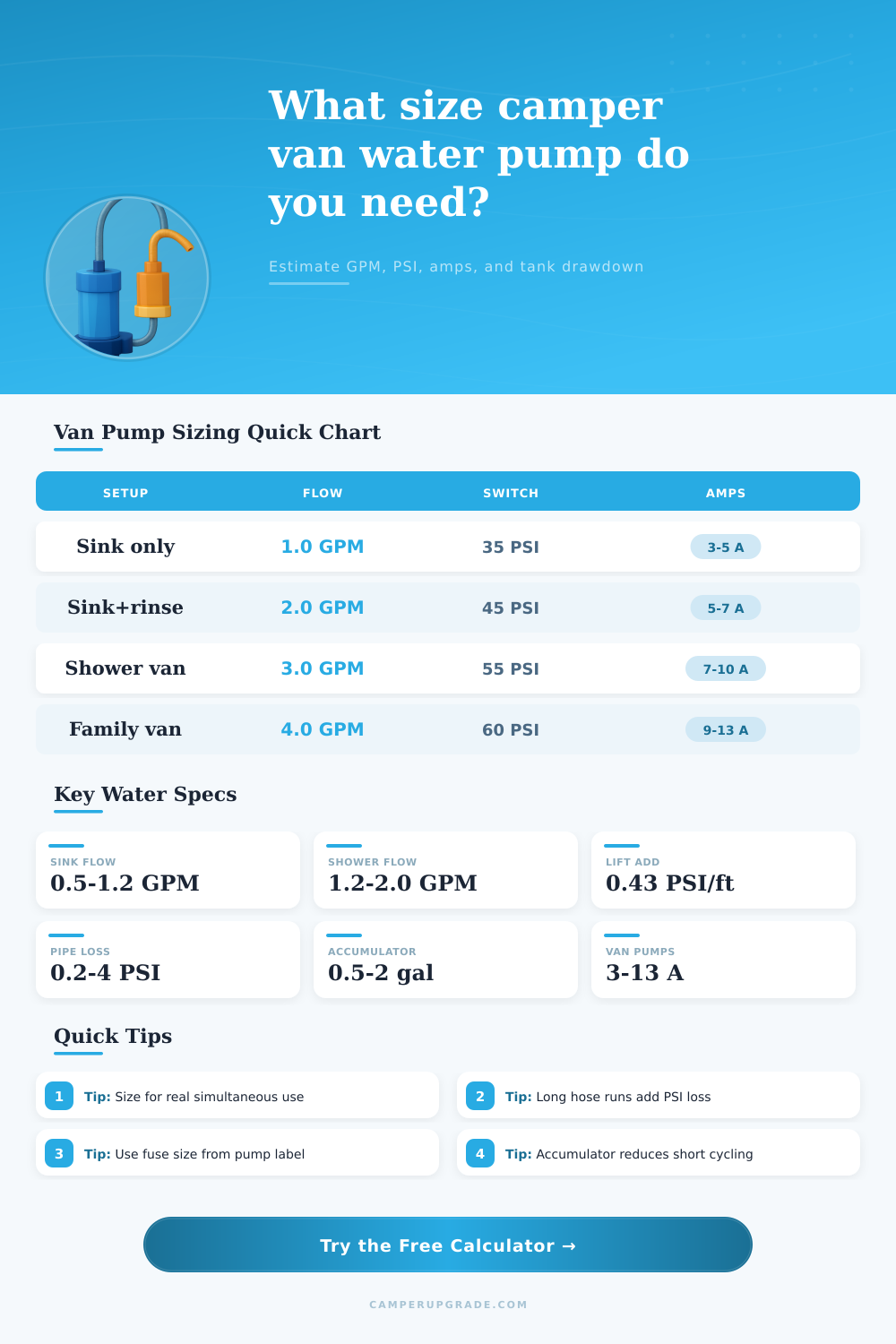
| Pump class | Rated flow | Switch pressure | Typical 12V draw |
|---|---|---|---|
| Micro sink pump | 0.8 to 1.2 GPM | 30 to 35 PSI | 2.5 to 4.5 A |
| Compact galley pump | 1.5 to 2.0 GPM | 35 to 45 PSI | 4.0 to 6.5 A |
| Standard van pump | 2.8 to 3.5 GPM | 45 to 55 PSI | 6.5 to 10.0 A |
| High-flow shower pump | 4.0 to 5.0 GPM | 55 to 60 PSI | 9.0 to 13.0 A |
| Large RV demand pump | 5.0 to 5.7 GPM | 55 to 65 PSI | 11.0 to 16.0 A |
| Fixture | Low-flow range | Comfort range | Sizing note |
|---|---|---|---|
| Galley sink aerator | 0.4 to 0.7 GPM | 0.8 to 1.2 GPM | Often the daily water-use limiter |
| Bathroom sink | 0.3 to 0.6 GPM | 0.7 to 1.0 GPM | Low flow works well in small vans |
| Navy shower head | 0.8 to 1.2 GPM | 1.3 to 2.0 GPM | Flow feel depends on pressure and hose |
| Outdoor spray port | 0.8 to 1.5 GPM | 1.5 to 2.5 GPM | Gear rinsing can exceed sink demand |
| Toilet flush valve | 0.3 to 0.6 GPM | 0.6 to 1.0 GPM | Short bursts matter less than showers |
| Plumbing factor | Planning value | What it covers | Calculator use |
|---|---|---|---|
| Vertical lift | 0.43 PSI per ft | Height from tank to outlet | Added directly to pressure need |
| Short van run | 0.06 PSI per ft | Under 15 ft, smooth tubing | Good for compact galley builds |
| Normal van run | 0.09 PSI per ft | 15 to 35 ft with fittings | Default planning loss band |
| Long wet bath run | 0.12 PSI per ft | 35 ft or more, heater, filter, hose | Use for long-wheelbase layouts |
| Comfort outlet pressure | 28 to 35 PSI | Useful pressure at faucet or shower | Sets base pressure target |
| System voltage | Current behavior | Wiring note | Fuse note |
|---|---|---|---|
| 12V pump on 12V battery | Uses nameplate amps | Most common camper van setup | Follow pump maker fuse size |
| 24V pump on 24V battery | About half 12V current | Use a true 24V pump or rated converter | Fuse the pump branch separately |
| 12V pump on 24V house system | Converter input amps are lower | DC converter must handle startup load | Fuse both converter and pump side |
| 48V system with converter | Low input amps, same pump watts | Converter quality matters for cycling | Leave surge margin for motor start |
| Van water system | Likely pump | Pressure rating | Accumulator fit |
|---|---|---|---|
| Sink-only weekender | 1.0 to 1.5 GPM | 35 to 45 PSI | 0.2 to 0.5 gal smooths taps |
| Galley plus rinse sprayer | 2.0 to 2.8 GPM | 45 to 55 PSI | 0.5 to 0.75 gal is useful |
| Indoor shower van | 3.0 to 3.5 GPM | 50 to 60 PSI | 0.75 to 1.0 gal reduces cycling |
| Family or gear shower build | 4.0 to 5.0 GPM | 55 to 60 PSI | 1.0 to 2.0 gal helps surges |
| Long-wheelbase wet bath | 3.5 to 4.0 GPM | 55 to 60 PSI | 1.0 gal offsets long lines |
When designing a water system for a camper van, you need to understand how flow rate, pressure, electrical load, and accumulator tanks will all work together for your vans water system. Each component of the water system impact the other components because the system relies on the pump to move the water from the tank to the outlets of the van. Two important characteristic of any water system are the flow rate and the pressure of the water system.
These two characteristics determine how the water system will feel when you are using the water in your camper van. Flow rate refers to the amount of gallons of water that pass through a point in the system per minute. Flow rate is an important consideration in determining how much water is required by each component of the water system.
Camper Van Water System Basics
For example, a sink faucet will require less flow rate than a shower head. The flow rate is also affected by how many outlets are simultaneous in use. If two outlets are simultaneously in use, such as a sink and a shower, then the flow rate of the pump will have to be great enough to supply water to both the sink and the shower.
Other factors that reduce the flow rate of the system include the length of the hoses used to distribute the water to the outlets and the number of fittings on those hoses. The longer the hoses or the greater the number of fittings in the water system, the more friction will reduce the flow rate due to the friction between the water and the hoses. The pressure in the water system is also another important variable.
The pressure in the system is measured in pounds per square inch, or psi. The vertical lift of the water system is the distance that the water must travel from the water tank to the highest outlet in the van. The farther the outlets are from the water tank, the more the water pressure will be reduced due to the force of gravity on the water.
There will also be a reduction in the water pressure due to the length of the hoses and the number of fittings in the vans water system. To compensate for the loss of water pressure, the pressure switch on the pump should have a higher psi than the total pressure loss of the vans water system. Many builders tend to choose a pressure switch for their water system that is set to forty-five or fifty-five psi to ensure that the flow of water remain steady without overworking the pump.
Pumps create an electrical load as a direct result of the hydraulic work that the pump does. If a pump is moving three gallons of water per minute against fifty psi of pressure in a twelve volt system, the pump will draw between seven and ten amps of current. In this instance, the electrical load of the pump is seven to ten amps.
It is important to size the wires and fuses in the system to handle more than seven or ten amps. This is due to the fact that pumps draw more amps at the time of startup than they do when moving at a steady rate. If the system is converted from twelve volts to twenty-four volts, the current draw will be halved.
Accumulator tanks are often used in water systems to change the rhythm of the water system, and to prevent the pump from starting too frequent. The accumulator tank store water under pressure. When a person uses only a small amount of water, that water comes from the accumulator tank instead of the pump.
Because only small amounts of water are drawn from the accumulator tank, the pump does not have to turn on every time a person uses a water outlet in the van. The amount of water that can be drawn from the accumulator tank is less than the total volume of the tank. This is due to the fact that the pressure switch will shut off the water supply when the tank reaches a certain water level.
Some people make mistakes when they choose the size of the pump for their camper vans water system. For example, some people may choose a pump that has a flow rate that is too small to effectively supply water to the vans shower when it is in use. In this case, there will be a weak flow of water from the shower head.
Other people choose a pump that is too large. In this case, the pump will cycle its power on and off too frequent. This cycling of the pump increases the electrical load on the pump and causes the pumps motor to wear out more quickly.
A method for avoiding either of these mistakes is to count every faucet and every sprayer in your camper van before you purchase your pump. In addition to the variables that manufacturers intend to impact the performance of the water system, there are some other variables that will impact the performance of that system. For example, the water system will experience problems if it is used in cold weather.
The hoses will become stiffer in the cold weather, and the accumulator tank may experience a change in it’s functioning. Another problem is the sediment that may be in the water. The sediment will clog the filters in the system.
This will force the pump to work harder to move water through the system. The battery voltage will also drop in the morning when the camper van is cold. Using the pump with a low battery voltage will reduce the output of the pump.
All of these problems indicate the need to purchase a pump that has some headroom beyond what is required for the camper vans water system. The size of the accumulator tank that is used in a camper vans water system will depend off how the camper plans to use the van. For example, if the camper van will only be used for weekend trips with only two people who will use it, then a small accumulator tank may be sufficient.
For those that plan to use the camper van on long trips or with a large number of people in the van, a larger accumulator tank will be better. The size of the pump, the pressure switch, and the accumulator tank should all be chosen according to the way in which the camper van will be used.