Camper Upholstery Fabric Yardage Calculator
Estimate fabric yards for RV cushions, dinette benches, bunk pads, sleeper sofas, boxed cushion sides, welt cord strips, repeat matching, and cut waste.
Calculation Breakdown
| Fabric type | Best camper use | Stretch or nap | Calculator allowance |
|---|---|---|---|
| Woven upholstery cloth | Dinette seats, cushions, backs | Low stretch, usually no nap | Base plus selected waste |
| Marine vinyl | Wet entry seats and cockpit pads | No nap, stiff corners | Adds 4% handling allowance |
| Ultrasuede or microfiber | Soft lounge cushions and backs | Directional nap likely | Adds one-way layout allowance |
| Solution-dyed acrylic | Outdoor camper cushions | Stable, stripe matching common | Uses repeat and stripe allowance |
| Cotton duck canvas | Bunk pads and simple covers | May shrink or skew | Adds 5% preshrink allowance |
| Faux leather | Sleeper sofas and trim panels | One-way grain appearance | Adds one-way layout allowance |
| Outdoor mesh vinyl | Draining cockpit cushions | Open mesh, little stretch | Base plus selected waste |
| Wool blend upholstery | Premium van lounge cushions | Directional face possible | Adds 6% nap control allowance |
| Roll width | Usable width after selvage | Best panel size | Planning note |
|---|---|---|---|
| 36 in specialty canvas | 34 in | Narrow bunk pads and backs | Large cushions often need piecing |
| 48 in marine vinyl | 46 in | Bench cushions under 44 in | Good for stiff waterproof covers |
| 54 in upholstery roll | 52 in | Most RV seats and dinettes | Default width for camper yardage |
| 60 in wide roll | 58 in | Mattress pads and van platforms | Can reduce seams on wide cushions |
| Pattern repeat | Use case | Extra yardage | Why it matters |
|---|---|---|---|
| 0 to 2 in | Solid, tweed, fine texture | 0% to 3% | Pieces can nest efficiently |
| 3 to 6 in | Small stripe or geometric | 5% to 8% | Panels may need aligned starts |
| 7 to 13 in | Medium plaid or motif | 10% to 16% | Seat and back faces should line up |
| 14 to 24 in | Large cabin print | 18% to 25% | Centered cushions create bigger offcuts |
| Common camper project | Typical cushion sizes | Typical fabric width | Usual yardage range |
|---|---|---|---|
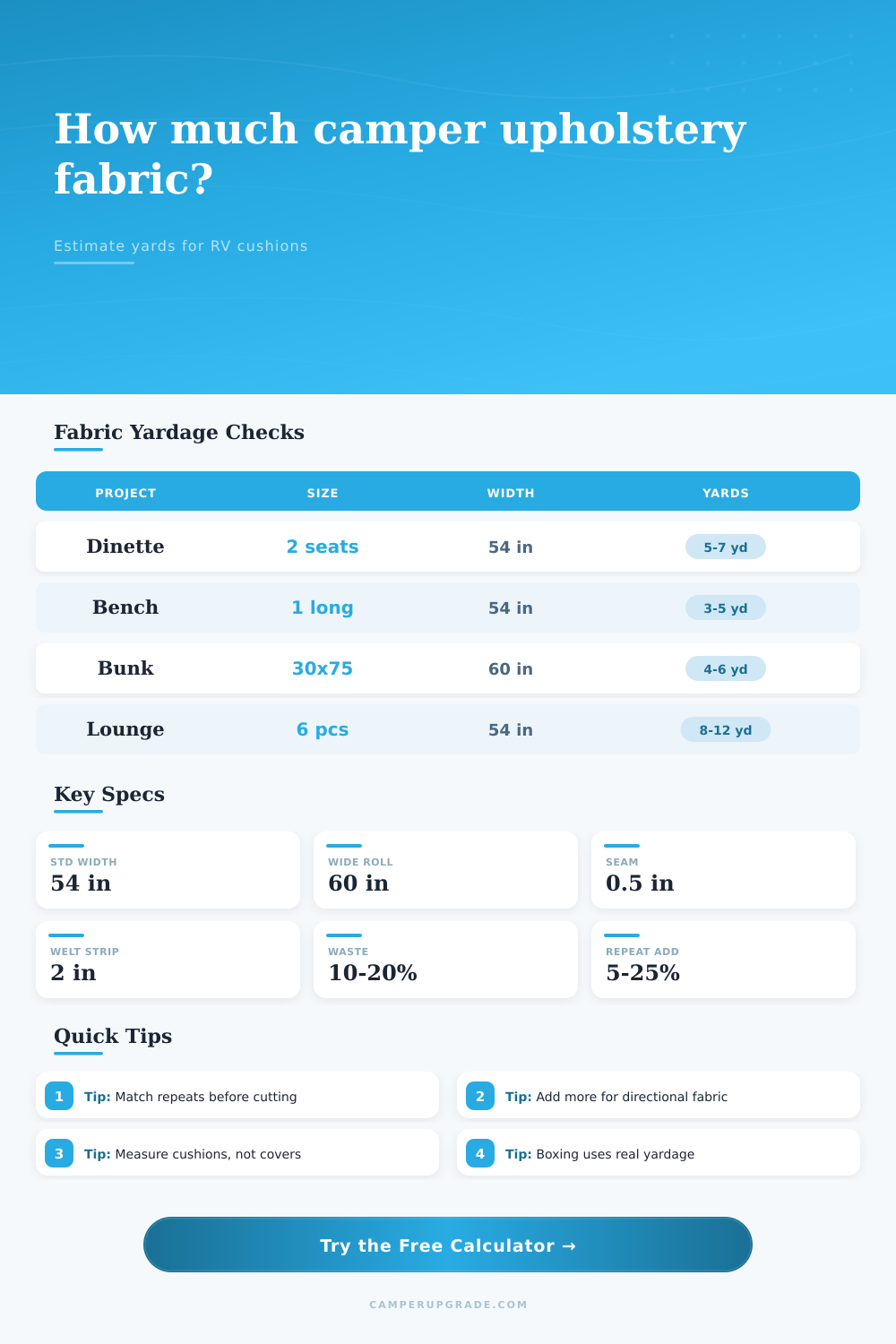
| Two-seat dinette | Two 42 x 24 x 4 in seats | 54 in | 5 to 7 yd with backs |
| Truck camper bench | One 72 x 24 x 4 in cushion | 54 in | 3 to 5 yd with welt |
| Teardrop bed pad | Two 30 x 75 x 4 in pads | 60 in | 7 to 10 yd if boxed |
| U-shaped lounge | Six 24 x 24 x 4 in pieces | 54 in | 8 to 12 yd with matching |
| Cab-over bunk | One 48 x 80 x 5 in mattress | 60 in | 6 to 9 yd with zipper flap |
Formulas estimate rectangular and boxed camper cushions. Curved corners, shaped bolsters, tufting, buttons, pleats, and extra zipper plackets may require additional layout testing.
Get a bit extra fabric. If you only buys enough fabric to fit over your foam, it will be too small on the zipper end unless you do some math. Upholstery math takes into account the fact that upholstery is, well, a craft: you’ll need yardage for top, bottom, sides, seam allowance, pattern matching, and errors. Errors? Yes. You are human and can tire and cut wrong.
People generaly use the old cover to measure but that’s a recipe for disaster; old fabric can sag, stretch, shrink. Measure the body (cushion or foam) directly and plug those dimension into the calculator to handle the conversion and coefficient math for you. Plug in your exact foam dimensions to the calculator; no need to guess at conversions or coefficients. It adds space for boxing and seams into total so you don’t run out halfway through a project! This is key because if you has to buy an additional yard from a different roll you’ll most likely notice a slight color shift.
How to Measure Fabric for Upholstery
This math differ widely depending on the fabric you select. Solid colors is forgiving; you can piece them together closely, with little waste. However, if you use a bold stripe or large-scale floral print, consider the pattern repeat. The repeat table show that a large motif will add an additional 25% to the final amount of material needed. This isn’t a surcharge, just necessary space to line up the pattern so the flower falls onto center of the cushion. Faux leather or other directional fabrics needs to be treated similar (for example, microfiber has a nap, so you want all the pieces lined up with the nap running in the same direction).
Another common source of error are boxed cushions. A boxed cushion is the kind that is all thick and structured like most new RVs have. They come with an additional piece of fabric to cover the side. That piece is called the boxing pleat. It’s a strip of fabric that goes over the thick part of the cushion. It also wraps around so the shape doesn’t get distorted. The boxing pleat adds length to the face panels which is why calculator does it. If it didn’t have that boxing pleat, the fabric would pull tight and distort the shape.
And then, there is another wrinkle in the complexity of sewing with welts or piping. Welts mean longer and longer continuous strips of fabric. You don’t necessarily sew the welt, but you still want to know if your fabric supplier are going to charge more to cut out the strips.
Another unexpected factor that goes into your final cost is the width of the fabric. Most upholstery fabric is 54” wide while some specialty canvas and heavy-duty marine vinyl are offered in a narrower roll. You’ll have to piece several panel if the available fabric is not as wide than your cushion. This creates waste and makes it more complicated. Occasionally wider rolls eliminate needing to piece so much on larger van platforms or mattress pads. This tool accommodates for that though.
Last of all….always leave yourself some room for error! There is always that one spot that was off by just a hair on the cut, or sometimes you get too close to a woven flaw in the fabric. Even an experienced upholstery person will miss something like this. A good rule of thumb is to allow 10-15% waste. It’s better to end up with a little bit of excess fabric left over, rather than to run out before your cushion is finished and now you are waiting for another roll to come in. You would of wanted to ensure that when you are done, it looks professional and you get it right the first time.
Measure the foam, not the fabric….and believe the numbers. Cut carefully. Don’t forget the extra yard for the zipper flap. That mistake is what ruins most projects.