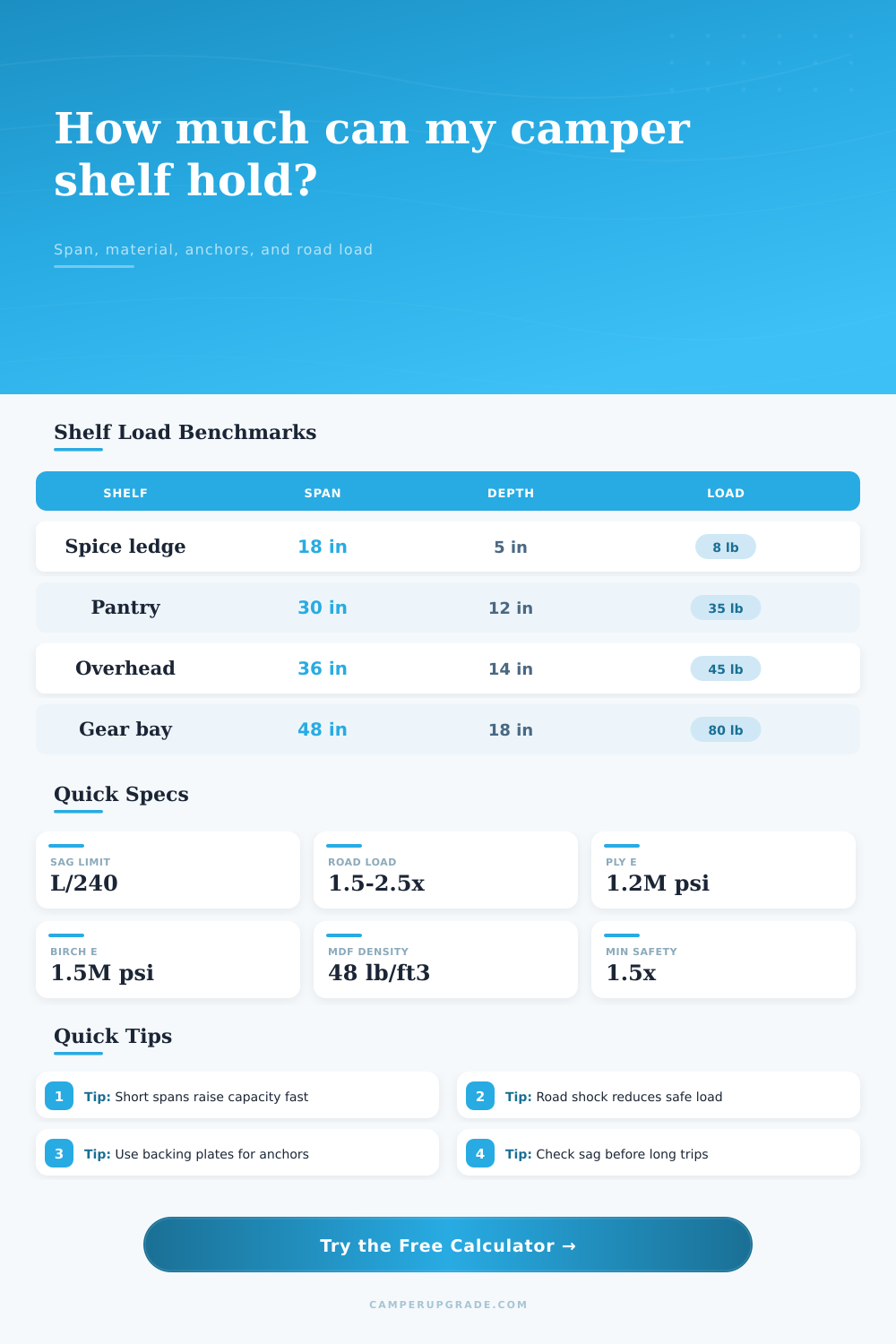
Camper Shelf Load Capacity Calculator
Estimate a practical shelf load from span, material stiffness, thickness, brackets, anchors, road shock, and sag limits.
| Material | Elastic Modulus | Allowable Bending | Density Used |
|---|---|---|---|
| Cabinet plywood | 1,200,000 psi | 3,000 psi | 34 lb/ft³ |
| Baltic birch plywood | 1,500,000 psi | 4,500 psi | 42 lb/ft³ |
| Marine plywood | 1,400,000 psi | 3,500 psi | 38 lb/ft³ |
| MDF panel | 500,000 psi | 1,500 psi | 48 lb/ft³ |
| Poplar solid board | 1,300,000 psi | 5,000 psi | 29 lb/ft³ |
| Laminated bamboo | 2,000,000 psi | 6,000 psi | 44 lb/ft³ |
| Light composite plywood | 900,000 psi | 2,500 psi | 28 lb/ft³ |
| Aluminum honeycomb panel | 3,000,000 psi | 7,000 psi | 18 lb/ft³ |
Values are representative calculator assumptions for planning. Check the exact panel grade, bracket rating, fastener data, and wall construction before loading a finished camper shelf.
| Anchor Setting | Typical Camper Use | Working Load Per Fastener | Calculator Note |
|---|---|---|---|
| Wood stud or rib screw | Cabinet rail into framing | 90 lb | Best when screws bite solid backing |
| 1/2 in plywood backer | Wall panel with backing plate | 55 lb | Good for distributed cabinet loads |
| Rivnut in metal rib | Van rib or aluminum extrusion | 70 lb | Depends on rib gauge and install quality |
| Thin panel screw | Luan or light RV wall skin | 18 lb | Use only for light shelves |
| Toggle or expansion anchor | Hollow wall where backing is absent | 35 lb | Check panel crush and pull-through |
| Adhesive plus screws | Bonded cleat with mechanical backup | 65 lb | Assumes clean surface and full cure |
| Setting | Use Case | Multiplier Or Limit | What It Protects |
|---|---|---|---|
| Parked or static | Stationary storage | 1.0x | Basic gravity load only |
| Normal paved travel | Most van and RV trips | 1.5x | Braking, turns, and small bumps |
| Rough roads | Forest roads or washboard sections | 2.0x | Repeated vibration and jolts |
| Severe travel | Heavy gear on harsh routes | 2.5x | Short impact loads |
| L/180 sag | Utility shelves | 0.167 in over 30 in | Visible but often acceptable sag |
| L/240 sag | Cabinet shelves | 0.125 in over 30 in | Cleaner door and latch alignment |
| L/360 sag | Low-sag storage | 0.083 in over 30 in | Rigid feel for delicate items |
| Camper Shelf | Typical Span | Typical Cargo | Design Priority |
|---|---|---|---|
| Spice ledge | 16-24 in | 5-12 lb | Front lip and small fasteners |
| Galley dish shelf | 24-36 in | 20-45 lb | Travel restraint and sag control |
| Overhead cabinet shelf | 30-42 in | 25-60 lb | Anchors into cabinet sides |
| Pantry shelf | 24-36 in | 30-75 lb | Dense food weight and vibration |
| Closet shelf | 30-48 in | 15-40 lb | Long span deflection |
| Rear gear shelf | 36-60 in | 60-140 lb | Brackets, backing, and road shock |
At some point in time you’ll have that one moment: the back doors open up, and gravity takes over. A heavy cutting board (or a bag of flour) goes into your pantry, and the shelf on top bow down. It does not happen right away. But it’s a sign. That the thing has too much stuff in it for the material and the span and anchors to support.
This is where engineering intuition and real-world travel livig meet. Yes, you’re putting stuff in there. But also you’re creating a dynamic system that needs to stand up to braking forces and vibration and longer term static stresses.
Why This Calculator Helps You Build Strong Shelves
So how does it help? Well, it’s kind of like the bridge from physics to guesswork. It factors in things like material choice, span length, anchoring/fasteners, driving conditions, weight distribution, and your safety margin.
The material selection is basis for stiffness. Marine plywood (and Baltic birch) are stiffer than MDF or standard cabinet ply. That means they deflect less easily under a given load. Plywood is heavier and denser than MDF. It also have layers inside, which makes it stronger at resisting deflection. That material stiffness is the one most important variable if your project include a long span. The tool accounts for that without needing to remember the psi of each different board type.
The longer your shelves are, the more they need to be supported. But if you load them up with thirty pounds of canned goods in the middle, those same thirty inches suddenly seem too short. This causes an unattractive sag. It also stresses out the door seals and cause stress points where the shelves attaches.
You tell the calculator what amount of sag you’ll allow before it’s an issue. For normal cabinet work, people use a rule of thumb of no more than L/240 (which makes the shelf still look nice and flat). But if you’re keeping fragile electronics or glass jars, you may wish to reduce that tolerance to L/360 instead. The math shows you exactly how much thinner or shorter the shelf needs to be to meet that stricter standard.
That’s where they fall out. Anchoring. Folks pay attention to the board and forget about what’s anchoring it up. A screw driven into a metal rib with no backing is far less holding power than a screw driven into a thick plywood backer or a wood stud. The breakdown of these working loads per fastener is listed in the table at the bottom of the page.
When you do the math and find that anchoring limits your safe load, adding a third bracket in the center does more for capacity then increasing the board thickness by a fraction of an inch. Using more points of support, such as backing plates, is better. Increasing your board thickness by even a fraction of an inch do little to improve the capacity of a long shelf compared to adding a third bracket midway.
Then there is the road. The static load is straightforward. But dynamic loads are trickier. How do you calculate the dynamic load of a 15-pound box? It is easy if you are stopped in traffic and sitting still. It is not so easy when you slam the brakes and ride over a bump. The effective load on your storage increases when you’re on the move.
The calculator factors in shock loading, which means how much harder you are hitting bumps while moving along. A smooth paved road may only add half as much load, but a gravel washboard or rough forest trail could double or even triple the load. That’s what prevents fatigue failure of your shelf. It protects against constant jolting over time that loosens screws and cracks glue joints.
It will even take into account where you place your weight. Can your shelf handle a pile of all your stuff at the very front (or top) where it overhangs the lip? Or would it be better with an even load spread out over the whole depth? The calculator accounts for this and, assuming you’re more likely to place most of your weight stacked forward, it will change the risk level to reflect that.
Finally, it will account for what safety margin you want to have. For general storage use, a safety factor of 1.5 is typical. But if you know you’ll be carrying some pretty heavy loads in your truck on extended trips, you can bump that up to 2.0. This provides a little wiggle room for those unexpected things that come along as part of the road experience.
So in closing, creating a good camper interior is all about limitations and setting expectations. When the engine turns off, you should of had confidence in your cabinets. But you also want them to last through the ride. Understanding how shelf spans, materials, stiffness, and anchor strength work together will help you create shelves that work instead of needing constant repairs.
Weight isn’t the sole purpose; it’s to keep weight in place safely while moving. And that tiny little creak at the start of the run means it’s time to double check your math before the spill.