Power Station Calculator
Estimate usable energy, runtime, recharge speed, and output headroom for real camper power planning.
🔋Scenario Presets
⚙Battery And Output Inputs
⚡Recharge Inputs
📊Battery Chemistry Spec Grid
0.5C charge
0.7C charge
0.25C charge
0.20C charge
📘Reference Tables
| Chemistry | Window | Max Rate | Best Use |
|---|---|---|---|
| LiFePO4 | 90-95% | 0.5C | Daily cycling |
| NMC | 88-92% | 0.7C | Lightweight packs |
| AGM | 55-65% | 0.25C | Simple sealed banks |
| Gel | 60-70% | 0.20C | Gentle taper bank |
| Camper Load | Running W | Duty / Day | Daily Wh |
|---|---|---|---|
| 12V Fridge | 45 W | 40% | 432 Wh |
| CPAP | 35 W | 8 h | 280 Wh |
| Laptop | 90 W | 5 h | 450 Wh |
| LED Lights | 18 W | 6 h | 108 Wh |
| Portable Fan | 32 W | 8 h | 256 Wh |
| Inverter Tools | 1200 W | 0.3 h | 360 Wh |
| Charge Source | Factor | Use Case | Notes |
|---|---|---|---|
| AC Wall | 1.00 | Fast turn | Most predictable |
| Generator | 0.95 | Backup top-up | Fuel and noise |
| Vehicle DC | 0.86 | Drive charge | Alternator bound |
| Solar MPPT | 0.78 | Camp recovery | Weather and shade |
| Bank Size | 120W Load | 300W Load | 600W Load |
|---|---|---|---|
| 500 Wh | 3.2 h | 1.3 h | 0.6 h |
| 1000 Wh | 6.7 h | 2.7 h | 1.3 h |
| 2000 Wh | 13.4 h | 5.3 h | 2.7 h |
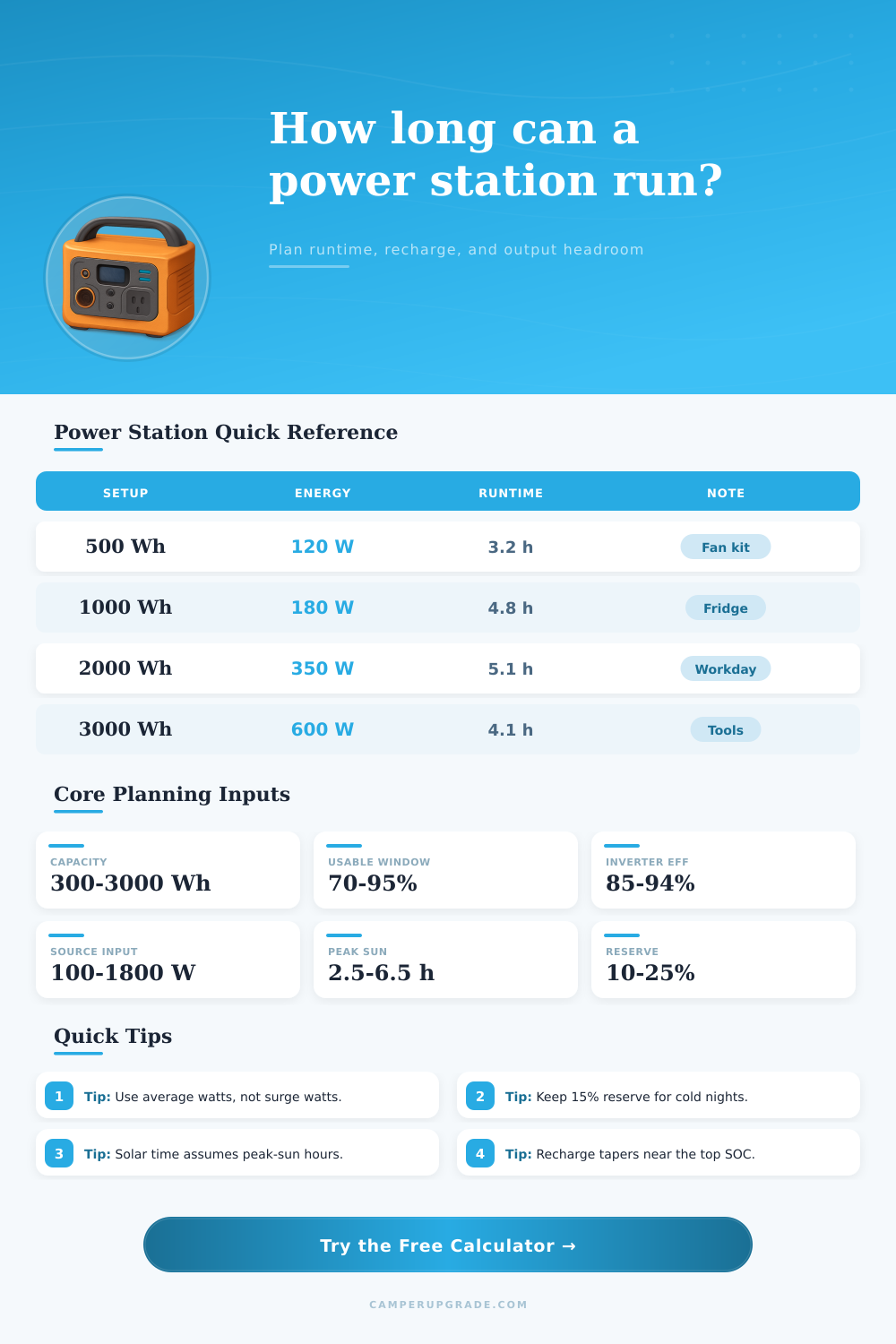
| 3000 Wh | 20.1 h | 8.0 h | 4.0 h |
When you use a portable power stations, you need to understand the difference between the rated capacity and the actual energy that the power station will give you. Many individuals makes the mistake of only looking at the total watt-hours that the power station can provide. However, the total watt-hours does not tell you the total amount of electricity that the power station will provide to the devices that you use.
The three factor to consider when estimating the amount of energy that a power station will provide to the devices that you use are the chemistry of the battery, the electrical loads that the devices use, and the energy it take to recharge the power station. The chemistry of the battery is the first factor that will determine how much energy you can extract from the power station. Power stations that uses LiFePO4 batteries allow individuals to use between 90 and 95% of the batterys capacity without damage the battery.
How Much Energy Will a Portable Power Station Really Give You
Additionally, the voltage provided by a LiFePO4 battery remains the same throughout the battery’s discharge cycle. NMC batteries are lighter and contain more energy, but the voltage drop much faster as the battery reaches a low charge. Lastly, you can also use lead-acid batteries such as AGM and gel batteries in power stations.
However, they should only be discharged to 60% or 70% of the battery’s capacity. Discharging the battery to a much deeper level will damage the lead acid battery. However, lead-acid batteries are more resistant to being dropped from a height or otherwise physical stressed.
The second factor that will determine the energy that the power station will provide to your device is the electrical load of those devices. The electrical load of a device is not the wattage that is listed on the device. For example, refrigerators will use the most power when the compressor is running.
The electrical load of a refrigerator will be low when the compressor is idling. You must calculate the average power that each of your devices will use. Another consideration is that inverter batteries will lose approximately 9% of the power that it converts from DC to AC energy.
Additionally, many devices use surge power to starting up. If the power requirement for starting up a device is greater than the power station can provide, the power station will shut off. The third factor to consider is the energy used to recharge the power station.
The fastest way to recharge a power station is to use a wall AC outlet. Another way to recharge the power station is by using solar energy. However, the number of peak sun hours in your area will determine the power that the power station’s solar panel can produce.
The number of peak sun hours in an area will vary depending on the weather and the time of the year. Finally, you can also recharge the power station using the vehicle’s alternator while the vehicle is in motion. However, vehicle alternators will take more longer to recharge the power station than using an AC outlet.
Additionally, the power station’s battery will become less efficiently the closer the battery is to a full charge. In order to ensure that the power station will last for your estimated amount of time with your devices, you should allow for a reserve buffer of energy. A reserve buffer is energy that you do not use in your devices.
It acts as a fail safe in case the devices use more energy then you calculated that they would. Many individuals use a 15% reserve buffer when calculating the energy requirement for their devices. Additionally, if you are using the power station in cold environments, it may be able to provide only 80% to 90% of the energy that the battery calculate for the devices.
This is because when batteries are exposed to cold weather, the electrolyte solution within the battery thickens, reducing the battery’s efficiency. Finally, you should test all of the device that you will use before you leave for your trip. Use a watt meter to calculate the actual wattage that the device uses.
This may be less then the wattage that is printed on the device. By using a power station that can provide 20% more energy than your devices require, you will have a buffer for startup energy and for any energy that your devices may use that you did not account for when purchasing the power station. If you plan your devices’ energy discharge and recharge properly, the power station should of be able to meet your energy need on the go.