Camper Drawer Slide Length Calculator
Size RV drawer slides from real cabinet depth, drawer box depth, rear clearance, latch space, travel needs, side clearance, and loaded weight.
🚙 Camper Drawer Presets
📏 Drawer Slide Inputs
The result uses common nominal slide lengths and planning clearances. Confirm the exact mounting hole pattern, release lever space, and manufacturer-specific drawer-box rules before drilling.
Formula Breakdown
🧰 Spec and Material Comparison Grid
📚 Reference Tables
| Slide Family | Common Nominal Lengths | Typical Camper Use | Fit Rule |
|---|---|---|---|
| Side-mount ball bearing | 10, 12, 14, 16, 18, 20, 22, 24, 26, 28, 30, 32, 34, 36 in | Galley, dinette, wardrobe, general storage drawers | Choose the longest standard size that fits behind the closed front |
| Concealed undermount | 9, 12, 15, 18, 21, 24 in | Clean cabinet interiors and quiet small drawers | Drawer box depth usually tracks the slide length closely |
| Center-mount light drawer | 12, 14, 16, 18, 20, 22, 24 in | Small lightweight drawers where side clearance is tight | Use only for light loads and short camper drawers |
| Heavy-duty locking pair | 12, 14, 16, 18, 20, 22, 24, 26, 28, 30, 32, 36, 40, 42, 48 in | Cooler trays, battery trays, rear cargo drawers | Reserve lock mechanism depth and verify latch orientation |
| Low-profile utility slide | 8, 10, 12, 14, 16, 18, 20, 22 in | Shallow shelves, spice pullouts, small electrical drawers | Keep travel and load conservative |
| Clearance Item | Side-Mount | Undermount | Heavy Locking |
|---|---|---|---|
| Side clearance per side | 1/2 in is common | About 5/16 in each side, spec dependent | 3/4 in is common for large pairs |
| Rear clearance | 1/2 in minimum planning gap | 1/2 in plus rear socket space | 3/4 in or more for lock hardware |
| Drawer box depth | Usually equal to or shorter than slide | Often matched to nominal slide series | Can be shorter than slide for cargo trays |
| Front reference | Closed drawer front plane | Front locking device plane | Closed and latched position |
| Camper Drawer | Usable Depth | Likely Slide | Load Planning Note |
|---|---|---|---|
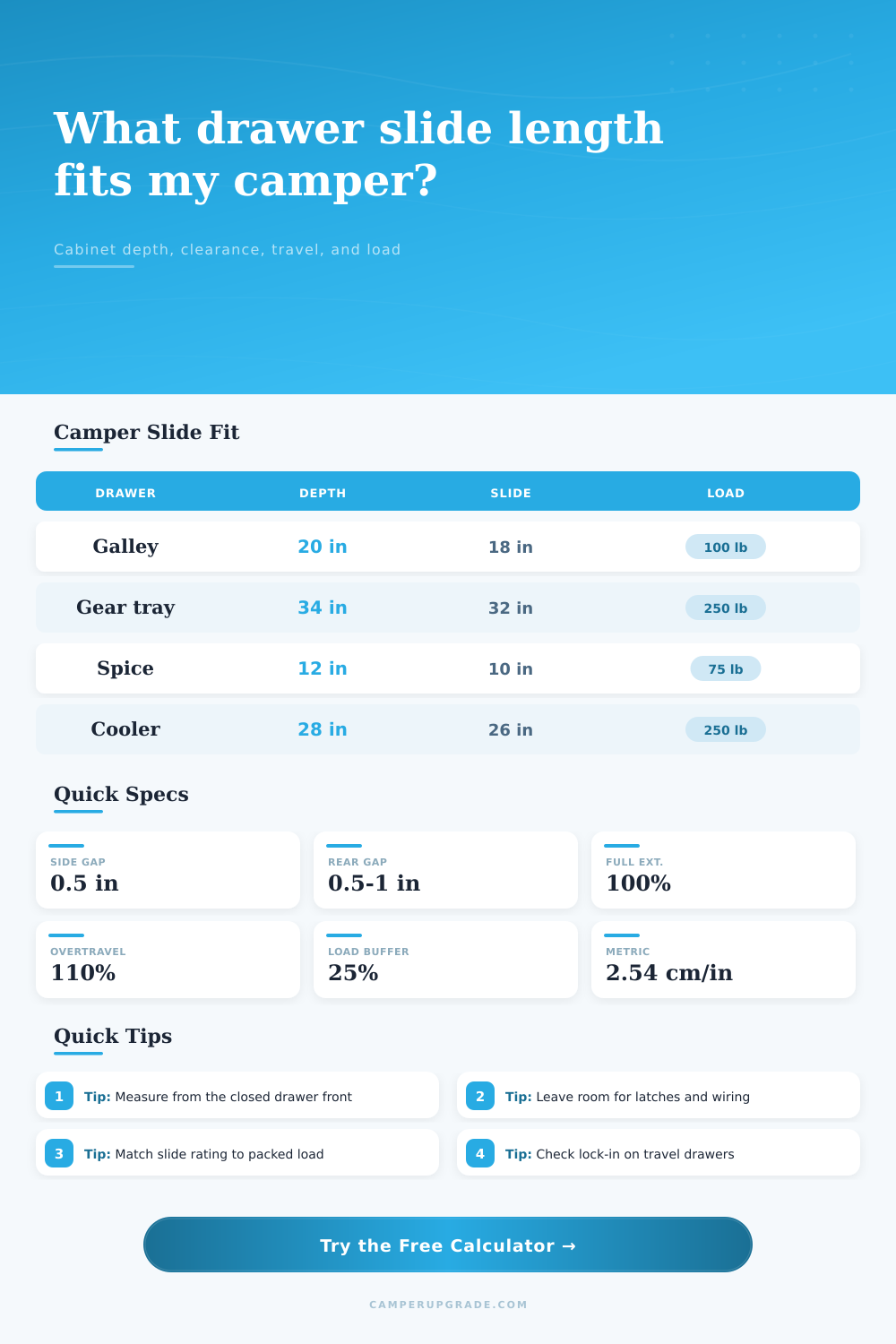
| Galley utensil drawer | 18 to 22 in | 16 to 20 in side-mount | Plan for cookware shifting on turns |
| Dinette base drawer | 20 to 26 in | 18 to 24 in full-extension | Use a latch so cushions do not block closing |
| Under-bed gear tray | 30 to 40 in | 28 to 36 in heavy locking | Buffer for tools, water gear, and recovery items |
| Cooler slide-out | 26 to 34 in | 24 to 32 in heavy locking | Rate for the cooler plus full food and ice load |
| Battery service tray | 22 to 32 in | 20 to 30 in heavy locking | Confirm fasteners and static support, not only slide rating |
| Travel Style | Travel Formula | Access Result | Camper Use |
|---|---|---|---|
| Three-quarter extension | Slide length × 0.75 | Rear of drawer remains partly inside cabinet | Light drawers and shallow cupboards |
| Full extension | Slide length × 1.00 | Drawer box reaches the cabinet front plane | Most galley and dinette drawers |
| Overtravel | Slide length × 1.10 | Drawer travels past the front plane | Deep trays under counters or beds |
| Reduced box depth | Drawer box shorter than slide | More rear clearance with the same slide | Useful around pipes, wiring, or curved wall ribs |
💡 Camper Drawer Slide Tips
There’s this thing about drawers. When you walk into high-end showroom and pull on a drawer handle, it opens effortlessy. What if I told you we were building them for an RV?
Our cabinets is 3 inches deeper than previous ones. They are next to a plumbing stack. They must also endure 60 miles per hour down the freeway. That is what a drawer build means in a Camper.
How to Choose the Right Drawer Slides for Your RV
Sometimes the success or failure of a drawer used daily for 10 years depend on making sure the slide length and rating are correct from day one. When most people is shopping for slides, they use their DIY eyeball method: “I’ll just measure the empty cabinet and pick the longest one that fits.” This is a disaster.
The actual limiting factor isn’t the empty space; it’s what remains once you subtract the length of your drawer box, latch mechanism, and hardware necessary to hold everything in place when you’re driving down the road at 60mph. If you purchase a too-long slide, you risk it being crushed by a pipe that stick out. You also risk it hitting back wall. Too-short? You’re going to be digging around in the darkness of your pantry with your fingers, desperate searching for that one elusive spice jar.
This calculator does all the tricky math for you. All you do is tell it the facts about your cabinet.
Begin with usable depth. But watch yourself there. A common mistake are measuring from the exterior of the cabinet front. That introduces some margin for error. What you’re looking for is distance between the back of the closed drawer face and any obstructions behind it. Is the front inset? Do you have a shadow gap? Add those to your depth measurement as well because the slide has to clear them too.
Rear clearance and latch allowances is built into the tool so you don’t end up with a drawer that cannot fully close. What about extension type? Less is more: You can get three-quarter extension slides at a lower price that also requires less room. The catch: You’ll never reach all the way to the back of the drawer. Standard full extension gets its name for a reason. For maximum capacity drawers, it provide access to everything. Overtravel may be an option if you’re making a large tray under your dinette or bed. This pulls the drawer beyond the front of cabinet. Sounds like a bunch of extra room? Yep, but this mean using a heavier duty slide with more structural support.
The other silent killer is weight. When folks look at a slide rated for a hundred pounds, they think they can load them to the max. They fail to remember that is a rating for the pair, not a single slide. The vibration on the road will multiply the stress. A box of canned goods or a drawer full of water bottles will move with dynamic shifting weight. Your load buffer adds to the math. It’s not paranoia. It’s engineering for the rough stuff.
If you’re loading near your calculated load, bump up to a heavier class. It’ll cost you a few bucks more but save your sanity when you have to haul all that gear over gravel roads.
Here’s an example of how the reference tables has listed typical applications ranging from light use like narrow spice pullouts to large loads such as heavy cooler trays. Look at how the suggestions vary depending on the application. For a small shallow shelf, a utility slide is good. However, place a fifty pound battery box on that and that same utility slide won’t last long. Choose correct slide family to do the job.
General storage is handled by side-mount ball bearing slides. These look cleaner when installed underneath the drawer, but they sometimes require a custom drawer box to be build. Go ahead and look at those clearances; they will bind if you have less than a millimeter on either side. Inside the camper, the wood goes up and down with the temperature and humidity. You want to leave some clearance so it doesn’t bind in the summer or rattle in the winter. It is just a bit, but it’s important over time.
Simplicity is key to having a good drawer system. When I tug on it, it opens, when I drive down the road it doesn’t slip out of place, and when we have stuff in there, it don’t sag or move around. Once you take all the guessing out of it, it’s just a bit of simple math. Measure correctly, don’t exceed the weight limit, and make sure you provide extra space for those random bumps in the road. Every time you reach in and grab a spoon, your older self would of said thanks.