Camper Dehumidifier Size Calculator
Estimate the pint-per-day rating and daily runtime needed for a camper, RV, van, or trailer using volume, people, cooking, showers, outside humidity, target RH, temperature, ventilation, and machine capacity.
💧Humidity presets
⚙Camper humidity inputs
Use measured camper volume when possible. Ventilation CFM represents roof vents, bath fans, leaky windows, or outside-air exchange while the dehumidifier is trying to hold your target RH.
Leave as 0 to calculate length x width x height.
Enter fan flow or estimated outside air exchange while dehumidifying.
Recommended Rating
Daily Moisture Load
Your Runtime Capacity
Humidity Hold
Calculation breakdown
📊Live dehumidifier comparison grid
🛻Camper moisture source grid
📘Reference tables
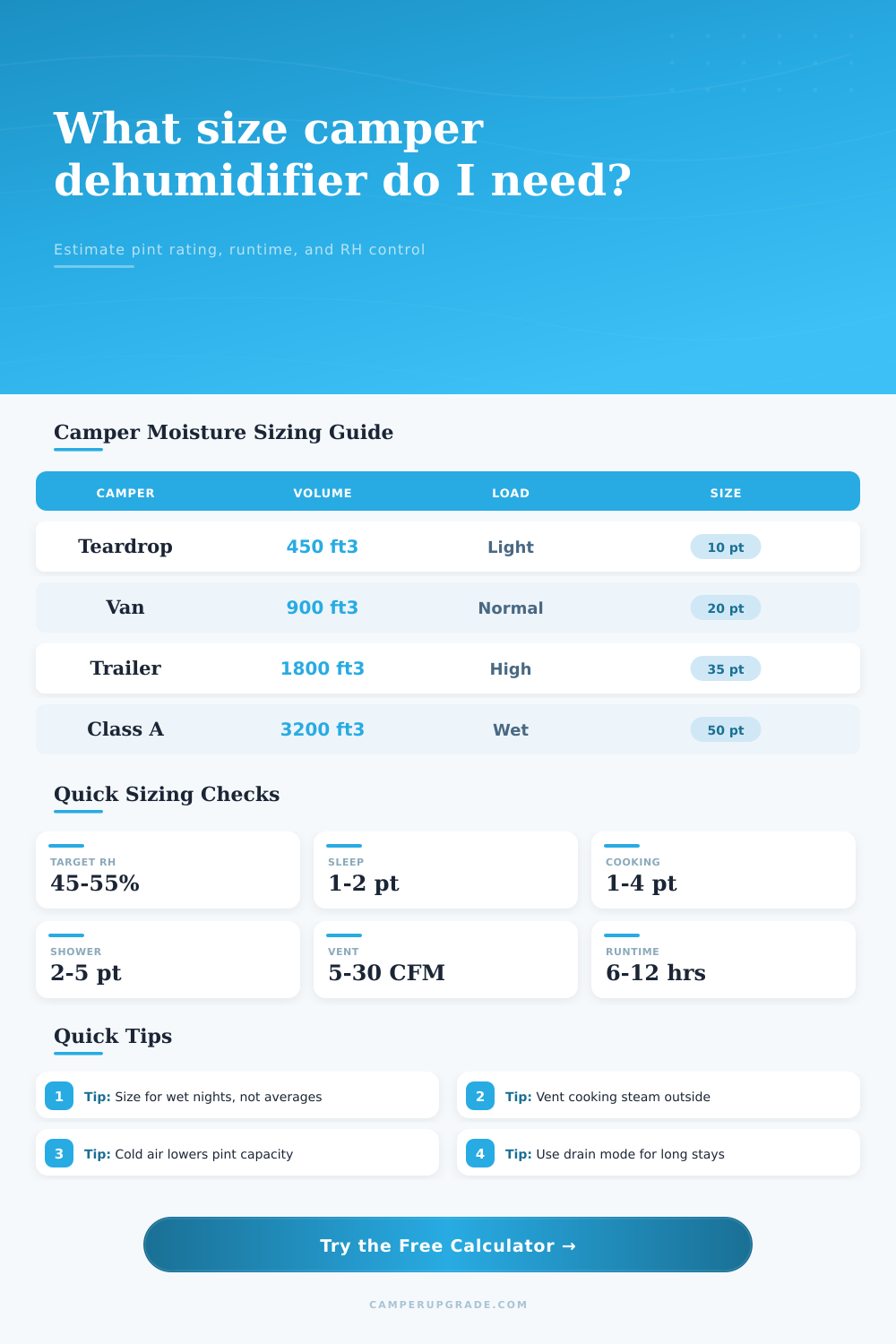
| Camper type | Typical volume | Common load | Typical rating |
|---|---|---|---|
| Teardrop or micro camper | 250 to 550 ft³ | One sleeper, low cooking | 10 to 16 pt/day |
| Camper van or Class B | 650 to 1,100 ft³ | Two sleepers, vent fan use | 16 to 25 pt/day |
| Travel trailer | 1,200 to 2,300 ft³ | Showers, cooking, wet gear | 25 to 40 pt/day |
| Fifth wheel or toy hauler | 2,200 to 3,800 ft³ | Family load, larger air volume | 35 to 50 pt/day |
| Class A motorhome | 3,000 to 5,500 ft³ | Long stay with zones | 45 to 70 pt/day |
| Moisture source | Daily estimate | Metric equivalent | Calculator use |
|---|---|---|---|
| Sleeping occupant | 1 to 2 pt/day | 0.5 to 0.9 L/day | Scaled by occupied hours |
| Quick cooking | 0.5 to 1.5 pt/day | 0.2 to 0.7 L/day | Dropdown cooking level |
| Boiling or simmering | 2 to 4.5 pt/day | 0.9 to 2.1 L/day | Higher cooking setting |
| Indoor shower | 2 to 5 pt each | 0.9 to 2.4 L each | Showers per day input |
| Wet towels and gear | 0.5 to 5 pt/day | 0.2 to 2.4 L/day | Direct added load |
| Indoor temperature | Capacity correction | What it means | Camper note |
|---|---|---|---|
| 80°F and warmer | 100% | Near rated performance | Warm humid sites favor removal |
| 70°F | 90% | Slightly below rating | Common occupied camper temperature |
| 60°F | 70% | Noticeable capacity drop | Watch condensation on windows |
| 50°F | 50% | Low-temperature operation | Defrost model may be needed |
| Below 45°F | 35% | Compressor units struggle | Desiccant units may perform better |
| Target RH | Result feel | Best use | Caution |
|---|---|---|---|
| 40% to 45% | Dry air | Storage or musty recovery | May feel too dry for sleeping |
| 45% to 50% | Crisp and controlled | Wet climates and window control | Needs more runtime |
| 50% to 55% | Comfort range | Most occupied camping nights | Watch cold glass and corners |
| 55% to 60% | Mild control | Dry climates and short stays | Mold margin is smaller |
💡Camper dehumidifier sizing tips
This calculator estimates moisture removal capacity for comfort and condensation control. Follow the dehumidifier manual for temperature limits, electrical load, drainage, and safe operation.
As you pull up to your campsite, you open the door and notice that window is foggy with condensation. The air is thick and humid. Air doesn’t flow in the corners so mold develops there too.
When most people buy a dehumidifier they just guess at size; they grab whatever looks cheap or fits on shelf. That means they end up purchasing a unit that suck up electricity but never turns off. Even though the dehumidifier are running, the wall remains wet. It’s not about which size says the biggest number on the package…it’s about sizing the dehumidifier to the true amount of moisture within your RV.
How to Choose the Right Dehumidifier Size for Your RV
Moisture from outside infiltrates around gaps. That’s important, but much of the wet air indoors come from indoor activity. Several pint of water vapor get released into the air each time you take a shower. Cooking (if done unvented) releases even more vapor. Breathing while sleeping puts moisture in the air too.
This online calculator will estimate your RV’s total daily moisture load (enter your camper size, number of occupants, frequency of showers & cooking). It spits out a number representing minimum capacity required.
If you buy a ten-pint dehumidifier when you need a twenty-pint, the motor overheat. You are outmatched; you can’t win the fight against dampness.
They also don’t consider temperature, which most buyers overlook. Dehumidifier ratings is based off warm/humid conditions. Compressor dehumidifiers start losing capacity as temperatures drop. That’s why you typically use them in cooler times of year and nights. What might be rated for twenty pints might pull only ten pints at sixty degrees.
Enter your typical inside temp into the tool. It’ll adjust the expected output for you. No need to remember correction charts. The logic does the math for you so you can concentrate on choosing what will work.
A fan moves air in and out: Outdoor air replaces indoor air. Opening a window brings humid outdoor air into the camper, which add moisture to it. Look at tables that list amount of water entering from regular airflow.
More powerful machines is needed if there are leaks in roofs or trailers. They are also needed if there are vents on the roof. Best to get cooking steam OUT asap. Source control costs less then pulling excess water later.
Maintain the humidity at around 45-55%. Anything under 45 will feel dry and make your lungs itch. Anything over 60 encourages mold growth. We want it within that range but not running all the time.
A large unit turns itself on and off too much, wearing out its compressor. A small one doesn’t turn off at all.
Set the unit to run in worst-case scenarios: push the preset buttons on the tool. Sizing it for a rainy week or if you plan to do lots of cooking while away ensures the right size.
It wouldn’t of make your windows weep, and the air won’t be clammy. You won’t have to worry about hidden mold behind the furnitures.