Camper Cushion Foam Volume Calculator
Size RV dinette seats, berth pads, bunks, backs, and wedge cushions by shape, thickness, density, quantity, allowance, and stock sheet yield.
Foam Cut Estimate
| Foam type | Density | Typical camper cushion | Calculation note |
|---|---|---|---|
| Polyurethane back foam | 1.5 lb/ft³ | Seat backs, low-load panels | Lightest option in this calculator |
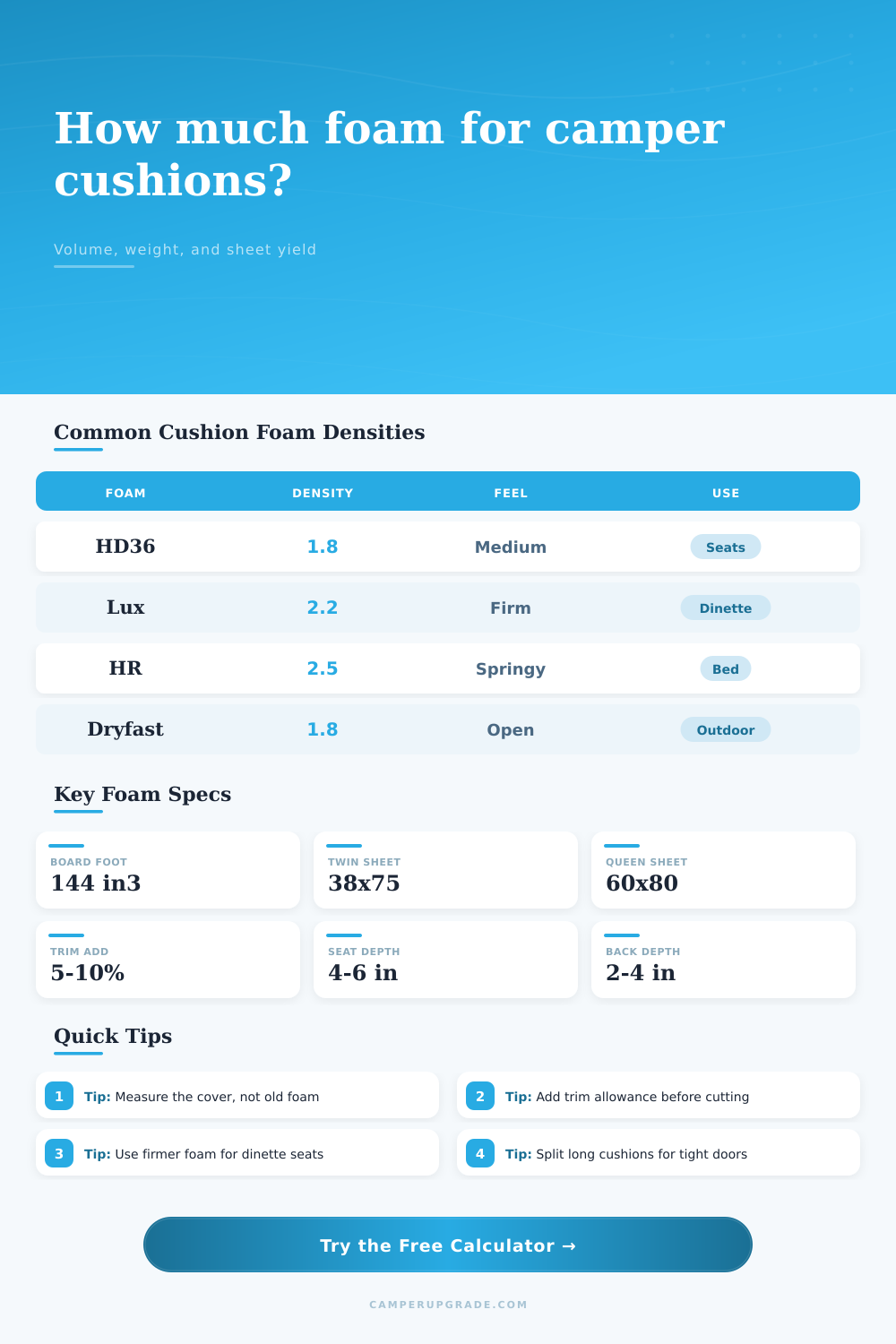
| HD36 medium foam | 1.8 lb/ft³ | General RV seats and benches | Good baseline for dinette cushions |
| Lux firm foam | 2.2 lb/ft³ | Firm dinette bottoms | Use when seats double as a bed |
| High resilience foam | 2.5 lb/ft³ | Premium berth or lounge pads | Higher weight for the same volume |
| Memory foam topper | 3.0 lb/ft³ | Thin comfort layers | Often layered over support foam |
| Dryfast open-cell foam | 1.8 lb/ft³ | Exterior or damp storage cushions | Volume is same; drying behavior differs |
| Natural latex foam | 4.5 lb/ft³ | Heavy premium sleep pads | Check lifted-bed and storage weight |
| Rebond utility foam | 5.0 lb/ft³ | Utility pads and support layers | Heaviest selection in this calculator |
| Thickness | Board feet per sq ft | Cubic ft per sq ft | Common camper use |
|---|---|---|---|
| 2 in | 2.0 bd ft | 0.167 ft³ | Back pads, thin toppers |
| 3 in | 3.0 bd ft | 0.250 ft³ | Back cushions, light seats |
| 4 in | 4.0 bd ft | 0.333 ft³ | Dinette seats, bench cushions |
| 5 in | 5.0 bd ft | 0.417 ft³ | Firm seats that convert to beds |
| 6 in | 6.0 bd ft | 0.500 ft³ | Berths, bunks, van beds |
| Stock sheet | Plan area | 4 in volume | Board feet |
|---|---|---|---|
| 24×72 in | 12.0 sq ft | 4.00 ft³ | 48 bd ft |
| 30×72 in | 15.0 sq ft | 5.00 ft³ | 60 bd ft |
| 36×72 in | 18.0 sq ft | 6.00 ft³ | 72 bd ft |
| 48×72 in | 24.0 sq ft | 8.00 ft³ | 96 bd ft |
| 60×80 in | 33.3 sq ft | 11.11 ft³ | 133 bd ft |
| 72×80 in | 40.0 sq ft | 13.33 ft³ | 160 bd ft |
| Common camper cushion | Finished size | Volume each | Board feet each |
|---|---|---|---|
| Dinette seat base | 42×18×4 in | 1.75 ft³ | 21 bd ft |
| Dinette back pad | 42×16×3 in | 1.17 ft³ | 14 bd ft |
| Van bench base | 54×22×5 in | 3.44 ft³ | 41 bd ft |
| Cab-over split pad | 38×75×5 in | 8.25 ft³ | 99 bd ft |
| Twin bunk pad | 30×74×4 in | 5.14 ft³ | 62 bd ft |
The Foam Calculator help if you ever order a cover that fits too snug. Or did you buy the wrong thickness of foam for your RV cushions? The Foam Calculator will help you with that so you don’t have to guess. Simply input your dimensions and let it do the volume math, it will save you a few headaches when trying to guess if a sheet of foam will cover an irregular shape.
The next consideration is thickness versus density. While thick padding sound nice, low-density foam will be soft but will collapse rapidly. You want a thicker pad but with high-density foam that won’t give in to pressure. If your dinette are a bed too, then firmer foam will be required different than just a casual sit-down. There are presets built into the tool for typical RV arrangements so you know where you stand compared to industry standards.
How to Use the Foam Calculator
Consider density the back-bone of the cushion. It is soft on top but collapses underneath you because it do not have enough density. The first thing they do is provide some cushion by being thick. How thick? For dining seats, four inches is typically ideal. It should be thick enough to be comfortable, but not so thick that it take away leg room or lets your knees bump into table. Lounges/pads tend to need at least six inches because our bodies spread out when we sleeps, much like they do on bunk beds.
Our converter will calculate your dimensions in terms of board feet. Board feet is what most foam suppliers price their goods in. A board foot is a piece of wood one inch thick and 12 inches long on each side. Once you know how many board feet something is, it’s no longer an abstract volume, it’s a concrete size to order. It is not a cube of inches, but a number of board feet.
There’s also a trim allowance that sets apart a pros job from a do-it-yourselfer’s work. When you make cuts on the foam it will shrink. When you wrap your foam with batting and fabric, the edges compress. When you close the cover, you might find yourself short by a fraction of an inch. It’s best practice to add another 5-10% for trim and waste. The calculator adds that extra amount to the final number to account for all of this. This ensures there is enough material to make less-than-perfect cuts and leaves some leftover foam in case you need to patch something later. Better to have more foam than to run out halfway through.
But your size choices are constrained by standard sheet dimensions. Big blocks of foam arrives in a rectangular shape, typically forty-eight by seventy-two inches. If you’re making long-narrow cushions, that’s fine: you’ll have great yield. But with oddly shaped or wide pieces, there will be lots of wasteful scraps. Here’s an idea of how much foam goes into each standard sheet. This will allow you to plan your cuts ahead, which means less wasted money and less frustration. Remember, a wedge won’t fit exactly into a rectangular sheet. Plan out the pattern first.
The type of foam to use depends on how it feels, how much it weigh, and how long it lasts. Rebond foam is cheap but heavy. High-resilience foam is pricier but bouncy. Your project’s estimated weight helps determine if a foam will fit in a small corner or be lifted up into a cab-over bunk. This is important if you have tight quarters or will be lifting the foam into a cab-over bunk. A heavier foam may stress the hinges and become tough to work around when doing repairs.
Medium-density polyurethane is a good place to begin for seats, but use something firmer for sleep spots. Make it something to sit on that you like after the numbers are gone. Numbers get you there, but your ass has to tell you how it is going to be. It should not be the shrunken remnant of last season’s foam.
Allow a smidge more than that for cutting. Pick based off use, not dollars. It’s easy math, hard comfort. You want the numbers, they get the volume. Everything else is sewing. You could of used better densitiy to make it feel more luxurius.