Camper Curtain Fabric Length Calculator
Estimate curtain yardage, panel cuts, lining length, repeat waste, hems, and finished coverage for camper van, RV, trailer, and bunk windows.
Use these ratios when the curtain hangs from a rod, track, snaps, or clips. Higher fullness increases both yardage and packed curtain bulk.
| Style | Typical Fullness | Best Camper Use | Formula Note |
|---|---|---|---|
| Flat snap panel | 1.0x | Cab glass, rear doors, magnetic panels | Finished span equals covered span |
| Slim track curtain | 1.25x | Van side windows and tight tracks | Multiply rod span by 1.25 |
| Light gather | 1.5x | Most camper privacy curtains | Good balance of drape and storage |
| Privacy gather | 1.75x | Bunk rooms and dinette sleeping areas | More overlap inside the stack |
| Full soft drape | 2.0x to 2.25x | Large RV windows and decorative panels | Expect more fabric widths per window |
| Usable Width | Common Label | Practical Max Flat Panel | Camper Planning Note |
|---|---|---|---|
| 42 in | Narrow cotton | 38 to 40 in | Often needs extra widths for dinette curtains |
| 45 in | Quilting cotton | 41 to 43 in | Works for bunks, small sliders, privacy valances |
| 54 in | Home decor | 50 to 52 in | Default for many blackout and upholstery fabrics |
| 60 in | Outdoor fabric | 56 to 58 in | Useful for wide cab and rear door panels |
| 72 in | Wide blackout | 68 to 70 in | Reduces seams on windshield and wraparound panels |
| Allowance | Typical Range | Use When | Calculator Treatment |
|---|---|---|---|
| Side hem | 0.5 to 1.5 in each edge | All sewn panels | Added twice per panel |
| Rod pocket/header | 2 to 5 in | Rod pockets, tape, clips, tabs | Added to cut drop |
| Bottom hem | 1.5 to 4 in | Loose-hanging fabric | Added to cut drop |
| Pattern repeat | 0 to 18 in | Plaid, stripe, scenic, directional prints | Cut drop rounds up to next repeat |
| Waste buffer | 5% to 20% | Curved walls, mistakes, future repairs | Added after repeat matching |
| Opening | Typical Glass Size | Useful Finished Span | Example Fabric at 1.5x |
|---|---|---|---|
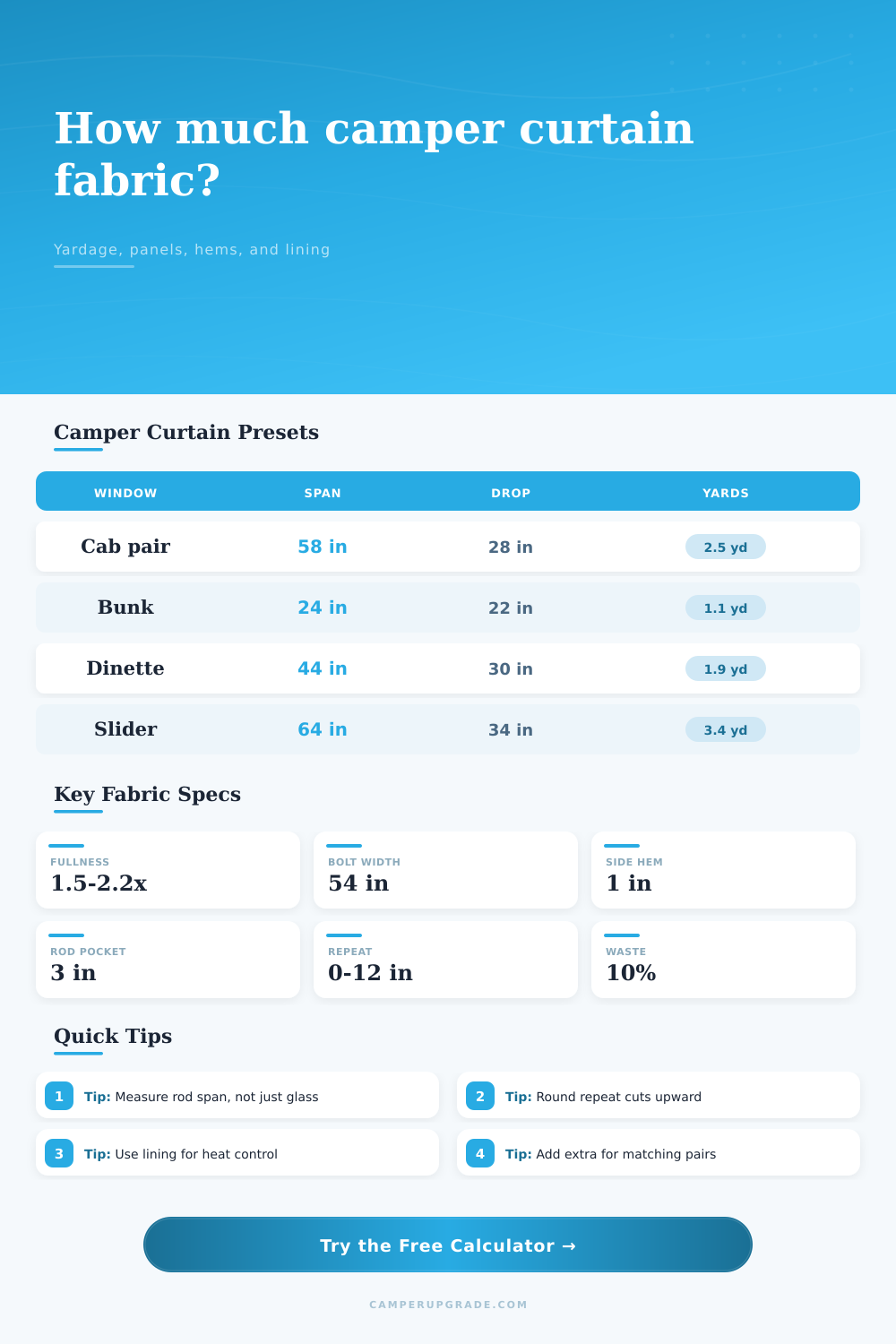
| Bunk side window | 24 in x 18 in | 28 in x 22 in | About 1.1 yd per pair |
| Van slider door | 46 in x 27 in | 52 in x 33 in | About 2.0 yd per window |
| Rear door glass pair | 30 in x 32 in each | 68 in x 36 in total | About 3.2 yd per pair |
| Dinette picture window | 44 in x 30 in | 48 in x 34 in | About 1.9 yd per window |
| Cab privacy span | 58 in x 28 in | 64 in x 32 in | About 2.5 yd per curtain |
I mean, who buys fabric to put on windows of their camper? And I am telling you, underestimating the waste are normal. You’re holding that fabric in your hand at the store and trying to picture it. Well, it’s more than just the glass…It’s the fabric and what happens as it meets the wall and starts gathering.
A calculator can help, but you’ve got to know your numbers. Fullness refer to the width of fabric compared to the window. If there’s no gather, the fabric is like a flat panel across the space. It is stiff. You can soften it with gathering. For a light gather, use one and a half times the window width. For a full drape, use up to twice the window width. The calculator figure the math, but then you get to decide just how froufy you can tolerate. Too many folds of fabric stack up on rod. They block your view.
How to Measure and Buy Fabric
Then there is the issue of repeat patterns. If your fabric has a solid blackout design, no worries. If it’s a plaid or a scenic print, trouble! All the seams needs to line up with each other. On a nine inch repeat, that means adding length over four panels. No slicing through a pattern and hoping it will work. Because then the rounding up to the next complete repeat happen. Which ensures that you’ll never run out of fabric for the final panel.
Hems and headers are silent yardage killers Rod Pocket require a minimum of three inches. Add a two-inch hem to the bottom to weigh it down. Use one inch on each side for finishing. And there is a large increase in the overall drop length. So you frequently overlook all those allowances. Now when you measure just for the glass, the curtain ride up (exposing the sill and letting light in).
That changes when you add lining. Maybe you wish to have a blackout liner so it sleeps well. Or maybe you want a thermal backing to keep the cab cool. That means twice as much fabric for line. If you choose a lining type on the calculator, it knows. It adds in the extra length required. It also calculates weight. A heavy quilted material need strong rods. Light wires don’t work with more than a dozen ounces of insulated canvas. So make sure to check your hardware first then pick your fabric.
The last part is measuring accuratley. Measure the rod span, not the glass. Add a few inches on both sides so no light seep through. Measure from the top of the rod to where you would like the curtain to break. If you’d like it to puddle on the floor, then add length. If you want it to clear the sill, stop there. Six inches make a big difference and could move you up to another yard.
The width of the fabric is standardized. Typically, it’s fifty four inches wide. If you have a wider panel, you need two widths sewn together to make one piece. That means having seams. Those weaken the fabric. If not well pressed, they are also ugly. The fewer seam the better. Using a wider bolt decreases seam count. It costs more per yard. It is a choice between cleanliness and cost.
And then you enter your numbers into the calculator, and it spits out the rest for you. It adds up the drops, provides a waste buffer, and then gives you the total yards needed. You go to the counter with that number. If you’re a beginner sewer, you should of tacked on a bit more just to be safe. It is better to have a few more inches than needed rather than a few less. After all, this is your tiny space, the fit should feel comfortabley. And everything else will work out.