Camper Cover Size Calculator
Estimate the right RV cover envelope from camper length, width, drop height, ladder or spare protrusions, air conditioner height, roof accessory adders, cover slack, tie-down allowance, class type, and packed storage bag volume.
📌Camper cover presets
📏Cover sizing inputs
Cover size breakdown
🧵Cover material and packed-size grid
Packed volume is an estimate from fabric surface area, material bulk, and compression. Actual storage bags vary by panel reinforcement, vents, zippers, and strap hardware.
🚘Common camper cover size ranges
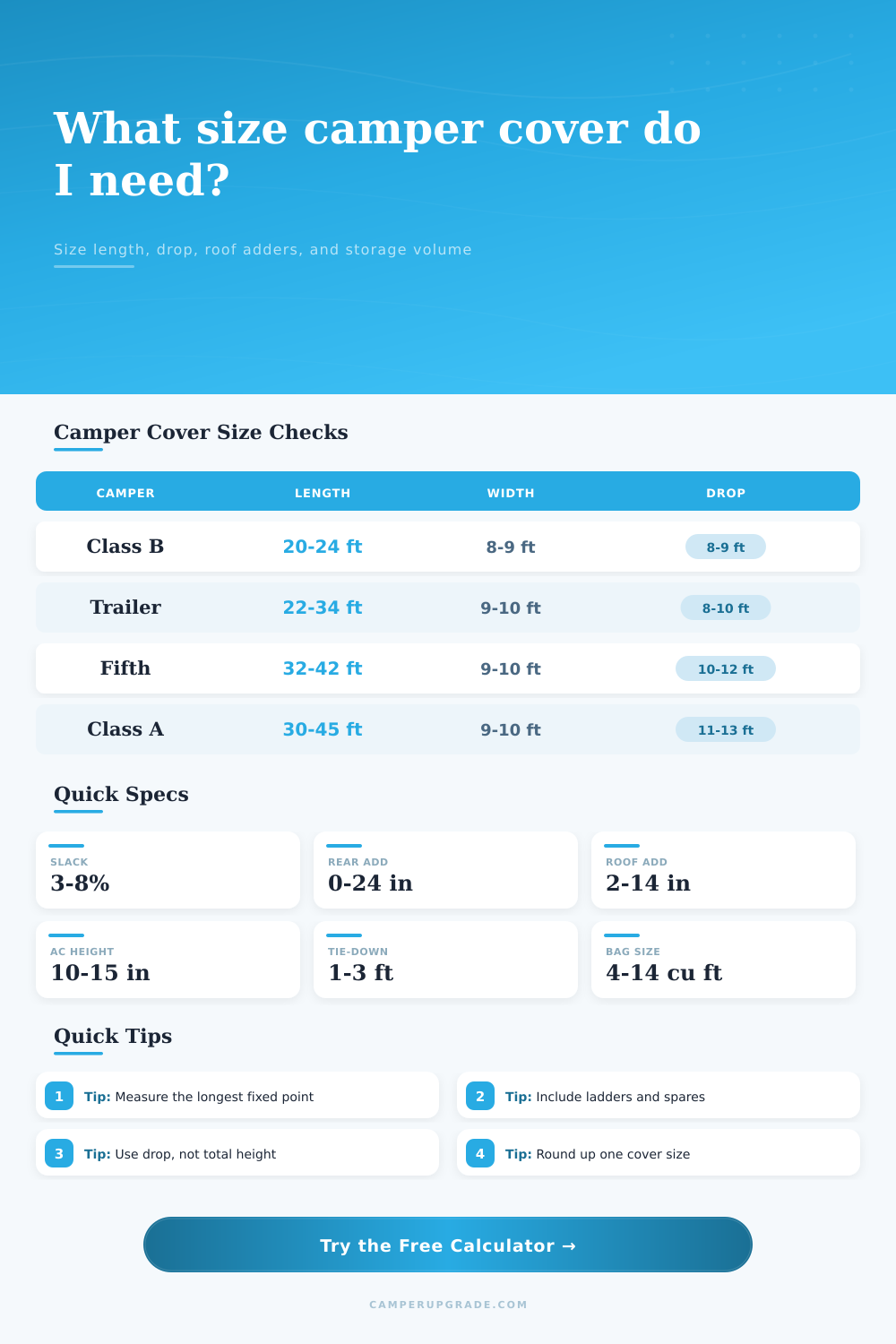
| Camper type | Typical cover length | Typical width range | Typical side drop | Watch point |
|---|---|---|---|---|
| Teardrop or compact trailer | 10 to 18 ft | 6.5 to 8 ft | 4 to 6 ft | Rear galley hatch, tongue box, and spare tire can add more length than the body suggests. |
| Pop-up or folding camper | 10 to 18 ft | 7 to 8.5 ft | 3.5 to 5 ft | Use lowered travel height and measure the box, not the opened tenting height. |
| Truck camper | 12 to 22 ft | 8 to 9.5 ft | 7 to 10 ft | Cabover nose, rear ladder, jacks, and bumper steps often set the cover envelope. |
| Class B camper van | 18 to 24 ft | 8 to 9 ft | 7.5 to 9.5 ft | Mirrors, roof fans, antennas, ladders, and rear tire carriers need extra slack. |
| Travel trailer | 18 to 36 ft | 8.5 to 10 ft | 8 to 10 ft | Measure body plus mounted spare, ladder, propane cover, tongue box, and awning arms. |
| Fifth wheel | 28 to 43 ft | 9 to 10.5 ft | 10 to 12.5 ft | High front caps and dual AC units often need a taller drop and roof allowance. |
⚠Accessory allowance table
| Accessory | Length adder | Width adder | Height adder | How to enter it |
|---|---|---|---|---|
| Rear ladder | 4 to 8 in | 0 to 2 in | 0 to 2 in | Add to rear protrusion; add small side protrusion if the ladder sits outside the wall line. |
| Rear spare tire | 10 to 18 in | 0 to 3 in | 0 to 2 in | Add tire depth to rear protrusion and keep slack above the tire cover. |
| Roof AC shroud | 0 to 4 in | 0 to 4 in | 10 to 15 in | Enter tallest AC height and choose an AC roof accessory adder. |
| Solar rack or rail | 0 to 6 in | 2 to 8 in | 4 to 12 in | Use roof accessory adder and side protrusion when rails stick past the wall line. |
| Side awning arms | 0 to 2 in | 2 to 6 in | 0 to 3 in | Add the outer arm depth to side protrusion so the width does not bind. |
| Front tongue box | 6 to 18 in | 0 to 4 in | 0 to 6 in | Add only the portion you want under the cover to front protrusion. |
📦Cover size categories and tie-down allowance
| Cover label | Length span | Typical tie-down skirt | Fit target | Use when |
|---|---|---|---|---|
| Small trailer cover | 10 to 18 ft | 0.5 to 1.5 ft | Snug with light slack | Compact trailers, teardrops, pop-ups, and short utility campers. |
| Mid trailer cover | 18 to 28 ft | 1 to 2 ft | Normal hem reach | Single-axle or tandem trailers with one AC and rear-mounted spare. |
| Large trailer cover | 28 to 36 ft | 1.5 to 2.5 ft | Relaxed over corners | Long trailers, toy haulers, rear ladders, and taller front caps. |
| Fifth wheel cover | 30 to 43 ft | 1.5 to 3 ft | Tall front cap | High-profile fifth wheels with deep drop, AC shrouds, and front cap radius. |
| Motorhome cover | 20 to 45 ft | 1.5 to 3 ft | Full wall coverage | Class A, B, or C bodies where mirrors and roof accessories affect fit. |
🗄Storage bag volume planning table
| Cover fabric | Typical packed bulk | Storage bag range | Handling note | Best suited to |
|---|---|---|---|---|
| Light poly fabric | 0.028 cu ft per sq ft | 3 to 7 cu ft | Smallest packed size but needs careful fold control. | Short trailers, pop-ups, and seasonal dust covers. |
| Multi-layer polypropylene | 0.040 cu ft per sq ft | 5 to 11 cu ft | Common RV cover bulk with moderate strap and vent hardware. | Travel trailers, Class C bodies, and fifth wheels. |
| Woven polyester | 0.052 cu ft per sq ft | 7 to 14 cu ft | Stiffer fabric usually needs a larger bag and cleaner folds. | Frequent installation, abrasion resistance, and outdoor storage. |
| Heavy canvas blend | 0.066 cu ft per sq ft | 9 to 18 cu ft | Bulky when dry and much harder to pack if damp. | Custom-fit heavy covers and long-term storage protection. |
💡Two camper cover sizing tips
An RV cover is a challenge to buy. Why? Because the RV isn’t easily shaped like one. You get your tape measure out and take measurements. You order what is supposed to be the right-sized RV cover. But when you get it home, the cover binds at the ladder or it doesn’t even cover the spare tire.
More times than not, the issue isn’t the cover itself. It’s the way we measure it. Most folks simply measure from front to back (or box length) and they is done. That’s the wrong thing to do.
How to Measure Your RV for a Cover
A cover needs to be pulled across all those bumps, vents, and other protrusions so they can finally settle into place. This page will help you factor that three dimensional world into the equation without having to pull out a calculator and tape measure.
So the distinction between cover length and body length matters. Cover must extend beyond the spare tire carrier, rear ladder, and frequently the front tongue box; that’s cover length. Body length is what you think of as the “skin” or metal skin. Fifth wheels with high front cap require additional height too.
Once you know your true physical measurements and enter them into calculator, it do the math for you. You won’t have to guess if six inches will be enough for your particular air conditioner. This isn’t about the model year; this is about the physical footprint.
Another finicky variable is drop height. You may believe all you need to do is measure from the ground to the roof. But not so fast; that’s counting on the gravel and the tires to protect the fabric. Allow the hem to touch the ground? No way: It’ll be shredded in the first windy night.
That’s where the bottom clearance number comes in. You’re creating a skirt that sits a couple of inches off the lowest part of the vehicle. That protects against abrasions while keeping dirt from wicking up into the seams. A small adjustment, but it saves the cover.
Most folks do this wrong: The roof. A few inches above your roofline is your air conditioner. Within one season, any cover purchased based off the edge of your roof will tear right over the AC unit. Whatever is the highest thing on your roof (whether it’s a vent fan, satellite dome, or solar panel rail) gets an allowance in the calculator. Better to have a bit more wiggle room than pull the fabric tight across something pointy.
Surprisingly, fabric selection has an impact. Some covers are super light (thin poly), packable and small, but won’t provide much protection against UV rays or heavy snow. Others are durable (heavy blend of canvas) but take up space. Based on what you pick, the calculator will estimate how much it will consume in storage.
And it ain’t no skin off anyone’s backside. Space is at a premium for many of us whether it’s a shared garage space or storing in a storage facility. Having a packable cover that swells to twenty cubic feet may not work well if you’re confined to a tight space.
There’s a stowability vs. You would of had to trade durability for stowability before you even buy the cover.
The best part about a good fit. Their secret weapon is Slack. You want the cover snug so it doesn’t blow off but not too snug because then it will rip the seam. Not too loose either or else it will flap itself to death. With the calculator you set your own percent for how much is right for local weather conditions and your comfort level.
That little bit of extra slack or tightness can make the difference in a cover lasting 5 years vs. You might need to replace it next spring. Needing to replace next spring.
So what does all this mean? Well, in the end, you want to respect the geometry of your rig when sizing a camper cover. A sheet doesn’t drape perfectly on a rectangle. Your RV has curves, vents, ladders, mirrors, etc., making it a much more complex shape. Figuring out the size will take some patience.
Consider your RV less of a vehicle than an obstacle course for fabric. Measure carefully. Don’t forget the little bits. The first time you pull it off and get it right will feel like a victory. Then all you need to do is keep it that way through the winter.