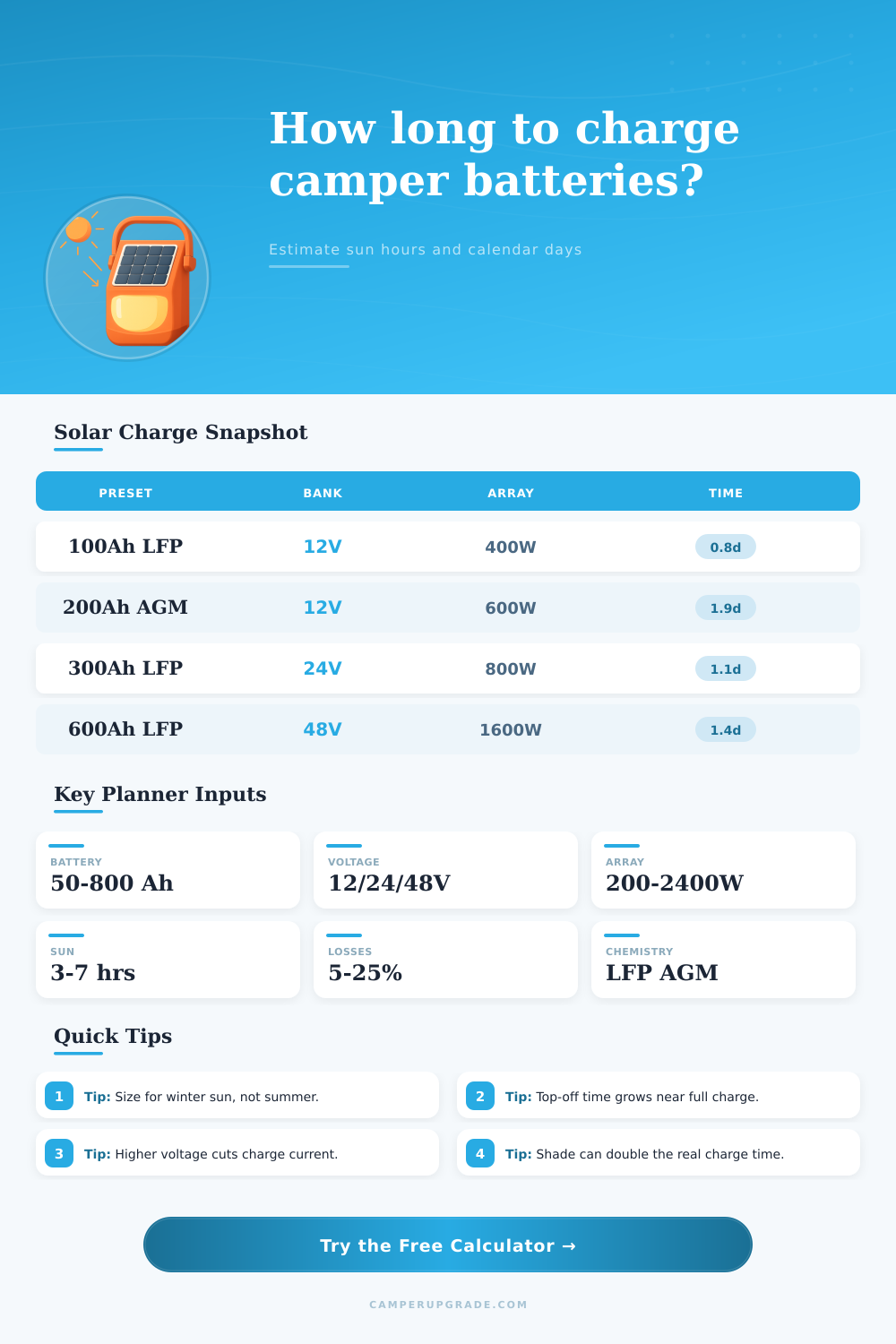
Solar Charge Time Calculator
Estimate how long your camper battery bank needs to reach target state of charge from a real solar array and charge profile.
☀️Real World Presets
⚙Solar Charge Inputs
📊Solar Charge Spec Grid
📘Reference Tables
| Charge Stage | SOC Range | What Happens | Time Share |
|---|---|---|---|
| Bulk | 0-80% | Fastest energy gain | 60-75% |
| Absorption | 80-95% | Voltage holds steady | 15-30% |
| Finish | 95-100% | Current tapers hard | 5-20% |
| Float | 100% | Maintenance only | Hold mode |
| Storage | 50-70% | Low stress sitting | Not a charge stage |
| Cycling Setup | 12V / 400W | 24V / 800W | 48V / 1600W |
|---|---|---|---|
| 100Ah LFP | 0.7-1.0d | 0.4-0.6d | 0.2-0.4d |
| 200Ah AGM | 1.7-2.4d | 0.9-1.3d | 0.5-0.8d |
| 300Ah LFP | 2.1-3.0d | 1.1-1.6d | 0.6-1.0d |
| 400Ah Flooded | 3.4-4.8d | 1.8-2.6d | 0.9-1.4d |
| 600Ah LFP | 5.0-7.2d | 2.6-3.7d | 1.3-2.1d |
| Chemistry | Tail Shape | Top-Off Speed | Best Use |
|---|---|---|---|
| LiFePO4 | Short tail | Fast | Daily cycling |
| AGM | Longer tail | Moderate | Mixed camping |
| Gel | Gentle tail | Slow | Careful chargers |
| Flooded | Heavy tail | Slowest | Ventilated banks |
| NMC | Very short | Fastest | Compact systems |
| Array Example | Module Size | Charge Current | Note |
|---|---|---|---|
| Portable Kit | 2 x 200W | 16-18A | Easy to move |
| Van Roof | 3 x 200W | 24-28A | Balanced daily use |
| Trailer Roof | 4 x 250W | 30-36A | Strong recovery |
| RV Roof | 6 x 200W | 40-50A | Fast after cloudy days |
| Large Bank | 8 x 200W | 60-70A | Shorter finish window |
To calculate how long it will take to charge a battery bank using solar panels, you must understand a few different variable. The charge time for solar panel batteries isnt dependent on the size of the solar panels and the amount of sunlight that will hit those panels. The charge time for these batteries also depends on a few other factors.
The first thing you need to do is determine the energy capacity of the battery bank. To calculate the capacity of the battery bank, you will have to multiply the amp-hour capacity of the battery bank by the voltage of the battery bank. The product of these two variables is the energy capacity of the battery bank in watt-hour.
How Long It Takes to Charge a Battery Bank with Solar Panels
If you are charging the battery bank from twenty-five to ninety percent, you will have to calculate the difference between these two percentage. Twenty-five percent to ninety percent of the battery banks energy capacity totals sixty-five percent of the total energy. You will have to convert this percentage to watt-hours to find the energy needed to charge the battery bank.
The second step is to calculate the amount of energy that your solar panels will harvests each day. To find the harvest of your solar panels, you will have to multiply the wattage of your solar panels by the number of peak sun hours that your location receives each day. The number of peak sun hours change with the weather and the season that falls upon the area in which your solar panels are located.
Many individuals use the average number of sun hours during the summer for solar panel calculations. However, the number of peak sun hours during the summer is higher than the number of peak sun hours during the winter months. Using the peak sun hours for the summer to plan for winter solar panel batteries will provide insufficient power for those winter month.
Batteries also do not charge at the same rate throughout the charge cycle. Batteries go through three different stages during the charging process for solar panels. The first stage is the bulk stage.
During the bulk stage, the batteries go from zero to eighty percent of the battery bank’s charge. During this initial stage, the batteries receive the highest amount of current from the solar panel batteries. The bulk stage of charging is the fastest stage of the battery charging process.
The second stage of charging is the absorption stage. The absorption stage occurs as the battery bank nears a full charge. During this stage, the voltage of the battery bank remains the same, but the current decreases.
The absorption stage takes more time than the bulk stage. The third stage is the float stage, which is used to maintain the battery bank’s charge once it has reached its full capacity. The chemistry of the batteries will also change the length of the charging process for the battery bank.
Battery chemistry affects the absorption stage of charging. For instance, lithium batteries, like LiFePO4 batteries, have a shorter absorption stage for charging as compared to lead-acid batteries. Additionally, because the acceptance rate for lithium batteries are high, they will take less time to charge than lead-acid battery banks.
Lead-acid batteries, such as AGM batteries or flooded batteries, will take more time to charge because their absorption stage is longer. If you plan to use lead-acid batteries for your battery bank, you will have to provide additional time to charge them to full capacity. Energy is also lost during the solar panel system.
Solar panels do not always produce the wattage that they are rated to produce. There are various factors that will lead to the loss of some of the energy produced by the panels. Trees or other branches can cause energy to be lost due to shading of the solar panels.
Dirt on the solar panels will also cause a loss of energy because the dirt will prevent some of the sunlight from reflecting onto the solar cells. The high temperature of the panels will also produce a loss of energy. Solar panels produce less power if they are hot because of the energy they produce.
The battery charge controllers also lose energy because they are not one hundred percent efficient in their function of the solar panels. The wiring of the solar panel system also loses energy because of the resistance of the wires. Four hundred watt solar panels may only produce three hundred watts of effective energy for the battery bank.
Once you have calculated the energy needed to fully charge the battery bank and the energy that the solar panels will produce, you can calculate how many day it will take for the battery bank to become fully charged. To calculate the number of days required to charge the battery bank, you will have to multiply the effective wattage of the solar panel by the number of peak sun hours that the area will receive each day. You will then take the total watt-hours that the battery bank requires to be charged and divide it by the watt-hours that the solar panels will produce each day.
The answer to this equation is the number of days that the battery bank will take to reach full charge. If you want to ensure that your battery bank has an ample amount of energy, you should aim for a time frame of more than one day for the battery bank to fully charge. This will allow for any cloudy weather to allow the battery bank to gain enough energy to reach full charge.
Using a higher voltage for your solar panel batteries will increase the efficiency of your system. Using a twenty-four volt or a forty-eight volt solar panel system will produce less energy loss than a twelve volt system. Higher voltages produce less current in the system, reducing the amount of energy that is lost to heat in the wiring of the solar panel system.
Using a higher voltage system will make your solar panel charging system more efficient. The use of higher voltages, however, will require the purchase of inverters and chargers that is compatible with that higher voltage. Overall, to calculate how long it will take to charge a battery bank with solar panel batteries, you will have to consider the capacity of the battery bank, the number of peak sun hours that your location will receive each day, and the chemistry of the batteries.
Additionally, you will have to account for the energy losses that may occur during the production of the solar panels. You can also account for the stages of battery charging because the rate at which the batteries are charged will slow as the battery bank reaches its full charge. By considering all of these variable, you will be able to come up with an accurate estimate of how many days of sunlight will be required to charge your battery bank.