Boil Time to Purify Calculator
Estimate heat-up time, altitude-based rolling boil hold, and fuel needed for camp water batches.
⛺Camp Water Presets
💧Boiling Inputs
Full Calculation Breakdown
Core Formulas Used
Local boiling point: 212°F – elevation ft × 0.00184, converted to °C for the heat calculation.
Heat-up energy: liters × 1 kg/L × 4.186 kJ/kg°C × temperature rise to local boiling point.
Heat-up time: water kJ divided by effective stove kJ per minute, where field efficiency and pot setup are applied.
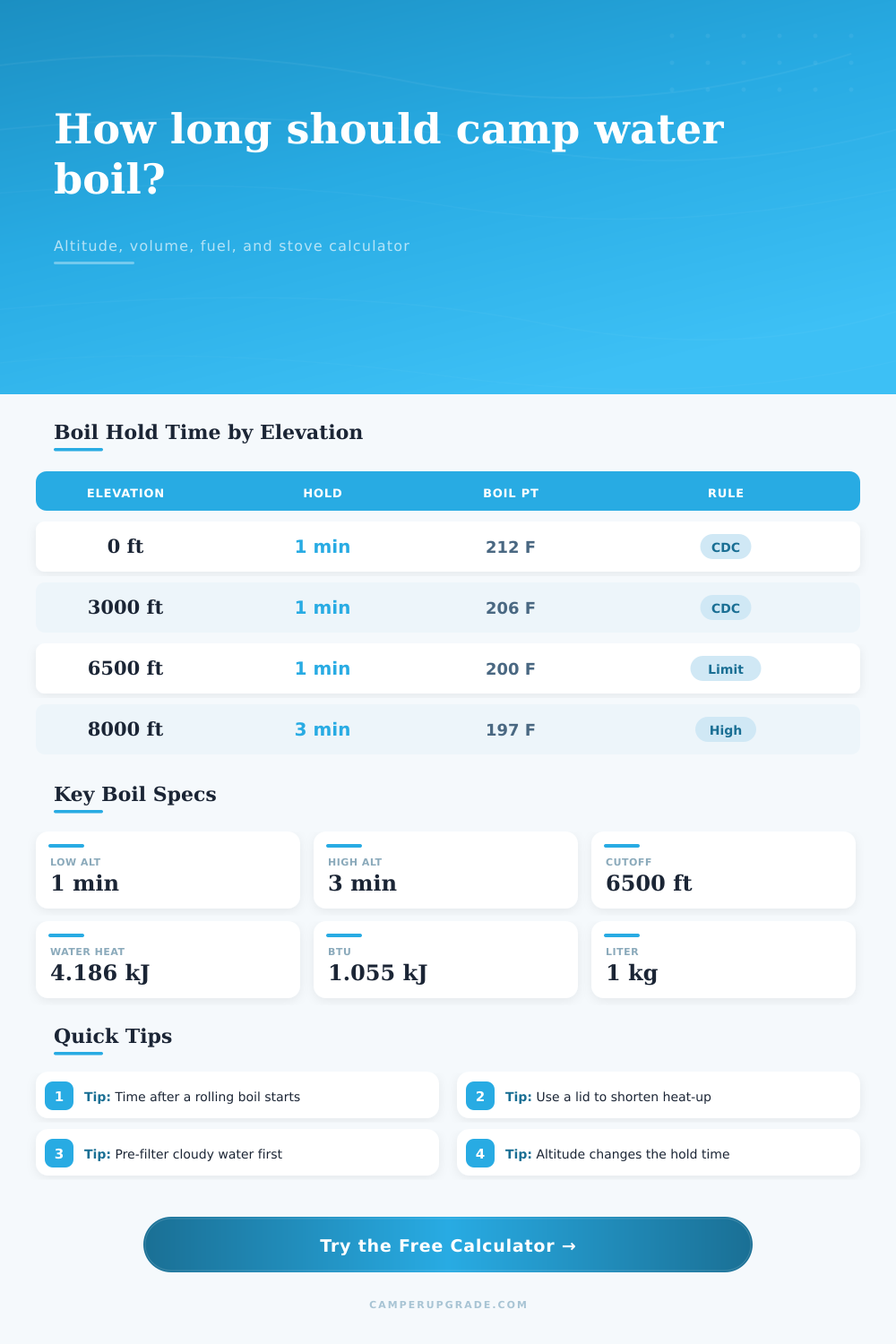
Purifying hold: 1 minute through 6,500 ft, 3 minutes above 6,500 ft, plus clarity and selected safety margin.
🔥Fuel and Treatment Spec Grid
🗻Elevation Hold Reference
| Elevation Band | Approx Boiling Point | Minimum Rolling Boil Hold | Calculator Use |
|---|---|---|---|
| Sea level to 2,000 ft | 212°F to about 208°F | 1 minute | Use 1 minute plus selected clarity and safety margin. |
| 2,001 to 5,000 ft | About 208°F to 203°F | 1 minute | Heat-up is slightly shorter, but the hold rule remains 1 minute. |
| 5,001 to 6,500 ft | About 203°F to 200°F | 1 minute | Close to the high-altitude threshold; add a margin when uncertain. |
| Above 6,500 ft | Below about 200°F | 3 minutes | The calculator switches the base hold to 3 minutes automatically. |
🌡Water Volume and Temperature Reference
| Batch | Volume | Cold Water Heat-Up Load | Typical Camp Use |
|---|---|---|---|
| Solo mug | 0.5 L / 0.53 qt | About 160 kJ from 45°F to sea-level boil | Drink mix, one meal pouch, small emergency batch. |
| Two-person pot | 1.5 L / 1.59 qt | About 475 kJ from 45°F to sea-level boil | Two meals, shared tea water, bottle refill starter. |
| Group cook pot | 4 L / 4.23 qt | About 1,270 kJ from 45°F to sea-level boil | Basecamp cooking, group drinking water, wash-water safety batch. |
| Stockpot batch | 6 L / 6.34 qt | About 1,900 kJ from 45°F to sea-level boil | Overland camp, large RV pot, multi-bottle refill. |
🛢Fuel Conversion Reference
| Fuel Type | Energy Density Used | Common Container Check | Best Calculator Match |
|---|---|---|---|
| Isobutane canister | 45.8 kJ/g | 100 g canister, 230 g canister, 450 g canister | Backpacking canister stoves and integrated stove systems. |
| Propane | 46.4 kJ/g | 1 lb cylinder contains about 454 g fuel | Two-burner camp stoves and RV outdoor burners. |
| White gas | 44.0 kJ/g | Liquid bottles vary; weigh before and after for field tracking | Cold-weather and high-output expedition stoves. |
| Denatured alcohol | 26.8 kJ/g | Lower energy per gram than canister fuels | Small batches and slower ultralight alcohol burners. |
| Solid fuel tablet | 30.0 kJ/g | Tablet output varies with wind and stove stand height | Emergency boils and compact backup kits. |
📋Named Scenario Reference
| Scenario | Water and Start Temp | Elevation | Expected Driver |
|---|---|---|---|
| High Sierra Campsite | 1.5 L at 45°F | 8,200 ft | Longer 3 minute hold dominates after heat-up. |
| Winter Snowmelt Batch | 2.5 L at 33°F | 7,000 ft | Very cold starting water plus high-altitude hold. |
| Bikepacking Alcohol Stove | 0.75 L at 55°F | 1,200 ft | Small volume helps, but alcohol energy density is lower. |
| Overland Basecamp Stockpot | 6 L at 65°F | 4,000 ft | Large water mass drives the heat-up estimate. |
💡Calculation Tips
There’s a particular kind of panic that sets in when you’re staring at a brown-paint stream and your canteen is bone-dry. It’s enough to trigger your survival instinct.
But guess what? You’re not the only one in this situation. Without excessive filtering or chemicals, there’s no more surefire method for cleaning water then boiling it. But here’s the catch: It’s not as straightforward as it sounds.
How to Boil Water Safely on a Hike
How efficiently does your stove use fuel? How well does its pot transfer heat to the water? Most backpackers don’t think about these variables, they only notice them when they are hunched over a cold stove with an empty canister.
But here’s where it gets tricky: The boiling point isn’t static. It depends on altitude. The thinner air at higher elevations decreases pressure, which cause water to boil at a different temperature. To be safe, you must reach a temperature that may be lower than 212 degrees Fahrenheit depending on your altitude.
That’s how hot water has to get at sea level to kill pathogens. But when you’re over 6,500 feet, the number falls under 200 degrees. Why does this matter? Because at those lower temperatures, you need to let the water boil for a longer amount of time to make sure it is safe.
Plug in the volume and elevation, and the calculator takes care of the rest. You don’t have to worry about converting and calculating coefficients, it calculates the correct rolling boil time for you. Once you’re past that high-elevation marker, itll change to a three-minute hold instead of just a single minute.
Hiking stoves are underrated: Hikers tend to think only about how long it takes to boil. They don’t realize that it take energy to get water from room temperature up to the boiling point. That energy requirement increase at a steady rate with amount of water. You might boil six liters for your group dinner. The heat-up time easily outweighs the minute or two that it takes to sterilize the water.
This is why the tool requests your stove’s efficiency rating and BTU output. A high-output canister stove in still air may only need minutes to boil a quart of water. The same stove blowing away in a windy gap with no pot cover can take double that, the difference may be the distinction between a hot meal and a cold one.
The secret ingredient here? Saving fuel.
Propane and isobutane both offer high energy density. Great for short trips and small amounts. But neither does well in cold weather. White gas is good in cold temperatures, but it needs to be maintained and primed. Alcohol stoves work simply and cost little money. But…they burn slow, so wind protection is required and patience are needed.
Depending on those factors, the calculator will tell you how much fuel you’ll need. No guesswork = carry exactly as much as necessary.
It also considers your cook pot set-up. By fitting the lid snugly, you retain more of the steam (which heats) and keep less heat escaping. It’s a minor tweak but it matters over time.
There’s another variable that will trip folks up: Water clarity. Viruses and bacteria is killed by boiling, but chemical contaminants and sediment are not removed. To make sure you’re being safe, pre-filtering cloudy source water using a commercial filter or even just a bandana will help eliminate these issues. Turbid water also protects pathogens from heat; they need to be boiled longer to kill them off completely.
The tool has an adjustment for clarity, which adds time when dealing with cloudiness. It also allows you to add a bit of safety margin. That’s good practice in situations where the conditions or your inputs is uncertain. Better to boil a few extra seconds than take a chance on getting sick.
At its core, it’s all about time and energy management in a variable environment. How do I boil water when I’m battling cold water temps, altitude, and wind, while also wanting to conserve my fuel? It isn’t so much getting the water hot as it is getting the water safe as efficienty as possible.
When you understand what elevation does to your boiling point, guesswork turns into planning. From there you’ll know exactly how long to wait, and how much fuel to carry. It’s not just about boiling water; it’s about boiling it enough to make the water safe. Respect the physics and plan for the variables the mountain throws at you.