Camp Stove Boil Time Calculator
Estimate how long your camp stove needs to boil water, how much fuel it will use, the energy required, and the local boiling temperature from water volume, start temperature, burner output, efficiency, wind, altitude, fuel, lid use, and pot material.
🏕Camp Stove Boil Presets
⚙Water, Stove, Pot, Weather, and Fuel Inputs
The model combines water heat capacity, local boiling point from altitude, a small pot heat-up allowance, burner output, fuel energy density, pot efficiency, wind exposure, and lid use. It estimates time for liquid water only.
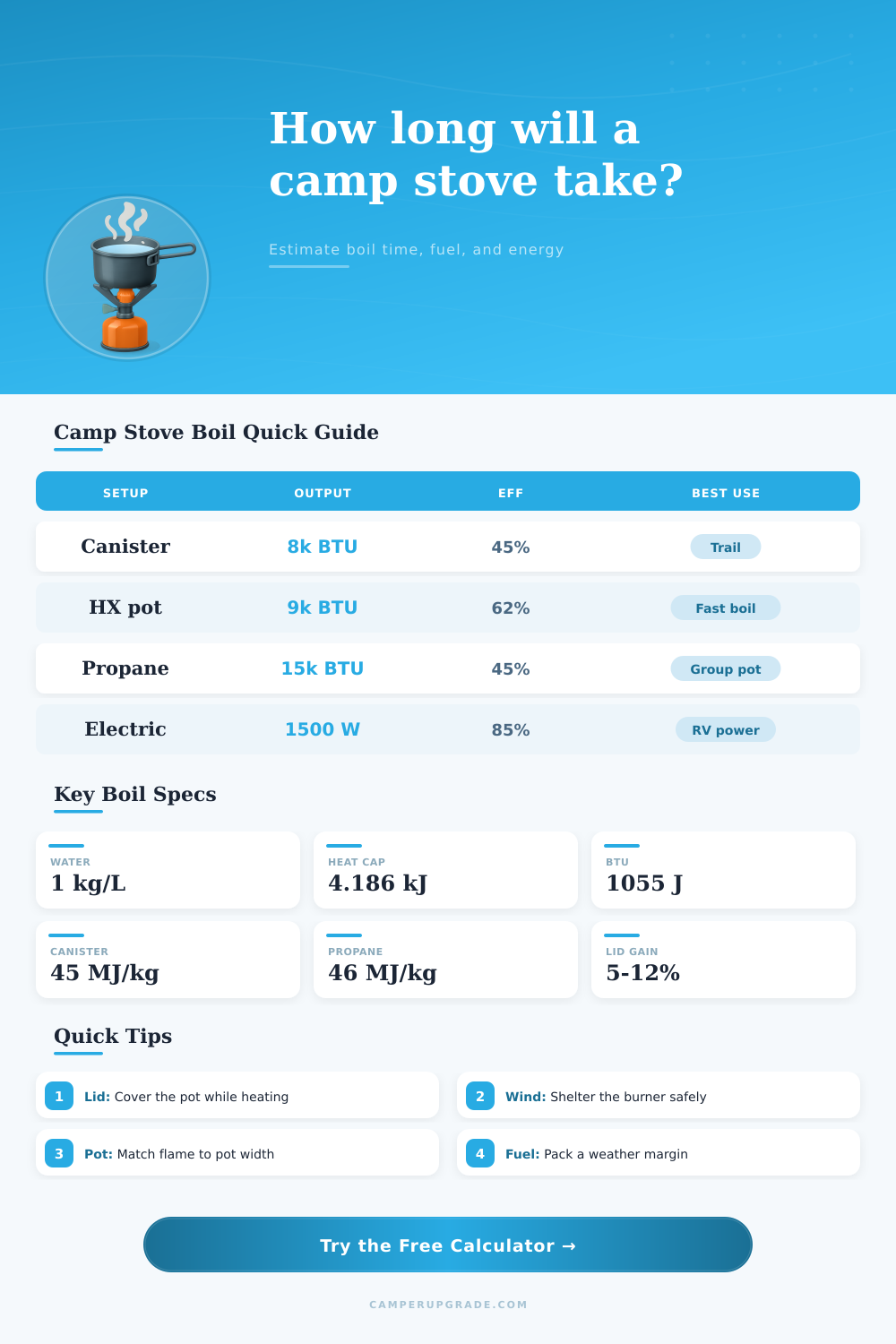
📊Stove and Pot Spec Grid
🌡Altitude Boiling Point Table
| Altitude | Approx boiling point | Boil-time effect | Cooking note |
|---|---|---|---|
| 0 ft / 0 m | 212 F / 100 C | Highest final heat target | Sea-level baseline for stove tests |
| 1000 ft / 305 m | 210 F / 99 C | Very small reduction | Most recipes behave normally |
| 3000 ft / 914 m | 206 F / 97 C | Slightly less energy to boil | Cold start temperature still dominates |
| 5000 ft / 1524 m | 203 F / 95 C | Noticeably lower target | Common mountain campground range |
| 7000 ft / 2134 m | 199 F / 93 C | Lower boil temperature | Food hydrates more slowly |
| 9000 ft / 2743 m | 195 F / 91 C | Less heat to reach boil | Protect the flame from wind |
| 11000 ft / 3353 m | 192 F / 89 C | Cooler rolling boil | Plan longer soak or simmer time |
| 13000 ft / 3962 m | 188 F / 87 C | High-country target | Use a lid and efficient pot |
| 15000 ft / 4572 m | 185 F / 85 C | Extreme camp altitude | Weather margin matters more |
⛽Stove Output and Fuel Reference
| Stove or heat source | Typical output | Practical efficiency | Best use |
|---|---|---|---|
| Small upright canister stove | 7000-10000 BTU/hr | 35-55% | Solo or two-person pots in sheltered spots |
| Remote canister stove | 8000-12000 BTU/hr | 40-58% | Better stability and careful wind protection |
| Integrated heat exchanger system | 5000-9000 BTU/hr | 55-72% | Repeated water boils and fast trail meals |
| Two-burner propane camp stove | 10000-20000 BTU/hr | 35-55% | Group cookware and family camp kitchens |
| Alcohol stove | 1000-2500 W equivalent | 25-45% | Simple solo boils with patient timing |
| RV electric kettle | 1000-1800 W | 80-90% | Shore power, generator, or inverter cooking |
| Fuel type | Energy content used | Calculator output | Planning note |
|---|---|---|---|
| Isobutane canister | 45 MJ/kg | grams and ounces | Cold can reduce delivered stove output |
| Propane | 46.4 MJ/kg | grams and ounces | Reliable for cool car-camping conditions |
| White gas | 44 MJ/kg | grams and ounces | Good for cold trips and longer expeditions |
| Alcohol fuel | 21 MJ/kg | grams and fluid ounces | Lower energy density than gas fuels |
| Butane cartridge | 45.7 MJ/kg | grams and ounces | Best in mild weather and picnic burners |
| Electric power | 3.6 MJ/kWh | Wh and kWh | Compare with usable battery and inverter capacity |
🍳Pot Material Reference
| Pot material | Heat-up allowance | Transfer factor | Best fit |
|---|---|---|---|
| Thin aluminum camp pot | Low | Fast heat transfer | General backpacking and compact camp cooking |
| Hard-anodized aluminum | Low to medium | Steady heat transfer | Durable trail pots with good boil performance |
| Titanium backpacking pot | Very low | Small transfer penalty | Ultralight small-volume boiling |
| Stainless steel pot | Medium | Moderate transfer | Durable group pots and camper kitchens |
| Heat exchanger pot | Medium | Improved capture | Fast repeated boils and fuel savings |
| Electric kettle | Medium | Very efficient coupling | RV shore power, inverter, or power station use |
| Heavy cast iron pot | High | Slow heat-up | Not ideal for quick water boiling |
📋Water Volume Planning Table
| Use case | Typical water | Boil sensitivity | Setup advice |
|---|---|---|---|
| Coffee or tea for one | 0.4-0.6 L | Very sensitive to wind | Small pot, lid on, sheltered flame |
| Freeze-dried meal | 0.45-0.75 L | Cold water changes time | Stop at boil and hydrate off-stove |
| Two-person dinner | 1.0-1.5 L | Pot efficiency matters | Use a lid and steady flame |
| Group pasta pot | 2.0-4.0 L | Burner output matters | Use wide stable cookware |
| RV kettle fill | 1.0-1.7 L | Power draw matters | Check inverter surge and circuit limits |
| High camp bottle fill | 1.0-2.0 L | Weather margin matters | Use efficient pot and safe shelter |
Efficiency in the kitchen is determined by several specific variable. Each of these variables have an impact upon the time it takes for a stove to boil a specific amount of water. Wind, the altitude at which the stove is burning, the shape of the pot that is being used to boil the water, and the starting temperature of the water influence the time it takes for water to reach a boil.
Each of these factors must be understood because each of these factors impact the amount of heat that is provided to the water, and each of these factors impact the length of time that must pass until the water reach its boiling point. The volume of water that is to be boiled is one of the primary factor that influence the length of time that it will take for that water to reach a boil. The amount of water that must be boiled is a variable that must be accounted for in the cooking plan.
What Affects Boiling Time on a Stove
Many cooks may underestimate the amount of water that they will need to boil. If such a situation occur, the stovetop will take longer to boil the water then those plans were made for. The starting temperature of the water is another of the primary factor that will impact the length of time that it will take for the water to reach a boil.
The starting temperature of the water will impact the amount of heat that the stove will provide to the water in order to reach the boiling point. If the starting temperature of the water is forty degrees, for instance, the stove will need to provide more heat to that water to reach its boiling point than it will need to provide to water that starts at a temperature of sixty degrees. Thus, the lower the starting temperature of the water, the more longer it will take for that water to reach its boiling point.
Another of the factors that will impact the amount of time that it takes for water to boil on a stove is the altitude at which that stove is burning. At higher altitudes, the water will boil at a lower temperature. Because the water will boil at a lower temperature, the stove will have to provide less energy to the water in order to boil it.
However, this lower temperature of the boiling water will mean that less of the water will be effective at tasks like rehydrating meals that have been dehydrated or killing pathogen that may be contained within the water. In order to account for the different boiling points that exist at various altitudes, it is helpful to utilize a calculator that will determine the boiling point of water at the altitude at which the stove is burning. Another of the factors that will impact the efficiency of a stove is the effect that wind will have upon that stove.
The wind will reduce the efficiency with which the stove can effective heat the water within its pot. Even with a moderate breeze around the stove, the stove may not be able to effectively heat the water within the pot. However, if a cook places a lid upon the pot, some of the efficiency of the stove can be regained.
Using a lid will increase the efficiency of the stove because the lid will reduce the amount of water that evaporates from the pot, and it will also reduce the cooling effect of the moving air. Another of the factors that will impact the efficiency of the stove is the material of the pot itself. For instance, titanium pots will heat the water more quickly than stainless steel pots, especially with larger amount of water.
Another of the factors that will impact the length of time it takes for water to reach a boil is the type of fuel that is used to heat the stove. For instance, alcohol stoves tend to be lightweight and simple in their design and function. However, because alcohol has a lower energy density than other fuels, alcohol stoves will take longer to heat the same amount of water to its boiling point as other type of stoves.
Using electric kettles will eliminate the variables of wind and altitude. However, in this case, it is important to account for the life of the battery of the kettle and any limits that the inverter may have. A calculator can help to account for each of the fuel types and help cooks to create a plan before beginning their trip into the wilderness or camping area.
In addition to each of the factors that can impact the time that it takes to boil water on a stove, it is also important for cooks to recognize that the estimated time to boil water will not always be met. The fuel tanks for camping stoves, for instance, may become cold. Additionally, there may be wind gusts that change the direction of the flames of the stove’s burner.
There may also be a need to boil more water than that which was estimated for such task. In such cases, cooks should of calculate the time that it will take to perform the task under estimated parameters, but also add some extra time to the task to account for these unknown variable. By understanding how each of these factors interacts with each other, cooks will be able to make better decisions about the tasks that they perform in the kitchen.
Furthermore, if cooks understand how each of these variables interact, they will be sure to be prepared for the length of time that it will take for the water to boil.