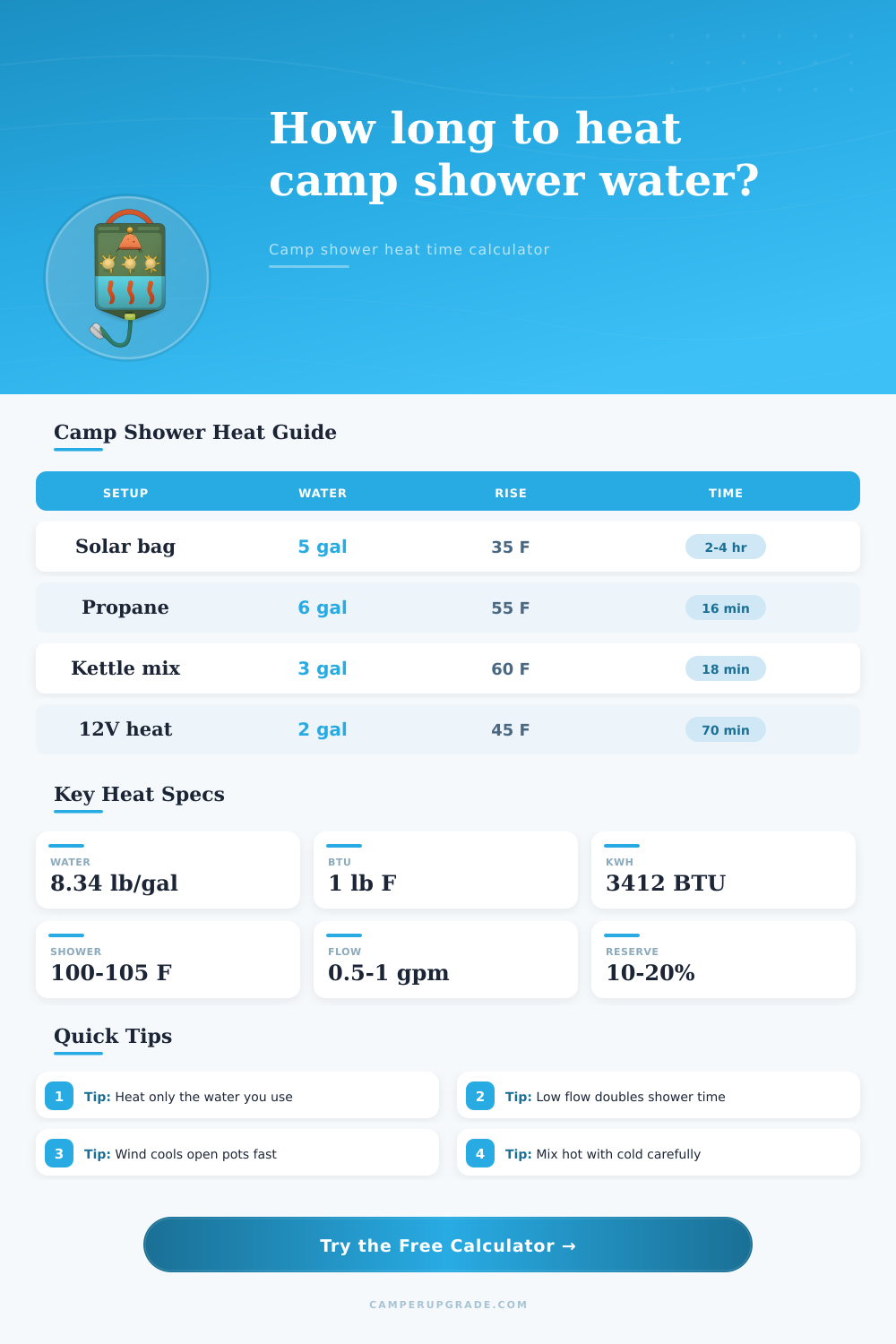
Camp Shower Water Heat Time Calculator
Estimate how long it takes to heat camp shower water from starting temperature to a usable shower temperature, with fuel or battery draw, shower minutes, reserve water, and mixing guidance.
🏕Camp Shower Presets
🚿Water And Heater Inputs
Count everyone sharing the same heated water batch or heater recovery cycle.
Use the actual heated volume, not the tank size unless the whole tank is cold.
Creek, jug, and tank water can be much colder than the air temperature.
Many camp showers feel comfortable around 100 to 105 F at the nozzle.
The calculator converts watts and BTU/hr into heat delivered over time.
Enter watts for electric mode, or BTU/hr for propane/stove mode below.
This only changes custom output; presets already include their units.
Covered pots and tank heaters are higher; open windy pots are lower.
This accounts for cooling into pots, hoses, bags, and surrounding air.
High elevation can slow practical boil-and-mix routines.
Low-flow camp shower heads often run 0.4 to 0.8 gallons per minute.
Navy shower style: wet down, pause, soap, then rinse.
Use 0 if heating the entire batch to final shower temperature.
Reserve covers priming, spill, hose water, and a final hand rinse.
This planning tool estimates heat time from water heat capacity. Always test the water before showering, especially when mixing kettle-hot water with cold water.
Camp shower heat estimate
📌Camp Shower Quick Specs
Target minus starting water temp.
Warm flow time per shower.
Batch volume before cold mixing.
Output after efficiency.
📊Heat Source Reference
| Camp heat source | Typical output | Efficiency range | Best use |
|---|---|---|---|
| Solar shower bag in full sun | 300 to 900 BTU/hr gain | Weather dependent | Slow daytime warming for low-flow rinses |
| Small propane portable heater | 8,000 to 12,000 BTU/hr | 70 to 85% | Quick single or duo shower batches |
| Camp stove with covered pot | 5,000 to 9,000 BTU/hr to water | 45 to 70% | Heating a pot, then mixing in a bucket |
| RV 6 gallon water heater | 8,800 to 12,000 BTU/hr | 65 to 80% | Tank recovery between short showers |
| 12V immersion element | 150 to 300 W | 80 to 95% | Small jug warming when time is available |
| Shore power element | 1,000 to 1,500 W | 85 to 98% | Campground hookups and insulated tanks |
🌡Temperature And Flow Planning
| Shower target | Feel at nozzle | Use case | Planning note |
|---|---|---|---|
| 95 F / 35 C | Lightly warm | Hot weather rinse | Fast to heat, but cools quickly in wind |
| 100 F / 38 C | Warm | Most summer camp showers | Good balance for low-flow rinsing |
| 105 F / 41 C | Very warm | Cool evenings and hair washing | Needs more energy and careful testing |
| 110 F / 43 C | Hot | Mixing with colder water | Use caution; do not shower directly if too hot |
| 0.4 gpm / 1.5 Lpm | Very low flow | Conservation rinse | Five gallons can last about 12 minutes |
| 1.0 gpm / 3.8 Lpm | Generous camp flow | Fast rinse | Five gallons lasts about 5 minutes |
🧮Water Volume Examples
| Setup | Water volume | Low-flow minutes | Typical people |
|---|---|---|---|
| Compact solar bag | 2.5 gal / 9.5 L | 4 to 6 min | One quick rinse |
| Standard shower bag | 5 gal / 19 L | 7 to 12 min | One to two people |
| Bucket shower | 4 gal / 15 L | 6 to 10 min | One careful shower |
| RV small tank | 6 gal / 23 L | 8 to 15 min | Two short showers |
| Family jug batch | 10 gal / 38 L | 15 to 25 min | Three to four rinses |
| Basecamp tote | 15 gal / 57 L | 22 to 37 min | Group rinse station |
💡Camp Shower Heat Tips
If you are camping without a shower it’s all about the math. Time, heat source and amount of water available needs to be considered. And once you plug in that element or start the fire, if your water isn’t properly matched with your heat source, then you’re only going to get so clean before impatience or chilly conditions sets in. It takes X energy to raise water by a certain degree. This is true no matter what.
But when you start adding variables in it starts to get interesting. How hot did all that water got? What percentage does the hose or the wind suck out of the tank? And how much cold do I have to throw into the tank to make it warm enough to take a shower? To figure out those answers, you simply plug in your heater output, your water volume, starting temp, and desired end temp on this calculator. Then it tells you how long it’s gonna be till you’re done. Those inputs tells you whether your setup will finish before dinner or not.
How to Calculate Your Camp Shower Time
The efficiency setting is more significant than most realize. Seventy percent of the energy output of your burner may end up warming the water if it’s a still night and the pot has a cover; a breeze can cut down that efficiency into the fifties, as heat escapes through the sides and steam rise away from the pot. The tool factors this loss adjustment in and makes the estimate without forcing you to guess at how much wind is blowing. Higher elevation hurts too; lower air pressure change how stoves work and causes more heat loss from exposed pots. It all combines to make an accurate estimate for real-world camping conditions instead of lab-perfect situations.
New campers are frequently surprised by interaction between shower length and flow rate. High flow is nice… Until it runs out halfway through the second person’s shower. Reducing your flow makes the water last a lot longer; you’re stretching the same heated gallons across more minutes. Likewise, the reserve percentage helps with other usage: the initial priming water, a quick hand rinse, and any water that cools in the line all use some water before anyone steps under the nozzle. These little uses add up, and if you don’t account for them, then you’ll find yourself without any hot water too soon.
Heating time is fuelled. Propane heaters give more energy in every pound, but lose some to their surroundings; electric elements are more efficient at converting but drain limited battery capacity. The calculator translates both to roughly equivalent units, and allows you to see whether you have sufficient resources to power as many showers as desired.
What’s cool though, is that you can test it against other conditions. How long will it take to heat it up in sun-warmed jugs compared to creek water? How fast does it recover its heat when you shrink down the batch size? What these comparisons do is show you what’s really constraining the process. Is it the heater itself or just that you don’t want to lug around that much water to heat? That’s where this experiment gets the most bang for the buck.