Camp Shower Duration Calculator
Estimate shower minutes, gallons or liters used, refill timing, and group capacity from tank size, shower flow, spray time, people, and camping shower style.
🏕Camp Shower Presets
⚙Water, Flow, People, and Time Inputs
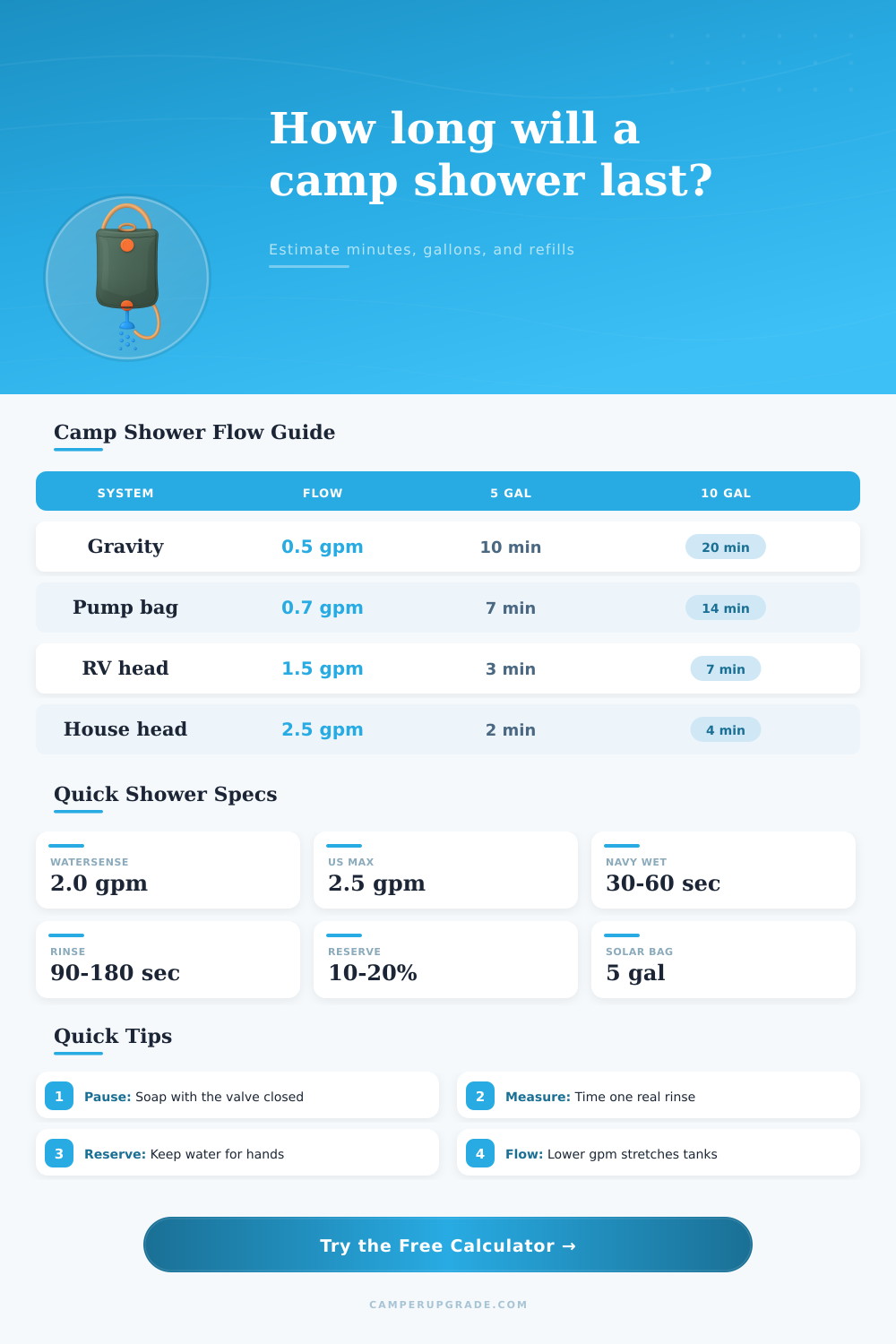
Flow math uses gallons per minute multiplied by active spray minutes. Federal showerhead flow is capped at 2.5 gpm in the United States, while WaterSense labeled showerheads use no more than 2.0 gpm.
📊Shower Flow Reference
🚿Shower System and Spec Comparison
Solar gravity bag
0.5 gpmSimple hanging bag flow; a 5 gal bag gives about 10 spray minutes before reserve.
USB pump shower
0.7 gpmSteadier pressure from a bucket or jug, usually good for navy-style rinses.
RV shower head
1.5 gpmComfortable flow with a shutoff valve; tank capacity matters more than pressure.
Propane camp unit
1.2 gpmHot-water comfort can increase spray time unless the valve is used actively.
📋Duration and Flow Tables
| Flow Type | Typical Flow | Water in 3 Min | Water in 5 Min |
|---|---|---|---|
| Foot pump rinse | 0.3 gpm | 0.9 gal | 1.5 gal |
| Gravity camp bag | 0.5 gpm | 1.5 gal | 2.5 gal |
| Portable pump | 0.8 gpm | 2.4 gal | 4.0 gal |
| RV low-flow head | 1.5 gpm | 4.5 gal | 7.5 gal |
| Federal max head | 2.5 gpm | 7.5 gal | 12.5 gal |
| Water Supply | 0.5 gpm | 0.8 gpm | 1.5 gpm |
|---|---|---|---|
| 5 gal bag | 10 min | 6.3 min | 3.3 min |
| 10 gal jug | 20 min | 12.5 min | 6.7 min |
| 20 gal tank | 40 min | 25 min | 13.3 min |
| 40 gal RV tank | 80 min | 50 min | 26.7 min |
| 60 gal tank | 120 min | 75 min | 40 min |
| Shower Pattern | Spray Time | At 0.8 gpm | Best Use |
|---|---|---|---|
| Foot rinse | 45 sec | 0.6 gal | Sand and mud |
| Navy quick | 2 min | 1.6 gal | Solo camping |
| Navy full | 3.5 min | 2.8 gal | Hair wash |
| Continuous short | 5 min | 4.0 gal | RV shower |
| Continuous long | 8 min | 6.4 gal | Large tank only |
| Reference | Flow | Meaning | Calculator Use |
|---|---|---|---|
| US max | 2.5 gpm | Legal showerhead limit | High-flow check |
| WaterSense | 2.0 gpm | Efficient label limit | Home-head compare |
| RV low-flow | 1.2-1.8 | Common shutoff head | Tank shower |
| Camp pump | 0.6-1.0 | Bucket pump range | Portable shower |
| Gravity bag | 0.4-0.7 | Height driven flow | Solar bag |
💡Camp Shower Calculation Tips
When you are traveling in the backcountry, you must manage your limited supply of water for bathing purpose. Many people experience anxiety about their supply of portable water because they is often concerned that they may run out of water while using soap to bathe. However, if you understand your water budget, you can enjoy cleanliness without having to worry about run out of water.
Many people tend to significantly overestimate how much water they have for their trip. This is because when people sees the total volume of the water container, they tend to assume that they can use all of the water. However, a five-gallon container of water can become depleted quite quick when people use containers with high flow rates.
How to Save Water for Showers When Camping
The flow rate of the water will significantly impact how long the water will last. Using a calculator will allow individual to determine the flow rate of their water container to ensure they are not guessing at the amount of water that they will have available on there trip. There is a significant difference between using a gravity bag versus using a motorized pump.
A gravity bag will use the weight of the water in the bag to create a stream of water from the bag. These create a slow trickle of water from the bag. A motorized pump will create a forceful spray of water from the tank.
However, using a motorized pump will deplete the water from the tank at a significantly higher rate then a gravity bag. For individuals with a small water tank, using a low flow rate is beneficial because it will allow the water to last the individual for more longer. The Navy method of taking a shower is one of the best methods to use your water for showering.
The Navy method involve wetting your body in the shower, turning the water off while you are lathering up with body soap, and then turning the water back on to rinse your body off. This method is efficient because it reduce the amount of time that the water is continuously spraying against your body. By using this method, it is possible to separate the time that you wet your body from the time that you rinse off of the body soap.
This will allow you to calculate how many individual can utilize the water before the water tank become depleted. In addition to the water that you use to wet your body and rinse it off, there are other amounts of water that you must account for. All water containers has a dead zone of water that remains at the bottom of the container and cannot be utilized.
There is also water that gets wasted when you direct the water down a hose or when it miss your body. These amounts of water are important to account for because they will reduce the total amount of water that is available for your showering need. When planning for a group of individuals, you must account for the number of individuals who will be using the water.
While one individual using the water is manageable, a group of four individuals can quickly deplete the water in the water tank. It is important to calculate the number of shower per person per day instead of simply the total amount of gallons of water in the container. Additionally, if the travelers in the group include children or pets, the travelers will need to adjust the number of showers to account for the additional amount of water need to bathe these individuals.
If the water container includes a propane heater for the water or if it is an RV tank, people may be tempted to use the continuous spray style for the showerhead. This style involve leaving the water valve open for the entire time that you are taking the shower. Using this style will significantly reduce the number of showers that you can have before the water supply becomes depleted.
It is better to use the Navy method instead of the continuous spray style so that the water supply will last you for a longer period of time. To calculate your water needs accurately, you should measure the gear that you will be using to carry and dispense the water. The flow rates that the manufacturers of your gear describe may not necessarily be the same as the water that you can dispense from your tank.
By measuring the flow rate, you can ensure that the number that you use to calculate your water needs is the most accurate number. Based off your measured flow rate, you can use reference tables to determine whether you need a larger water tank or different habit with your scrubbing of the body. There is a need for individuals to have foresight in managing their water supply.
By planning how you are going to use the water that you have brought into the backcountry, you can ensure that you do not run out of water while you are bathing. By planning your water usage, you can remain clean and comfortabley during your trip while also avoiding the stress that can be caused by an empty water tank.