Camp Setup Time Estimate Calculator
Estimate the minutes from parking to camp-ready using shelter type, crew size, site conditions, utilities, kitchen setup, daylight, weather, and gear complexity.
⛺Named Camp Presets
📋Camp Setup Inputs
Formula: task minutes are adjusted for crew efficiency, site difficulty, light, weather, carry distance, loose gear, experience, children, and the selected planning buffer.
Estimated Camp Setup
⚙Gear Time Factor Grid
📊Reference Tables
| Shelter or Rig | Baseline Minutes | Includes | Typical Crew |
|---|---|---|---|
| Backpack tent | 18 | Tent body, fly, pad, sleep kit | 1 to 2 |
| Car camping tent | 26 | Tent, stakes, bedding, chairs | 2 |
| Large family tent | 34 | Large tent, cots, interior layout | 2 to 4 |
| Roof-top tent | 22 | Level vehicle, deploy tent, bedding | 1 to 2 |
| Teardrop trailer | 32 | Park, stabilize, galley, sleep area | 2 |
| Truck camper | 36 | Level, utilities, steps, cabin prep | 1 to 2 |
| Class B camper van | 24 | Level, power, interior reset | 1 to 2 |
| Travel trailer | 46 | Back in, level, chock, utilities | 2 to 3 |
| Fifth wheel or toy hauler | 58 | Hitch release, jacks, ramps, utilities | 2 to 4 |
| Group tent camp | 72 | Multiple tents, kitchen, shared zones | 4 to 8 |
| Site Condition | Time Modifier | Why It Changes Time | Best Use |
|---|---|---|---|
| Paved pull-through | -8 min | Minimal positioning and leveling | Overnight RV stops |
| Level back-in | +2 min | Small backing and alignment check | Campgrounds |
| Standard gravel | +6 min | More leveling and mat placement | Most public sites |
| Primitive flat | +10 min | More layout choices and carry distance | Dispersed camping |
| Sloped or uneven | +18 min | Blocks, tent orientation, safety checks | Older campgrounds |
| Tight tree-lined | +20 min | Slow backing, branch and awning checks | Forest sites |
| Soft sand or loose soil | +24 min | Traction, staking, stabilizer pads | Beach or desert |
| Added Task | Baseline Minutes | Labor Type | Notes |
|---|---|---|---|
| Leveling or stabilizers | 14 | Sequential | Usually limits the whole setup pace |
| Water hookup or jug fill | 8 | Parallel | Can overlap with interior setup |
| Electric or solar setup | 7 | Parallel | Includes cord, panel, or battery station |
| Sewer or gray tank setup | 9 | Sequential | Keep separate from food tasks |
| Awning, tarp, or shade | 16 | Parallel | Wind can move this to critical path |
| Pet or child boundary | 8 | Parallel | Best assigned to one person |
| Fire ring and seating zone | 10 | Parallel | Includes chairs and safe spacing |
| Bedding or sleep systems | 12 | Parallel | Cots, pads, bags, pillows |
| Safety walkaround and locks | 6 | Sequential | Final check before relaxing |
| Common Setup | Fast Crew | Average Crew | Difficult Arrival |
|---|---|---|---|
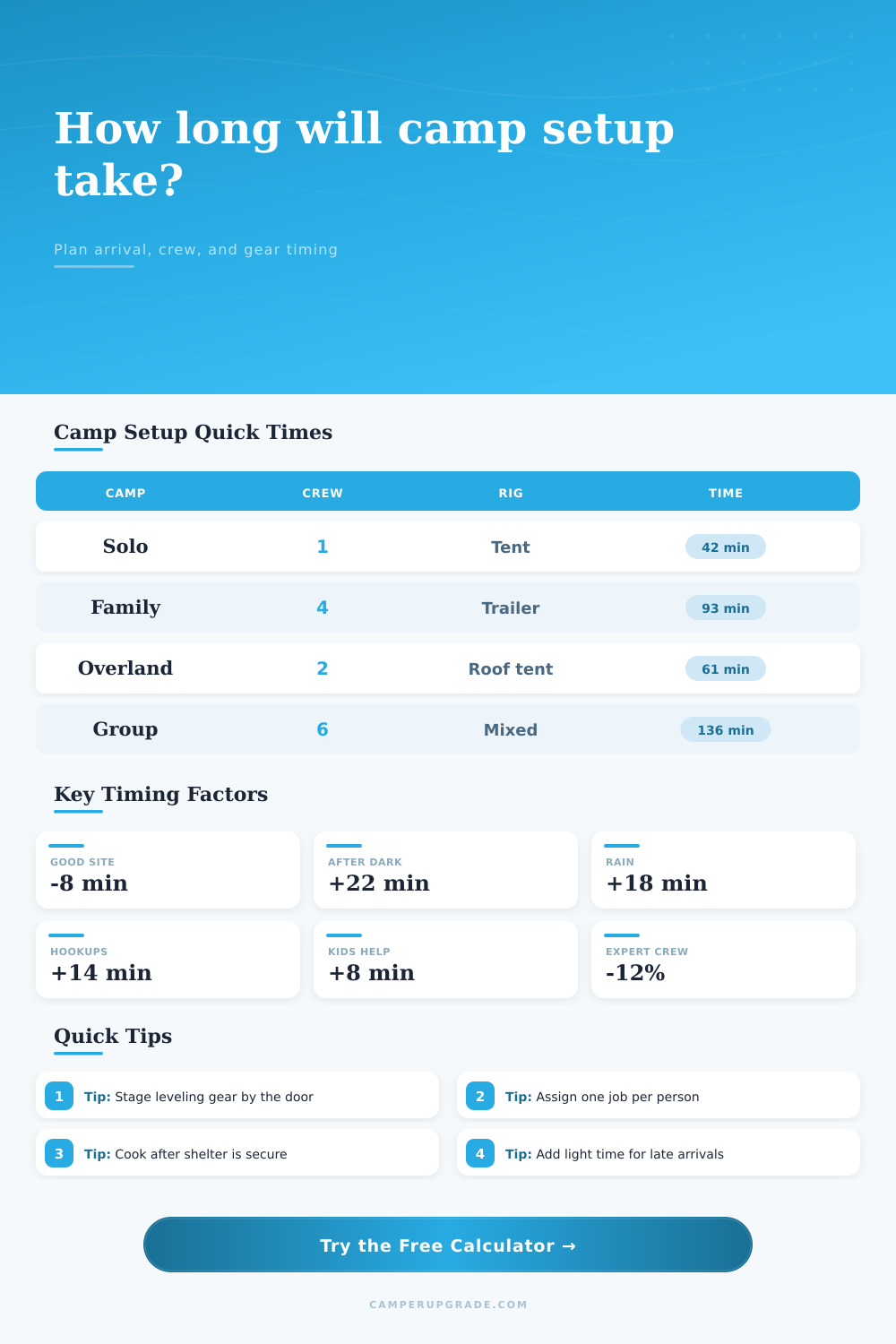
| Solo tent, simple kit | 28 min | 42 min | 64 min |
| Two-person roof tent | 35 min | 55 min | 82 min |
| Family tent campsite | 61 min | 88 min | 128 min |
| Travel trailer with hookups | 69 min | 96 min | 142 min |
| Toy hauler basecamp | 92 min | 126 min | 181 min |
| Scout or group tent area | 98 min | 138 min | 198 min |
💡Setup Timing Notes
With just twenty minutes of sunlight remaining, you’re pulling into the campsite, yet your trailer won’t back in straight. It’s dark now. The sun is sinking past the tree line. The dog are waiting and the kids is hungry. This will be a relaxing vacation… Or a chaotic scramble to escape the cold.
For novices, setting up time isn’t even on their radar, but it’s the one greatest factor in making that first night feel more like a retreat then a work shift. Enter your crew size, rig type, and site conditions, and the calculator above will do the math for you so you don’t have to guess how long it takes to get from parking to ready.
Why Setting Up Camp Takes Time
The thing most folks think: that adding someone else will cut your setup time in half? It doesn’t. Because there’s a physical maximum to what you can do at the same time, the tool take into account that truth and treats these key path elements (hookups, leveling) as serial bottlenecks. Sure, add four adults to the mix, but only one person can stands behind the brake while another backs them in. That’s where folks err. The reference table on this page explains why a fifth wheel/toy hauler begins at fifty-eight minutes no matter who drives. That baseline represent the non-negotiable physical labor, such as hitching/unhitching, lowering jacks/stabilizing, and alignment checks.
After those big-ticket items, everything else can be done at the same time: While someone sets up awning, another unloads kitchen bins. This is why crew size matter. If two people set up camp together, one can do the awning while the other unpacks. Because first-timers are a mixed bag (more hands on deck = more help, but more supervision required), the inputs let you list adults and children separately. That’s how the calculator includes a bit of supervision lag in its estimate, so it stays real-world.
And then there’s the environment. Eight minutes can be shaved off if site is a paved pull-through, where all you do is pull in; no maneuvering required. But soft sandy soil? It take twenty-four minutes because stabilizers sink into loose soil and stakes aren’t secure. You start reading the ground before getting out of car.
And then there’s weather; both for comfort as well as mechanics. Add eighteen minutes if it’s raining: you’re moving slower, fighting with slippery zippers, opening doors wider. Worse is wind. It makes you go against grain, having to deal with the tarp and awning first thing, before you’ve even got anything unpacked, disrupting your naturaly flow.
Add an extra twenty-two minutes if you arrive in the dark. Give your eyes some time to adjust (trust me, this is no joke). There’s nothing worse than stumbling on a step or failing to find a stake hole in the dark. To reflect this lack of confidence and slower cognitive processing, the tool can be adjusted for dusk, daylight, or even after dark arrival. It’s little, but it counts when you’re tired.
The most honest feature is maybe the planning buffer slider. Life happens. You forgot to bring coffee maker; you realized that water hose was kinked. That’s not pessimistic; that’s realistic. Ten to fifteen percent is respect for the chaos of outdoor living.
The ultimate time estimate lets you know not only how much time you’re looking at working, but also when you’ll get to sit down. So if you get there at four and result reads camp-ready at eight-thirty PM, you know you’ve got four hours‘ work in front of you. That changes what you pack. Maybe you set out the leveling blocks near the door so nobody has to go back for them. Maybe you divvy up tasks, so no one is standing idle waiting on someone else. It’s not about logging minutes; it’s about getting back that first night of the trip.
As soon as possible, you want to go from being a camper to being a guest. Fear goes away once you know the variables. Then you aren’t in a hurry anymore. Now you set things up with intention. And by dark, there you are: In your chair, not still in your raincoat, holding on to a tent pole. You should of planned for this.
This luxurios site is perfect. If you recieve the email early, it helps. We saw two adult-sized sofa sitting near the fire. It was moddern and comfortabley.