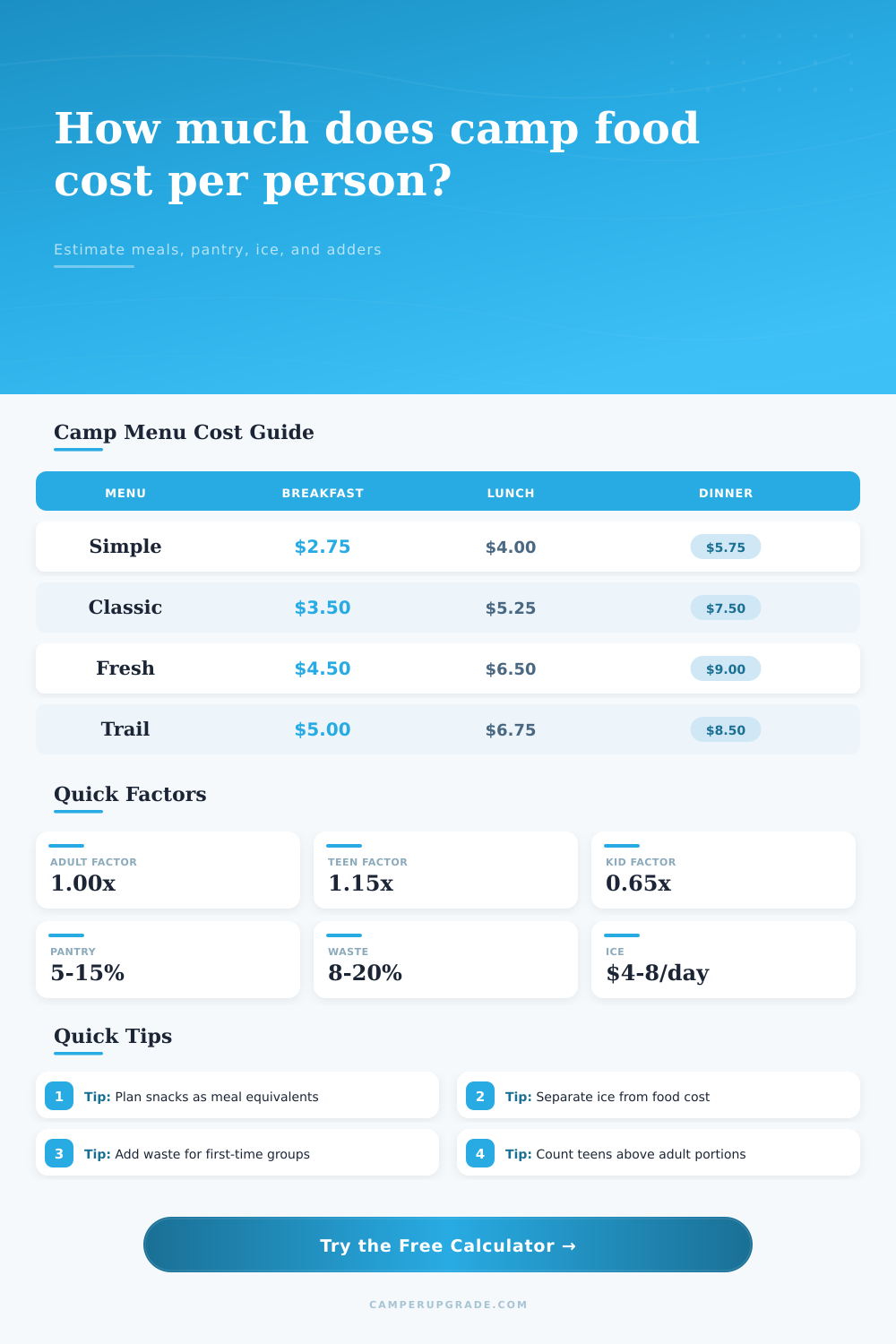
Don’t just calculate how much food each person needs; adjust for their actual appetites so you have enough. This helps you avoid buying too much or to little. Even though kids, teens and adults may sits at the table together, they don’t eat the same amount. If you share items or anticipate some spoilage, it gets tricky. Then add in the ice needed to chill dairy etc., and that makes it even more difficult.
Use an estimation tool to determine how much food you’ll need so you don’t go hungry during the trip. How does it work? It takes your party and turns them into adult-equivalent serving. Active adults or teens will burn more calories while hiking so they’ll also eats more. To account for this plus increased appetite from chilly weather nights, multiply the amount per person by 15 percent. Young children won’t eat as much food so figure them at only thirty-five percent of what an adult would eat. Put everyone’s age into the calculator and it will do the math for you. It makes things really easy when grocery shopping because it converts different appetites down to one number.
How to Plan Food and Budget for Camping
Convenience and price depend on what’s on the menu. For example, a menu of oatmeal, rice, and peanut butter is cheap, easy, and takes a long time to shop for. Less refrigeration space are needed. A menu with deli meats, cheese, and fresh eggs is pricier and riskier. Unless there’s a solid cold chain, that fresh food spoils. A quick grocery run becomes a wasted-food issue if the ice in your cooler melt before the end of the day.
The daily ice expense needs to be factored in. Resetting the ice several times over five days doesn’t seem like much until it becomes part of the budget calculation.
A second invisible expense is shared items. Paper towels, spices, oil, aluminum foil… These are things that don’t increase at same rate as the number of people. If you’re cooking for just two, you still have to purchase an entire bottle of oil. If you’re cooking one meal and need a bit of foil, you’re still going to get a whole package. The extra cost of purchasing in full packages should of about 10-15% and that’s your buffer. Otherwise, you think your budget is fine on paper, but it won’t work out in the store.
It cuts into your budget: When you’re on a camping trip you don’t have a lot of wiggle room for wasted food. There’s shrinkage (hello, meat!), spilled milk and lost food. Novice campers will assume no-wasted = no problem. Seasoned campers know that logistics never work out just so and include a buffer (fifteen to twenty percent) in their budgets. Better to be overstocked than hungry.
For more complex diets, this complicates things even more. Allergies and vegetarian preferences can mean you can’t simply swap one item for another. Cross-contamination can require two items rather then one, doubling the price of those meals.
With this tool, you can see what the total cost will be for the trip as well as how much that will be per day per person. That last one (the per-day-per-person) is the one I use most. Before heading out to the campsite, I can see if my menu will work. Is it too high? Then go back through and look at your menu type or waste buffer. Is it too low? Look at your ice estimate. You’re not trying to reach an exact dollar amount; you just want to know where your money is going.
Most folks overestimate the convinience of bulk purchases and underestimate cooler upkeep. Properly weighing your group also factors in hidden expenses such as spoilage and packaging. It turns the guessing game into planning.
At the end of the trip, your wallet won’t feel like Swiss cheese, your cooler won’t be empty, and your belly will be full of a good meal.