Camp Lantern Fuel Duration Calculator
Estimate how long camp lantern fuel will last from fuel type, container size, BTU draw, dimming level, cold delivery loss, nightly burn time, and reserve margin.
⛺Lantern Fuel Presets
🔥Lantern and Fuel Inputs
The calculator converts each fuel to BTU, then compares that energy with lantern draw.
Use weight units for pressure canisters and volume units for liquid fuel bottles.
For a 1 lb propane bottle enter 16 or 16.4 ounces by weight.
Use BTU per pound, gallon, liter, or other selected unit as appropriate.
Small mantle lanterns may be near 1000 to 1800 BTU/hr; bright dual mantles are often higher.
Count every lantern drawing from the planned fuel supply.
Lantern valves are not perfectly linear, but dimming usually extends runtime.
Loss reduces usable energy, especially for small pressure canisters in cold weather.
Use this for partially used bottles, canisters, or refillable tanks.
Count actual lantern-on hours, not just dark hours.
The result compares your fuel against planned nights plus reserve.
Reserve covers colder-than-expected nights, extra table time, and mantle changes.
Add arrival setup, repairs, storm waiting, or a final packing night.
This helps flag whether your planned pack count covers the schedule.
Fuel values are planning estimates. Follow lantern instructions, ventilate combustion lanterns, and never run fuel lanterns inside a sealed tent or vehicle.
Lantern fuel duration estimate
📊Live Fuel Snapshot
🔢Calculation Steps
📘Fuel Energy Reference
| Fuel type | Energy estimate | Best unit to enter | Planning note |
|---|---|---|---|
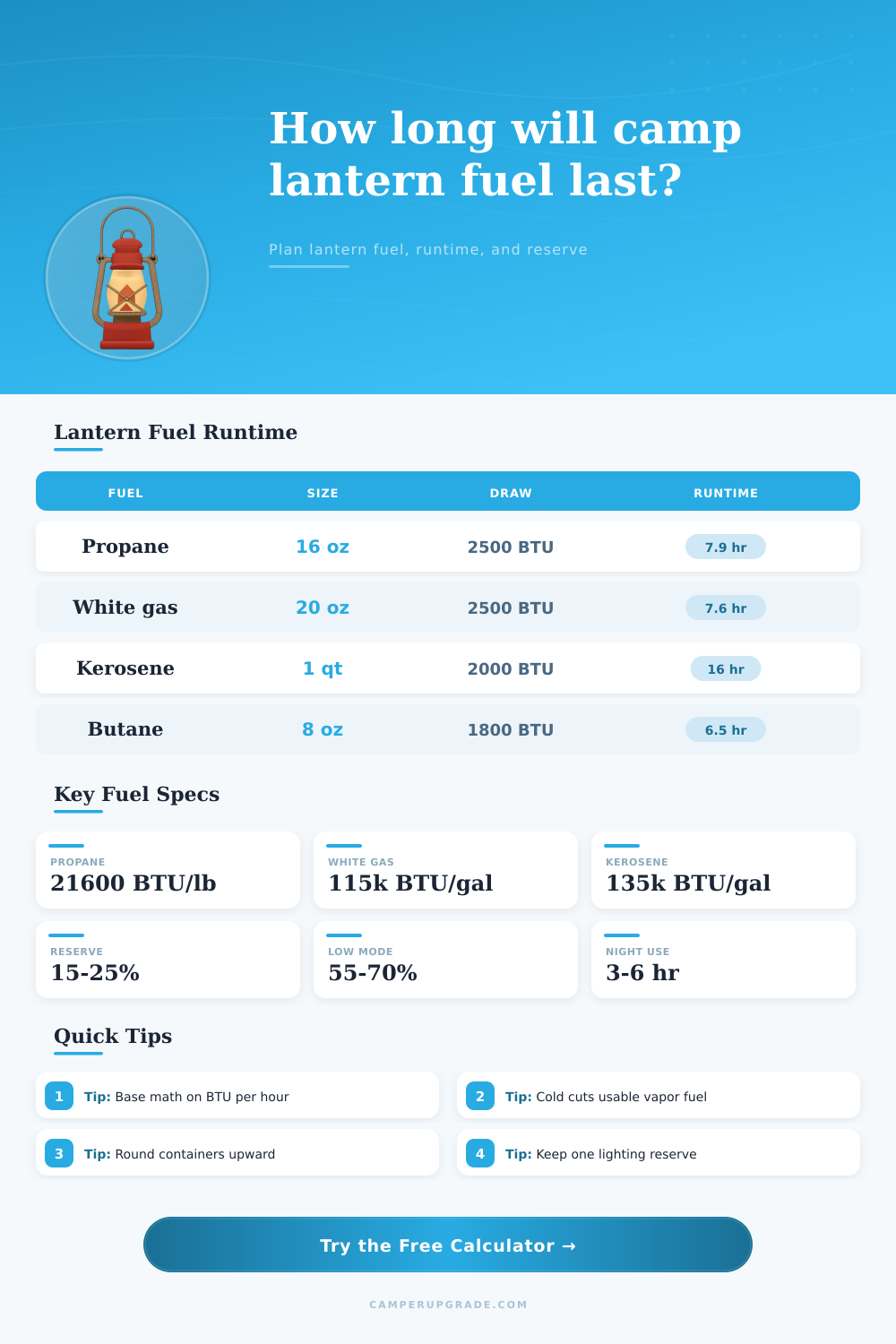
| Propane | About 21,600 BTU/lb | Ounces or pounds by weight | Common 1 lb bottles are easy to count; cold can reduce vapor delivery. |
| White gas / camp fuel | About 115,000 BTU/gal | Fluid ounces, quarts, or liters | Works well for refillable liquid fuel lanterns and cold-weather camps. |
| Kerosene | About 135,000 BTU/gal | Quarts, liters, or gallons | High energy density, but lanterns must be designed and maintained for it. |
| Lamp oil / paraffin oil | About 125,000 BTU/gal | Fluid ounces or liters | Often used in wick lanterns with lower light output and long burn times. |
| Butane | About 21,300 BTU/lb | Ounces, grams, or cartridge weight | Fine in mild weather; vapor pressure drops sharply in cold. |
| Isobutane mix | About 21,500 BTU/lb | Grams or ounces by weight | Useful for compact lantern heads sharing backpacking canisters. |
💡Lantern Draw Guide
| Lantern setup | Typical draw | 1 lb propane runtime | Use case |
|---|---|---|---|
| Low mantle glow | 700 to 1000 BTU/hr | 21.6 to 30.9 hr | Marker light, quiet table light, low evening chores. |
| Single mantle medium | 1200 to 1800 BTU/hr | 12.0 to 18.0 hr | Small campsite, cooking table, two-person camp. |
| Single mantle high | 2000 to 2500 BTU/hr | 8.6 to 10.8 hr | General table and gear sorting light. |
| Dual mantle standard | 2500 to 3500 BTU/hr | 6.2 to 8.6 hr | Family campground site or bright kitchen zone. |
| Lantern tree pair | 4500 to 7000 BTU/hr | 3.1 to 4.8 hr | Group cooking, awning, or shared basecamp area. |
| Wick oil lantern | 300 to 900 BTU/hr | Fuel varies by oil | Long low-output ambience and sheltered table use. |
🧭Container Planning Table
| Container | Fuel amount | Approx energy | Runtime at 2500 BTU/hr |
|---|---|---|---|
| Small propane bottle | 16 oz by weight | 21,600 BTU | 8.6 hours before reserve |
| Compact butane cartridge | 8 oz by weight | 10,650 BTU | 4.3 hours before reserve |
| Backpacking canister | 230 g isobutane mix | 10,900 BTU | 4.4 hours before reserve |
| Liquid fuel bottle | 20 fl oz white gas | 17,970 BTU | 7.2 hours before reserve |
| Quart kerosene bottle | 32 fl oz | 33,750 BTU | 13.5 hours before reserve |
| 5 lb propane tank | 5 lb by weight | 108,000 BTU | 43.2 hours before reserve |
✅Camp Fuel Tips
There are a lot of little choices you make to ensure an enjoyable evening while out in the wilds: How will I see once it gets dark? Will there be enough lantern fuel to read or sort gear after dark? How will I see once it gets dark? One of them is lantern fuel, which determine whether you’ll be able to find your way around, untangle tent lines or even read a book by lantern light. It’s not a crisis moment until night number three when the final canister empty, so why not consider these variables beforehand instead of after the first chilly night?
There are three types of fuels available, and how they behave under actual conditions varies considerably; propane is convenient in mild weather but loses usable pressure when temperatures drop, while white gas and kerosene handles cold better yet require different lanterns. You need different lantern for each of these fuels, and white gas can be tricky. Once you input the amount of fuel and its energy density into the calculator, it will do the rest: no more wondering just what you’ve got left in those containers.
How to Plan Your Lantern Fuel for Camping
The next item that throws folks for a loop are lantern draws. A single mantle running at medium will pull 1200-1800 BTU’s per hour; a dual mantle running bright will easily double that. Throw in another lantern for your cook area, and it add up quickly. The tool has a setting for how bright you’ll run your lanterns (dim them after dinner) which will allow you to plan it out. It’s the thing that most campers fail to consider when they plans it out in practice.
When the lantern doesn’t want to light while you’re freezing on a picnic table, it’s tempting to blame weather and delivery loss. Wind will chill the mantle and force flame to work harder for less light; cold diminishes the vapor pressure inside the little canister. The condition selector in the calculator factors those in automaticly. That’s helpful, as most of us underestimate how much fuel gets wasted when conditions isn’t ideal.
Nightly burn time and trip length together determine how much total lighting you need. Three nights at four hours each seems reasonable. Add another hour for setup when arriving. Add still another if a storm comes through. That’s why we have the reserve percentage, it protects against surprises while not requiring you to lug around a full spare canister “just in case.”
With that output, you’ll see if your intended pack quantity realy meets your itinerary, or requires trimming back some lights luminosity (or reducing the lantern count) or adding one more bottle after all. The math is the easy part; rounding up is where it get interesting. When the tool tells you that you need 1.7 containers to achieve your reserve target, you round up and pack two. Things get complicated with partial bottles from prior trips, which is why there is a remaining fuel percentage field. The common error here is thinking that because all cans are same size they’re all full but that’s rarely the case. Weigh the canister at home and input the real-world percentage.
However, if you change any variable and see how other variables move around, then you start seeing the real value. For example, most people will say “full brightness is best.” But if you dial back down to just “medium-low,” that’ll give you a whole extra night off the same bottle. Changing out the fuel (i.e., switching from white gas to butane) will alter the tradeoff between cold weather performance and what kind of lantern you’re running. You would of known what those tradeoffs are until you apply your own trip details to the numbers. And ultimately, nobody wants to be carrying as much fuel as they possibly could. They want to be carrying enough so that they don’t have to worry about it, they get to enjoy the dark.