Camp Griddle Area Per Person Calculator
Estimate usable flat-top area per camper, people per batch, batch count, and total cook time from griddle size, edge loss, menu footprint, spacing, and turn time.
🔥Camp Griddle Presets
Your Griddle Capacity Snapshot
⚙Griddle Size And Meal Inputs
🛠Griddle Surface Spec Comparison
📊Reference Tables
| Food Style | Typical Footprint | Turn Time | Capacity Note |
|---|---|---|---|
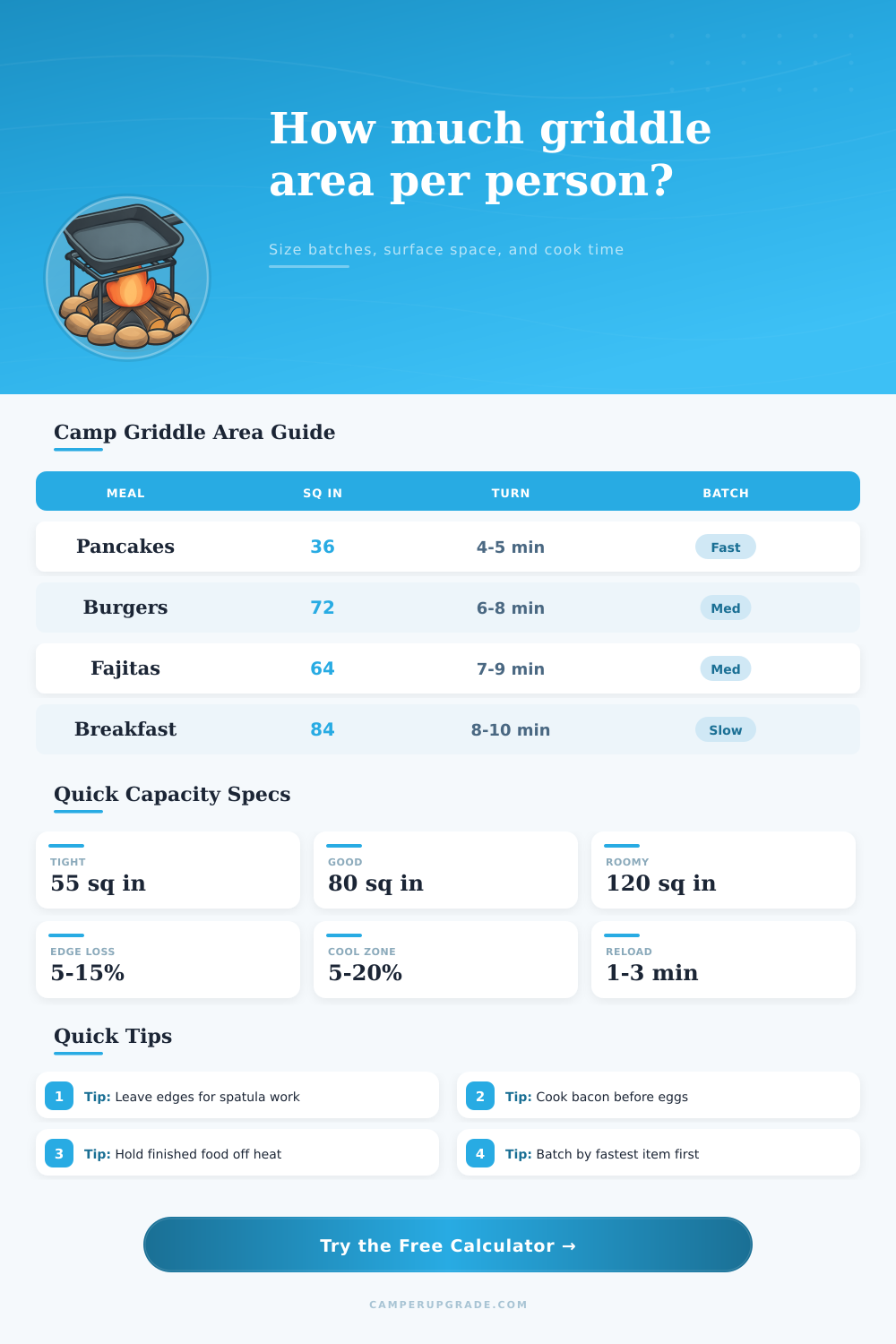
| Pancakes or French toast | 30 to 40 sq in per portion | 4 to 5 min | Fast batches; spacing matters for flipping. |
| Mixed breakfast plate | 75 to 95 sq in per portion | 8 to 10 min | Bacon, eggs, and hash compete for zones. |
| Smash burgers or sliders | 65 to 85 sq in per portion | 6 to 8 min | Needs press room and landing space. |
| Fajitas or stir-fry | 55 to 75 sq in per portion | 7 to 9 min | Often cooked in waves by protein and veg. |
| Quesadillas or melts | 85 to 110 sq in per portion | 5 to 7 min | Large footprint but predictable turns. |
| Common Griddle Size | Raw Area | Usable Area At 80% | Typical Camp Role |
|---|---|---|---|
| 17 x 15 in portable | 255 sq in | 204 sq in | Two to three light breakfast portions. |
| 22 x 16 in tabletop | 352 sq in | 282 sq in | Small family pancakes or burgers. |
| 28 x 18 in cart | 504 sq in | 403 sq in | Family dinner with several batches. |
| 36 x 20 in family griddle | 720 sq in | 576 sq in | Large family or small group service. |
| 48 x 22 in event griddle | 1056 sq in | 845 sq in | Rally, scout, or group kitchen line. |
| Meal Pace | Cycle Time | Reload Time | Holding Risk |
|---|---|---|---|
| Fast pancake line | 4 to 6 min | 1 min | Low if plates move continuously. |
| Bacon and eggs | 8 to 12 min | 2 to 3 min | Medium; eggs decline quickly. |
| Burgers | 6 to 9 min | 1 to 2 min | Medium; buns and toppings can bottleneck. |
| Fajitas or tacos | 7 to 10 min | 2 min | Low when fillings are held covered. |
| Quesadillas | 5 to 8 min | 1 to 2 min | Medium; best served hot and crisp. |
| Usable Surface | Meal Assumption | People Per Batch | Planning Note |
|---|---|---|---|
| 250 sq in | Pancakes at 36 sq in | 6 portions | Small top works if batches are fast. |
| 400 sq in | Burgers at 72 sq in | 5 portions | Good for families, slow for a crowd. |
| 575 sq in | Breakfast at 84 sq in | 6 portions | Use a tray for earlier batches. |
| 700 sq in | Fajitas at 64 sq in | 10 portions | Cook tortillas separately if needed. |
| 850 sq in | Quesadillas at 95 sq in | 8 portions | Large footprint still needs batches. |
💡Griddle Planning Tips
If you’ve ever cooked breakfast in the backcountry, you probably have a good idea of what I’m talking about. It’s a cool Saturday morning. You need to cook pancakes on a griddle that only holds three, but there are ten mouths to fill. You scrape, rush, and flip, but by the time the final flapjack hits the plate the initial one is stone cold.
This isn’t normaly an issue of culinary skill; more often than not it’s a matter of surface area math. Most flat tops looks as large as they are when they’re raw, and most campers believe each square inch can be used to prepare food. They’re mistaken. To demonstrate, I’ve fed that into the above calculator, which will run the numbers based off the reality of outdoor cooking.
How to Use Your Griddle Better
It subtracts for edge loss. This is area along the rims that is technically part of your griddle but can’t actualy be used because you might burn yourself or your spatula might slip. And then there are heat zones; you’ll want a cool spot to set down something when you move raw batter onto hot spot. Most meal plans go wrong because of difference between total area and actual capacity, or what you actually has to work with versus what you think you have.
Think you have eight hundred square inches? You may find that only seventy percent of it is realy usable for active cooking. This means you will be off by minutes on your batch timing. You can adjust the menu once you get comfortable thinking in terms of footprint per person. Pancakes are easy, they don’t take up much room (about 36 square inches) and turn quickly, so you can keep them coming.
Hash browns, eggs, and bacon is another story; because they’re competing for turn space and time under the hood, they require almost three times as much (almost). Adjusting the batch size to match your desired meal style lets the tool visually show this trade-off. So if you have a big crowd to feed but a tiny griddle, it’ll tell you to expect multiple batches and show you what that looks like in terms of output. This is not necessarily bad news, but just know what it says about your timeline.
One thing that’s easy to overlook that is very important: reload time. That’s the amount of time required between batches, as you scrape last bit of food off the griddle, add some oil, and get ready for the next round of whatever food you’re making. It may not seem like much, a minute or two feels inconsequential, but imagine doing that five or six times and those wasted minutes starts adding up. It means it will take longer to get last person served.
Those “dead” minutes is listed out in the reference tables on the page; they break down average time needed for most foods, why, for instance, pancakes go quicker then fajitas. Fajitas require chopping, browning protein and wilting veggies. All three tasks need space and your attention at the same time.
Beyond raw measurements, there’s also issue of how well the heat is distributed. Cast iron will retain and radiate more heat than steel, which affects how much stuff you can stack onto the thing at once before temperature plummets into “not-sear” territory. Hot spots in your griddle decrease total usable area even more, since you’ll need to avoid those while you’re working. The calculator takes this into account.
It allows you to set aside a certain percent of the griddle’s surface as holding or warming zone, which is a good decision for feeding more people. It prevents cooked food from being burned on the actual cooking surface while keeping it nice and warm. More space is better than less. If you’re cramming an extra burger onto a full griddle, there will be torn buns and stuck meat. A little wiggle room makes everything better.
It gives things time to cook properly, and it improves the flavor and texture of whatever is cooking. This thing accommodates whatever style of spacing you like, from carefree flips with delicate items to tightly packed line-cooking speed. This forces you to decide before the first flip instead of halfway through when hungry campers are waiting patiently nearby.
In the end, it’s all about managing not just heat but flow: How many people can I feed at once? How big is my actual usable space? When should of I started cooking to ensure everything will be done by the time we’re all hungry? Knowing this lets you schedule starting point of your process, instead of scrambling through a frenzy of scraping dishes around last second.
It allows you to plan ahead, stroll out to grill with confidence, and watch those burgers sizzle and that batter bubble under your eyes as you monitor the clock. That makes breakfast taste good, on every single plate, even right down to the final bite.