Camp Fuel Per Meal Calculator
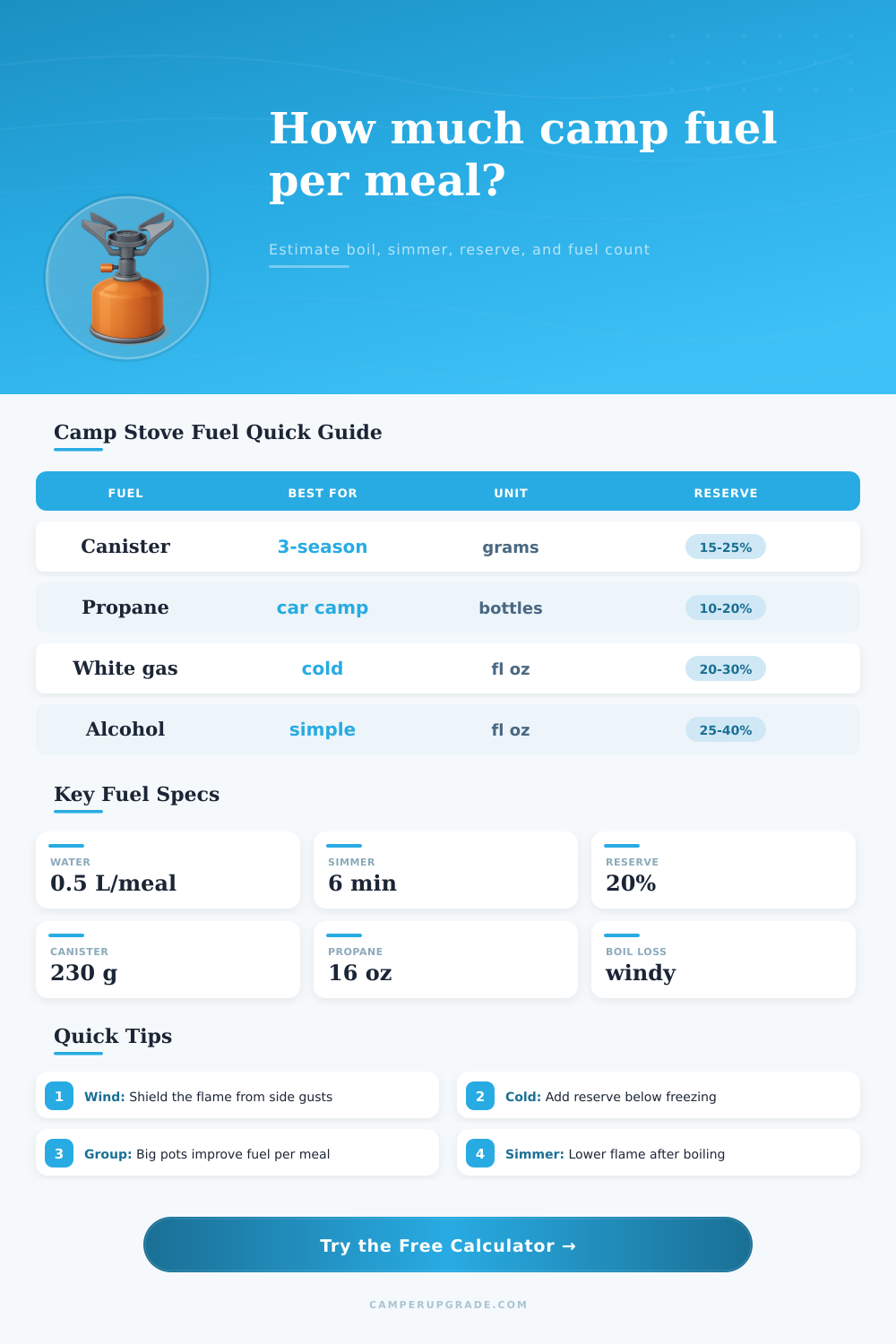
Estimate fuel per meal, total trip fuel, canister or bottle count, and boil versus simmer split from meals, water volume, simmer time, stove type, efficiency, windscreen use, altitude, start temperature, and reserve.
🏕Camp Cooking Presets
⚙Meal, Stove, Boil, Simmer, and Reserve Inputs
The boil model uses water heat capacity, altitude-adjusted boiling temperature, fuel energy density, stove efficiency, and wind exposure. Simmer fuel uses a reduced practical burn rate for each fuel type.
📊Fuel and Stove Spec Grid
Isobutane Canister
46 kJ/gCommon backpacking fuel with 110 g, 230 g, and 450 g canisters.
Propane Bottle
46.4 kJ/gStable car-camping fuel; a 1 lb cylinder holds about 465 g.
White Gas
44 kJ/gCold-weather liquid fuel often planned in fluid ounces.
Alcohol Stove
21 kJ/gSimple and quiet, but lower energy density and efficiency.
Solid Tablets
28 kJ/gCompact backup fuel with fixed tablet portions.
Butane Cassette
45.7 kJ/gConvenient for mild-weather camp kitchens and picnic cooking.
Good Efficiency
45%A lidded pot, steady flame, and sheltered stove often land near this range.
Reserve Range
15-30%Most trips benefit from a buffer for cold water, wind, and extra hot drinks.
📋Reference Tables
| Fuel Type | Typical Container | Planning Unit | Best Use |
|---|---|---|---|
| Isobutane canister | 110 g / 230 g / 450 g | grams | Backpacking and compact camp kitchens |
| Propane | 16 oz cylinder | bottles or grams | Car camping, group meals, camp stoves |
| White gas | 11 oz / 20 oz bottle | fluid ounces | Cold weather and longer liquid-fuel trips |
| Alcohol | 4 oz / 8 oz / 12 oz bottle | fluid ounces | Simple solo boil-and-soak cooking |
| Solid tablet | 14 g tablet | tablets | Backup, emergency, or minimal meals |
| Butane cassette | 220 g can | cans | Mild-weather camp cooking |
| Cooking Style | Water Per Meal | Simmer | Planning Note |
|---|---|---|---|
| Hot drink and oats | 0.4-0.6 L | 0-3 min | Mostly boil fuel with little simmer draw |
| Freeze-dried meal | 0.45-0.75 L | 0-2 min | Boil, pour, seal, and wait off-stove |
| Ramen or quick pasta | 0.5-0.9 L | 3-6 min | Simmer share becomes noticeable |
| Rice or thick pasta | 0.8-1.5 L | 10-18 min | Use a lid and lowest stable flame |
| Family pot meal | 1.5-3.0 L | 8-20 min | Larger pots often improve fuel per meal |
| Snowmelt start | 1.0-3.0 L | 0-8 min | Add reserve for melting and cold starts |
| Altitude | Boil Temp | Fuel Effect | Cooking Effect |
|---|---|---|---|
| Sea level | 212 F / 100 C | Full heat rise | Normal cook times |
| 3,000 ft | 206 F / 97 C | Slightly less boil energy | Food may need longer soak |
| 6,000 ft | 201 F / 94 C | Lower boil temperature | Simmer foods cook slower |
| 9,000 ft | 195 F / 91 C | Less energy to boil water | Plan more time for rice or beans |
| 12,000 ft | 190 F / 88 C | Lower boil target | Use covered pots and longer hydration |
| Container Size | Canister | White Gas | Alcohol |
|---|---|---|---|
| Small | 110 g | 11 fl oz | 4 fl oz |
| Medium | 230 g | 20 fl oz | 8 fl oz |
| Large | 450 g | 30 fl oz | 12 fl oz |
| Propane standard | n/a | n/a | 16 oz bottle |
| Butane cassette | n/a | n/a | 220 g can |
When planning a backcountry trip, it is important to consider the weight of each items you will have to carry. One such item is fuel, which can either save you weight on your trip or create additional problems for you on your trip. An extra fuel canister might seem like a small addition to the gear that you will have to carry on your trip, but an extra fuel canister could be the difference between having enough fuel to complete your meals on the trip versus not having enough fuel to complete your meals on the trip.
The amount of fuel that is required for your trip will change based off the environment in which you will be cooking. Because cooking outdoors isnt always as simple as adding the amount of water that you need for your recipe and bringing it to a boil, there are a variety of environmental factor that will play a role in the amount of fuel that will be required for your meals. For instance, altitude will impact the boiling point of the water that you boil for your meals.
How Much Fuel to Take on a Backcountry Trip
Cold water will require more fuel than water that is warmed by the sun, and meals that require boiling in windy environments will lose some of the heat that your stove generates. Additionally, the type of stove that you use will effect how much fuel is consumed during the boiling and simmering of your meals. Each of these factor can impact the amount of fuel that will be used for each meal, so the amount of fuel that will be required for the meals that you will cook on your trip may be more than you may have guessed.
The cook stove fuel calculator mathematically calculates the amount of fuel that will be required for your trip based upon the information that you enter into the calculator. That information includes the number of meal that you will cook on your trip, the volume of the water that will be boiled for each meal, the length of time that each meal will simmer, the type of stove that you will use, the efficiency of that stove, whether you will use a windscreen while cooking, the altitude of your cooking location, the temperature of the water that you will use for each meal, and the percentage of fuel that you will reserve for unforeseen events. Based upon these variables, the calculator will determine the amount of fuel that will be required for each meal that you will cook on your trip, the total amount of fuel that will be required for your entire trip (including reserve fuel), the number of fuel containers that will be required to provide such fuel, and the split between fuel that will be used to boil the water for your meals versus simmer the cook for meals that require simmering fuel.
Some meals will contain simmering requirements, but other meals will not. Many individuals underestimate the amount of fuel that simmering fuel require for meals. Meals that contain only hot drinks or breakfast meals may require minimal fuel for simmering, but meals that contain rice or pasta will require more fuel simmering the cook.
The fact that the fuel calculator separates boiling fuel from simmers fuel allows individuals to understand the simmers fuel requirements for meals, instead of guessing at fuel requirements for each individual meal. In addition to the fuel that is required to boil water for meals and simmer meals, an additional variable that will have an impact upon the fuel calculations of your trip is the percentage of fuel that you will reserve for unforeseen events. This reserve fuel will help to ensure that your fuel can account for potential issues such as colder water temperatures than expected, longer simmer times, or boiling additional water for additional hot drinks.
Additionally, using a percentage of fuel to reserve for unforeseen events is critical for those trips that are in colder climates or cannot resupply fuel on the trip. Therefore, the reserve fuel percentage for your meals will be an important variable for your fuel estimation, and adjusting this percentage will allow you to see how the number of fuel containers that you will have to carry will change with your use of reserve fuel for unforeseen circumstances. An additional factor in your fuel planning is the type of stove that you will use on your trip.
For example, canister stoves are popular amongst backcountry cooks, but they lose their effectiveness in cold weather due to the difficulties in vaporizing the fuel that is contained within the canister. Liquid fuel stoves do not experience these same difficulties with cold weather, but require more maintenance for keeping the fuel clean. Finally, alcohol stoves are lightweight and quiet when burning alcohol fuel, but use more fuel than other stove types and have difficulty simmering food on the stove for long periods of time.
Each of these variables is accounted for in the fuel calculator for each trip, which will help to provide you with a realistic estimate for the fuel requirements of your meals on the trip. The reference tables included within the fuel calculator can help to provide additional information about the sizes of fuel containers, types of cooking techniques that may be required, and how altitude may impact your trip. Additionally, these tables can help you to verify your calculations made with the stove fuel calculator.
For example, if you are a family that cooks with large pots of propane fuel, you will have different fuel amounts per meal than a solo traveler that uses an alcohol stove. The reference tables make clear these potential fuel amounts. Fuel is an essential element for preparing your meals while on your trip.
However, you dont want to have too much fuel to add to your weight on the trip. Each of these variables has an impact upon the amount of fuel that will be required for your meals during your trip. By understanding each of these variables and the impacts that they have upon fuel requirements for your meals, you can make decisions about the fuel that you will carry prior to beginning your trip.
Thus, understanding these variables and how they may impact your fuel use will help you to ensure that you have enough fuel for your meals on the trail, without having too little fuel to cook meals.