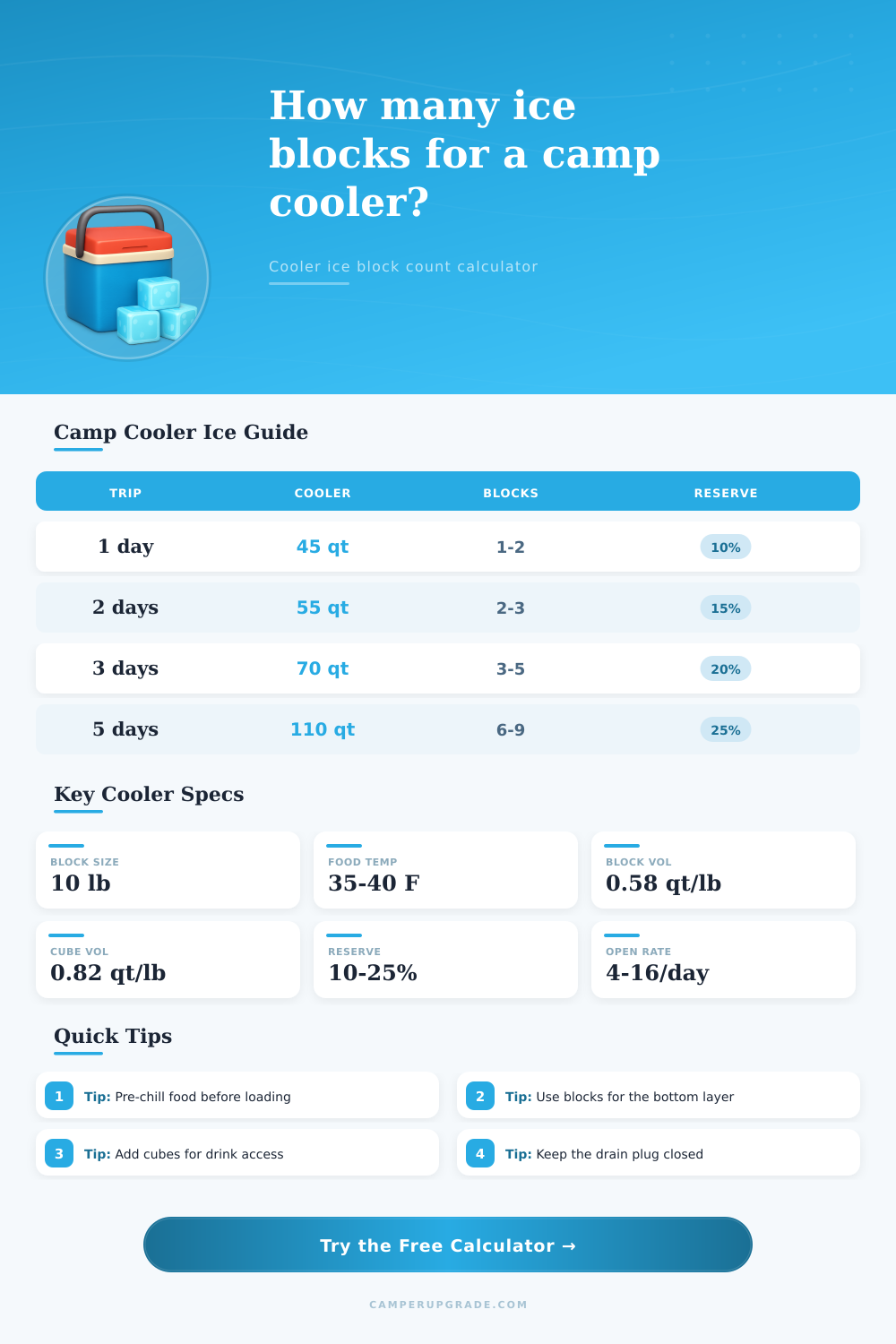
Camp Cooler Ice Block Count Calculator
Estimate how many ice blocks to pack, how much cube ice to add, and how much cooler volume the ice will occupy for camping, fishing, beach, overland, and RV cooler trips.
🏕Cooler Trip Presets
🧊Cooler Ice Inputs
Use the published capacity stamped on the cooler or listed by the maker.
Count the time from packing until the last cold meal or drink.
Use the warmest normal daytime temperature, not the overnight low.
Radiant heat can matter as much as the forecast temperature.
This sets the base melt rate per quart of cooler size.
A separate drink cooler usually reduces food-cooler ice demand.
Include cans, bottles, meals, fish, bait, and container weight that must be cooled.
Warm cans and groceries can consume a surprising amount of ice.
The plan controls the block share and cooler volume estimate.
Common store blocks are 5, 7, 10, or 20 lb depending on region.
Reserve is added after daily melt and cool-down load.
Use a lower number when the cooler must carry bulky food containers.
This calculator models cooler heat gain from capacity, insulation, air temperature, sun exposure, lid openings, starting food temperature, and desired reserve. It estimates ice needed for planning; actual melt changes with packing, drain use, and cooler condition.
Cooler Ice Block Results
📊Ice Plan Spec Grid
🧊Ice Format Reference
| Ice format | Packed volume | Best use | Calculator effect |
|---|---|---|---|
| Solid block ice | About 0.58 qt per lb | Bottom layer, long hold, food coolers | Highest block count, lowest space used per lb. |
| Bagged cube ice | About 0.82 qt per lb | Drink access and filling air gaps | Adds volume faster but chills contact points well. |
| Frozen water jugs | About 0.62 qt per lb | Clean meltwater and organized packing | Counts like block ice with slightly more space. |
| Dry ice slab | About 0.38 qt per lb | Frozen chest only with venting | Reduces wet ice demand but needs separate handling. |
| Crushed ice | About 0.95 qt per lb | Fish, bait, and quick chilling | High contact area, high volume, faster melt. |
☀Heat Load Multipliers
| Condition | Low load | Normal load | High load |
|---|---|---|---|
| Average daytime high | 60 to 75°F: 0.70x to 0.90x | 80 to 90°F: 1.00x to 1.30x | 95 to 110°F: 1.50x to 2.10x |
| Lid openings | 3 to 5 per day: 0.88x | 6 to 10 per day: 1.00x | 19+ per day: 1.45x to 1.75x |
| Sun exposure | Deep shade: 0.85x | Mixed shade: 1.00x | Boat deck or truck bed: 1.30x to 1.40x |
| Insulation class | Rotomolded: 0.033 lb/qt/day | Marine: 0.044 lb/qt/day | Soft cooler: 0.095 lb/qt/day |
📦Cooler Capacity Planning Table
| Cooler size | Ice volume at 40% | 10 lb block fit | Typical camp role |
|---|---|---|---|
| 35 qt compact | 14 qt for ice | About 2 blocks plus cubes | Overnight food or drinks for two. |
| 48 to 55 qt midsize | 19 to 22 qt for ice | About 3 blocks plus cubes | Weekend tent camp or beach day. |
| 65 to 75 qt large | 26 to 30 qt for ice | About 4 to 5 blocks | Family meals, fish, or RV backup. |
| 100 to 120 qt expedition | 40 to 48 qt for ice | About 7 to 8 blocks | Long overland, group camp, or resupply gap. |
| 150 qt group chest | 60 qt for ice | About 10 blocks | Base camp kitchen or shared drink cooler. |
🗺Common Camp Cooler Scenarios
| Scenario | Starting inputs | Block strategy | Planning note |
|---|---|---|---|
| Overnight tent camp | 48 qt, 1.25 days, 75°F | One or two 10 lb blocks | Pre-chilled food often matters more than extra reserve. |
| Family weekend | 70 qt, 3 days, 85°F | Three to five 10 lb blocks | Use cubes on top only for frequently grabbed items. |
| Fishing day | 65 qt, 1 day, 82°F | Blocks below, crushed or cube ice above | Fish contact needs loose ice even if blocks provide hold time. |
| Overland five day | 110 qt, 5 days, 88°F | Six to nine 10 lb blocks | Remote trips benefit from a 25% end reserve. |
| Beach drink cooler | 55 qt, 1 day, 95°F | Two blocks plus plenty of cubes | Heavy lid openings drive the result more than duration. |
💡Cooler Ice Calculation Tips
Food and then…will anything be cold when I want to eat it? When we’re planning a camping trip, these are the two questions that frame any excursion.
How much ice will you need? Too little and you’ll be gnawing on warm cheese by day three; too much and you’ve wasted valuable space. But there’s a silent variable at play here, and it’s the one that determines the true shelf life of your cooler: ice. That’s because the cooler is battling itself, heat infiltrating the walls, warm food pull energy out of the ice, and each time the lid is opened letting a new wave of warm air course through its confines.
How Much Ice Do You Need?
Ice cubes cool down more quickly and fit between items for better insulation; however, they don’t last as long since they has more surface area exposed to the air inside the cooler. Block ice lasts longer due to having less surface area. That’s where this tradeoff comes into play in deciding what percentage of block vs. Cubes to bring along.
To save you from the guesswork of trying to figure out how fast ice will melt under actualy conditions, the calculator above does the math for you based off your estimated daytime high temps, trip length, and cooler size. It takes into account how frequently you anticipate opening the lid, too… Since an empty drink cooler opened every twenty minutes melts ice at a totally different pace then a full food cooler kept closed all day.
Exposure matters more than you think. Even if the air temperature is seemingly mild, that warm sun bake a cooler resting on a sunny boat deck or in the back of your truck. And while a shade will help, the hot surface still radiates its warmth right through the insulation.
To reduce your initial ice demand, pre-chill your grub before packing. The first thing your cooler must do is bring those room-temperature groceries and cans down to serving temperature before it begins its true task of maintaining a consistant chill.
First, the melt rate is set by the insulation quality of the cooler itself. In general, a thicker-walled rotomolded model retain significantly more ice than a soft-sided bag or a budget hard cooler. This effect builds up over multiple days. Just as one cooler will hold twice as much ice as another of same size, it will also keep that ice for twice as long.
What’s your final reserve percentage? That’s mostly a bet on how much risk you’re willing to take. The bigger the reserve, the better off you are in case the predicted weather proves hotter than expected or you decide to stay an extra day, but it also means bringing more ice to begin with. Most people overpack ice.
Most everyone treats each trip as if it’s identical. But this calculator allows you to account for the specific conditions you’re expecting so you don’t guess whether you should of brought five blocks for your weekend at the lake or eight for your remote stretch where there’s no resupply.
Now that you know about how much total ice you’ll need for the trip, you can determine what proportion of cubes vs. You should decide how many blocks to pack for easy access and long-lasting use without running out of space for the real food. It’s not about bringing home a big stack of semi-melted ice cubes; it’s about leaving with just enough ice to get you through your trip. And that sweet spot lies in matching your ice plan with the conditions (weather), the cooler itself and what you’ll use it for.