Camp Chair Weight Capacity Calculator
Estimate real camp chair load from body weight, lap gear, sitting style, frame material, fabric condition, ground angle, and a practical safety margin.
🏕Camp Chair Presets
⚙User, Gear, and Frame Inputs
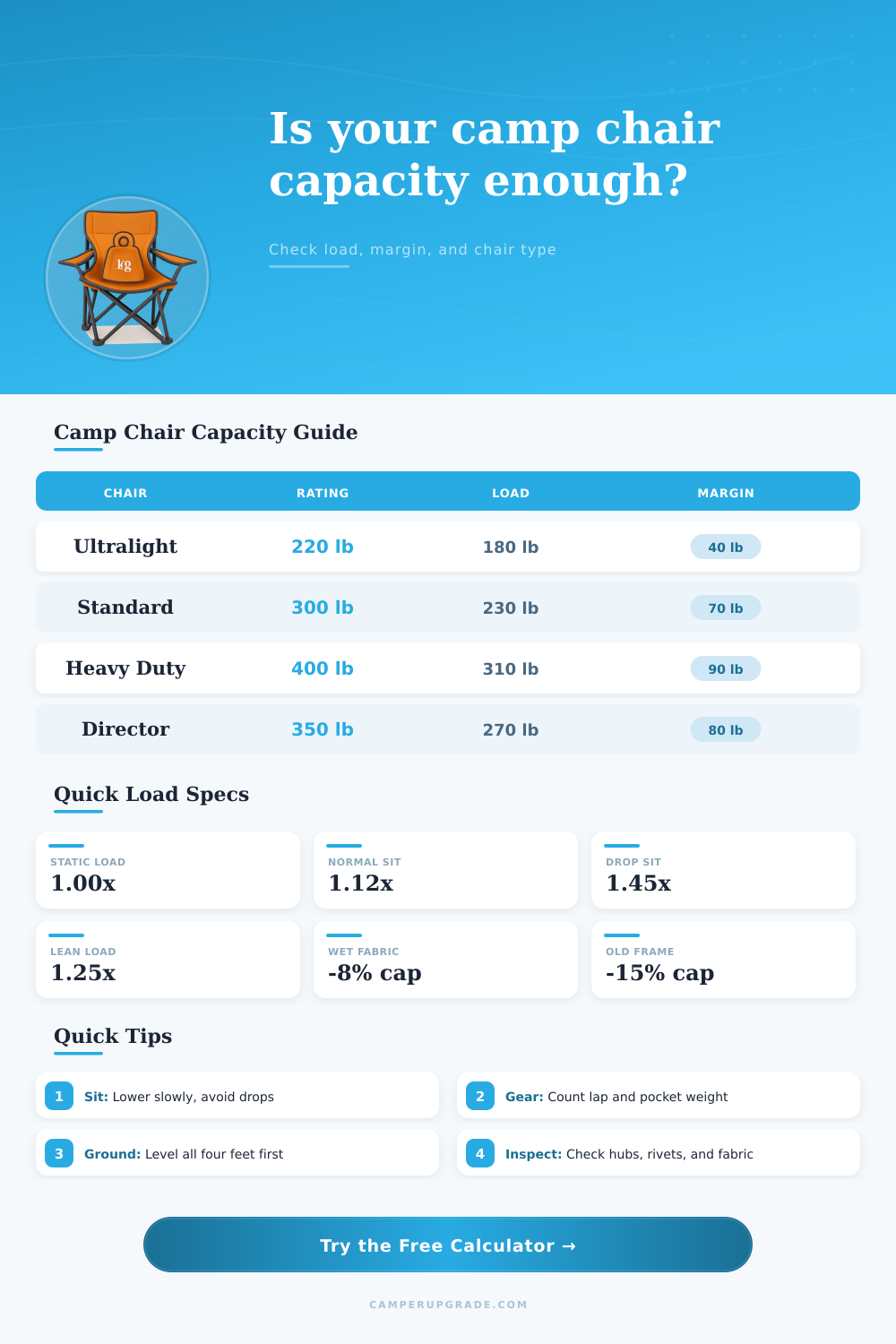
This calculator compares an adjusted chair capacity against total static load, dynamic movement load, and your chosen safety margin. It does not certify damaged seating.
📐Formula Cards
Body weight plus lap gear, pockets, side-table items, and any shared seat load.
Normal sitting, leaning, rocking, or drop-sitting multiplies the load placed on the frame.
Frame material, fabric wear, ground support, and seat leverage reduce usable capacity.
Suggested label rating equals dynamic load plus your selected camping safety margin.
🪑Chair Frame and Spec Grid
📊Chair Capacity Reference Tables
| Chair Type | Typical Rating | Best Use | Watch Point |
|---|---|---|---|
| Ultralight compact | 180-250 lb | Backpacking rest stops | small hubs |
| Standard folding | 250-325 lb | General campsite seating | fabric seams |
| Low beach chair | 225-300 lb | Sand and low lounging | rear lean |
| Director chair | 300-400 lb | RV pads and cooking areas | side table load |
| Camp rocker | 250-350 lb | Patio and level pads | moving joints |
| Heavy-duty oversized | 400-600 lb | Large users and guests | wide foot print |
| Movement | Factor | Example Load | Meaning |
|---|---|---|---|
| Careful static sit | 1.00x | 220 lb | steady load |
| Normal shifting | 1.12x | 246 lb | camp use |
| Side lean | 1.25x | 275 lb | leg bias |
| Rocking motion | 1.32x | 290 lb | joint cycling |
| Drop sit | 1.45x | 319 lb | impact peak |
| Child on lap | add weight | plus 35 lb | static base |
| Frame Condition | Capacity Factor | Signs | Action |
|---|---|---|---|
| New or light use | 1.00x | tight hubs | use rating |
| Good normal wear | 0.96x | minor scuffs | keep margin |
| Worn fabric | 0.88x | loose seams | reduce load |
| Older faded chair | 0.85x | UV fabric | guest caution |
| Visible damage | 0.60x | bend or tear | retire chair |
| Rust at pivots | 0.70x | orange joints | avoid use |
| Reference Scenario | User + Gear | Suggested Rating | Margin |
|---|---|---|---|
| Solo meal stop | 175 + 8 lb | 250 lb | comfortable |
| Campfire adult | 210 + 12 lb | 300 lb | normal |
| Adult with child | 190 + 45 lb | 350 lb | normal |
| Big and tall user | 310 + 15 lb | 500 lb | better |
| Older spare chair | 180 + 10 lb | 300 lb | safer |
| Two-person bench | 330 + 20 lb | 500 lb | normal |
💡Camp Chair Capacity Tips
When you use a camping chair, you must ensure that you understand the capacity limit of the chair. Many people will think that if they is within the weight limits of the chair, they are fine using the camping chair. However, these limits are often based off static loads only, meaning that the weight is not moving.
However, the person that is using the chair is a moving subject that can add to the loads placed upon the camping chair. These dynamic load can add to the amount of force that is placed upon the chair frame. In addition to the weight of the camping chair user, there may be additional weights being added to the camping chair.
How to Use a Camping Chair Safely
For instance, the individual may be wearing heavy clothes such as denim jeans and hiking boots. In addition to that, they may be adding additional items to there lap, such as a camera, a cooler, or a baby. Because of these additional items and people, the total amount of weight that may be placed upon the camping chair may be greater than the weight of the individual using the camping chair by themselves.
Thus, it is important to also consider and account for any additional weight of items or individuals that the user may add to the camping chair. Another factor to consider is the ground upon which the camping chair is placed. Many camping trips may involve placing camping chair upon slopes or soft sand.
If the ground upon which the camping chair is placed is not even, then the weight will not be distributed equal to each of the four legs of the camping chair. Thus, the camping chair may snap to one side instead of the other. Therefore, it is important to ensure that the user levels the camping chair such that the weight is distributed equal to each leg and each hub of the camping chair.
Another factor to consider is the material from which the camping chair is made. For instance, backpackers often use aluminum camping chair due to their lightweight frames. However, over time, aluminum develops fatigue.
Additionally, those chairs that is coated in nylon may experience the breakdown of that nylon due to the uv rays from the sun. Thus, the camping chair that is safe for certain weights five years ago may not be safe for the same individual by the chair today due to the decay of the camping chair materials. Therefore, camping chair materials and their potential for fatigue or decay are another factor that must be considered in the evaluation of camping chair safety.
It is also important to establish a safety margin for camping chairs. A safety margin is established as extra capacity between the weight of the individual that is using the camping chair and the capacity of that camping chair. If the weight of the individual is equal to the adjusted capacity of the camping chair, there is a risk of the camping chair snap.
By establishing a safety margin of 20 or 30 percent, there will be extra capacity for the camping chair to withstand dynamic loads that are often experienced while sitting in a camping chair. Thus, establishing a safety margin ensures that an individual can enjoy the use of a camping chair without fear of the chair collapse. To evaluate a camping chair, it is important to determine the adjusted capacity of the camping chair.
The adjusted capacity is the manufacturer’s specified capacity after subtracting the weight of any additional gear, dynamic loads, and the decay of camping chair materials. Furthermore, if this measurement is determined to be close to the weight of the individual that will use the camping chair, the individual should avoid movements that add to the forces upon the camping chair, such as falling into the chair from standing position. Falling into a camping chair that has a worn out pivot joint may snap the joint due to the impact load upon the joint.
Thus, by understanding the adjusted capacity of the camping chair as well as dynamic loads and safety margins, an individual can determine what camping chair best suit their needs and can enjoy using the camping chair safe.