Bulgur Camp Water Ratio Calculator
Size bulgur, water, soak time, fuel time, and pot capacity for trail meals, basecamp sides, thermos lunches, and no-cook camp bowls.
Camp Bulgur Calculation
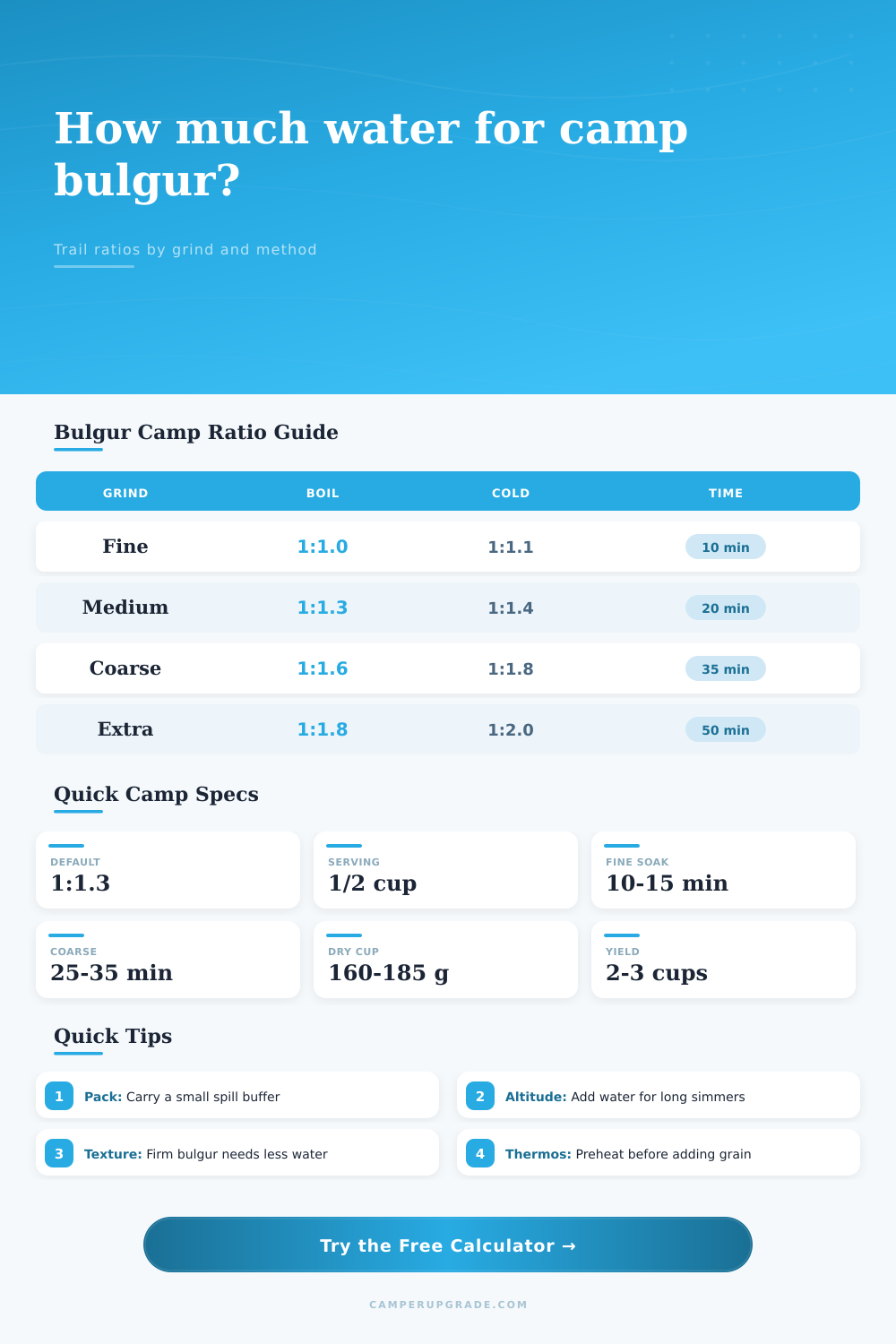
| Bulgur grind | Base water ratio | Best camp method | Typical covered time |
|---|---|---|---|
| Fine bulgur | 1.00 to 1.10 cup water per cup dry | Salad soak, hot soak, cold soak | 10 to 20 min |
| Medium bulgur | 1.20 to 1.35 cup water per cup dry | Boil, cover, and soak | 12 to 25 min |
| Coarse bulgur | 1.50 to 1.70 cup water per cup dry | Short simmer or thermos | 18 to 40 min |
| Extra-coarse bulgur | 1.75 to 2.00 cup water per cup dry | Simmer with tight lid | 25 to 60 min |
| Whole-grain bulgur | 1.55 to 1.85 cup water per cup dry | Thermos or simmer | 25 to 55 min |
Ratios are volume ratios for parboiled bulgur; raw cracked wheat needs a longer cook and should not be substituted directly.
| Camp method | Water adjustment | Fuel impact | Container note |
|---|---|---|---|
| Boil, cover, and soak | Baseline | Short boil only | Use a lid or pot cozy |
| Short simmer with lid | Add 0.10 to 0.18 ratio | Moderate fuel | Stir once, then cover |
| Preheated thermos jar | Subtract about 0.03 ratio | Boil water only | Preheat, drain, then add grain |
| Cold soak container | Add 0.08 to 0.18 ratio | No stove fuel | Use fine or medium bulgur |
| One-pot with vegetables | Add 0.12 ratio before wet add-ins | Longer active heat | Allow extra headroom |
| Serving plan | Dry bulgur per person | Cooked yield per person | Best use |
|---|---|---|---|
| Small side | 1/3 cup or 55 to 60 g | 3/4 to 1 cup | Shared camp plate |
| Standard side bowl | 1/2 cup or 80 to 90 g | 1 to 1 1/3 cups | Lunch or dinner side |
| Main trail bowl | 2/3 cup or 110 to 125 g | 1 1/2 to 1 3/4 cups | One-person meal base |
| High-calorie bowl | 3/4 cup or 125 to 140 g | 1 3/4 to 2 cups | Long hiking day |
| Condition | Ratio change | Time change | Calculation cue |
|---|---|---|---|
| Below 3,000 ft | No altitude change | No added time | Use base method ratio |
| 3,000 to 6,000 ft | Add 1% to 5% | Add 2 to 5 min | Mainly for simmered bulgur |
| 6,000 to 10,000 ft | Add 5% to 10% | Add 5 to 10 min | Cover tightly after boiling |
| Loose lid or wind | Add 0.08 to 0.20 ratio | Add 1 to 4 min | Evaporation, not absorption |
It’s the classic “water-is-infinite” scenario that hits most campers when they’re standing in front of a boiling pot, holding a half cup of dry grain, wondering if there’s even enough water to make coffee. The thing about bulgur (a favorite trail carb) is that it’s quick-cooking, but since it’s already parboiled, it soaks up water different than say, raw quinoa or rice. This isn’t a volume measurement. It’s an exercise in texture preference, altitude physics, and evaporation.
Use the handy-dandy calculator found on this page. It figures out how much water and fuel you should use based off the kind of meal you want to eat. Will my meal be a soggy mess or a dry crumble? That’s the question you don’t need to guess anymore.
How to Cook Bulgur on the Trail
People also struggle with size of bulgur grind itself. Fine bulgur is nearly instant-rice-like; it doesn’t need much heat, and absorb water rapidly. A coarse grind has more surface area to cover, meaning you’ll have to simmer it longer (or let it sit long enough) to get soft enough. And if you’ve got too big a ratio of grain size to water, you wind up with either a gunky porridge stuck on the bottom of your pan, or a bunch of chalky mouthfuls in your throat. The amount of water in base mix changes based on that grind, more for the extra-coarse which will take a while to expand and less for fine stuff destined for a cold salad.
Because who wants to be carrying around water they don’t need on a hike? There’s also altitude, one of those quiet killers of food in the backcountry. Water doesn’t boil as hot at higher altitudes, meaning it takes longer to get into the middle of each grain. The calculator factors this in, and if you enter your altitude, it will add just a little more time and water to account for the slower heat transfer. What’s perfect at sea level may come up short in high-elevation environment (seven thousand feet), where you’ll need to account for the slower transfer of energy.
Depending on whether or not you’re covering the pot with a loose or tight-fitting lid, you’ll want to adjust the lid setting in the calculator, since losing steam means losing heat, the math adjusts accordingly so that your grains don’t just warm on the exterior but actualy cook through. How long? How much fuel? This depends on what kind of cooking you’re doing. Soaking and boiling takes less fuel than a slow simmer (and even less if you have a lid that keeps heat in). Cold soaking doesn’t use any fuel at all. However, it requires way more water and far longer times, which is why it’s best suited to finer bulgur. These trade-offs are spelled out in detail in the reference tables on the page. You will see that in some cases, waiting ten minutes without the stove on may be the same as saving ten minutes of actual cooking time. So choose according to your day’s energy budget.
If you’re weary from a long day on trail, that extra pound of water would of been well-spent helping you rest. How chewy do you prefer your grain? That’s a personal choice, but one that can be measured. Do you prefer firm bulgur, where each piece retains its shape, or do you prefer soft, spoonable? You can adjust for texture with the calculator, and it will automatically recalculate how much water to add.
Because pots of varying sizes and spills inevitably occur, I typically include a ten percent buffer when cooking for group. If you’ve got an extra bit of water, great; if you drained every last drop only to discover there’s still an uncooked lump in the middle of the bowl, not so good. Fresh herbs or canned tomatoes, etc., will add moisture to whatever you’re making; think about the amount of liquid they’ll contribute, and subtract it from the amount of water you add. This way, you won’t end up with a soupy mess.
It’s just as critical to get the proper volume of dry bulgur in the bag as it is the water amount. It tells you how much is made total and whether there is enough for a single pot to serve all of camp. On average, most adults requires three-quarter a cup (dry) of bulgur for a main bowl and half a cup for a side dish. This allows you to properly pack weight and make an accurrate grocery list. It also prevents that embarrassing “oh crap we’re out of grains” moment during dinner.
All these variables are tied together into one actionable plan with the calculator; no more guess work when it comes time to cook on the trail. The trick is getting the right amount of bulgur to water so it isn’t a disaster. Instead, it becomes a staple in your arsenal that can transform an inexpensive ingredient into a filling meal. This meal will power your next mile while still leaving room for your pack. No more stirring a pot while trying to soak up the views, just leave that part of the equation to the calculator.
Once you know the variables involved, the math is easy, and every time the result is worth the advanced preparation. Get out your grains: bring along plenty of water, double-check your lid, and appreciate the simplicity of cooking with respect for your stomach and your time. When you really think about it, it all comes down to having the confidence to know exactly how many cups of bulgur need how much water to reach the best texture.