
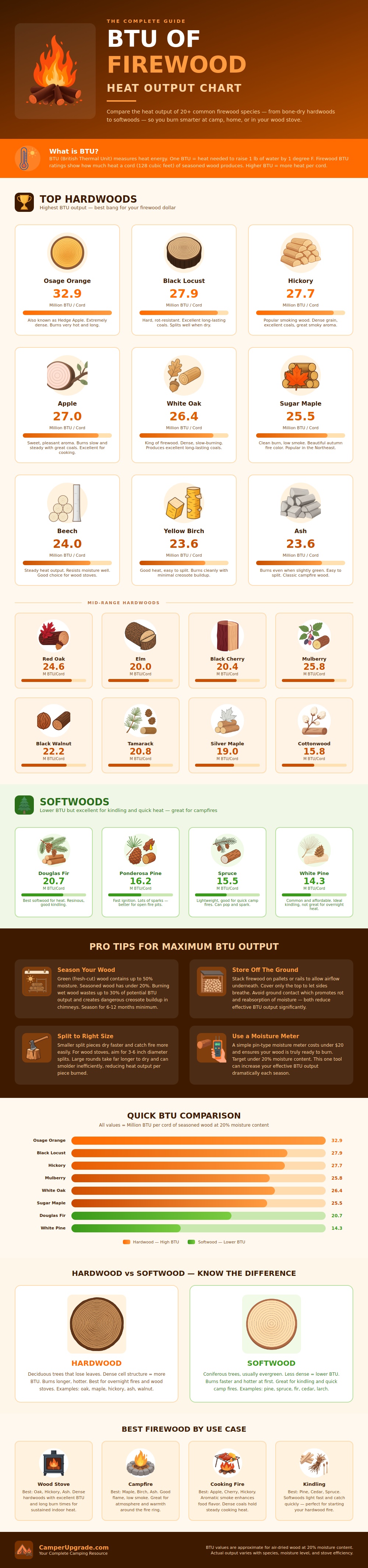
BTU stands for British Thermal Unit. That is the energy required to warm one pound of liquid water in one degree Fahrenheit Understand BTU help to pick the heat from combustion and choose firewood for camping, whether for a cozy campfire or outdoor cook.
Not all firewood has same BTU each pound. Non-resinous wood reaches around 8,000 to 8,500 BTU per pound, while resinous wood comes to 8,600 to 9,700 BTU per pound. One pound of dried wood gives around 8,084 BTU.
BTU and How to Choose Firewood for Camping
The main difference in energy depends on the density of the wood. One pound of dense hardwood carries the same energy as one pound of light softwodo. Because of its weight per cord it delivers more total heat.
Oak and hickory are the best choices for firewood. They give high BTU, form good coals and have little spark. That matters for campfire.
Interesting fact: famous red oak is not the highest on BTU charts. It is beaten by 13 other species with up to 37 % more BTU per cord.
Osage orange, or hedge, is at the top with around 30 million BTU per cord. Shagbark hickory reach 25.3 million BTU per cord. White oak come to around 24.2 million BTU per cord.
Even inside same species, various bits burn hotter than others, depending on dryness and growth conditions. Tight grain old wood can be almost twice as dense as planted wood of same species. Hardwoods give more BTU, if cut in winter after leaves fall.
For maximum energy from firewood, it must be seasoned. Right dried wood have around 20 % humidity, which delivers more heat and less smoke. BTU figures usually relate to cord of 128 cubic feet, air-dried under 20 % humidity.
Other factors affect the BTU value: size and shape of bits, age and health of tree, geographic place of growth.
Timbers with low BTU work for early autumn and spring camping, when you only want to remove cold. Mix various types is a smart strategy. One cord of maple firewood match around 175 gallons of fuel oil according to BTU.
Cord measure 8 feet long, 4 feet high and 4 feet wide. Price of firewood stay more stable than that of fuel oils or gas.
