Briquette Count by Temperature Calculator
Estimate Dutch oven charcoal briquettes by target temperature, oven diameter, top heat split, weather, elevation, food load, and cook duration.
Briquette plan
| Oven size | 300°F low bake | 325°F standard bake | 350°F common bake | 375°F hot bake |
|---|---|---|---|---|
| 8 inch | 9 top / 3 bottom / 12 total | 11 top / 5 bottom / 16 total | 13 top / 7 bottom / 20 total | 15 top / 9 bottom / 24 total |
| 10 inch | 11 top / 5 bottom / 16 total | 13 top / 7 bottom / 20 total | 15 top / 9 bottom / 24 total | 17 top / 11 bottom / 28 total |
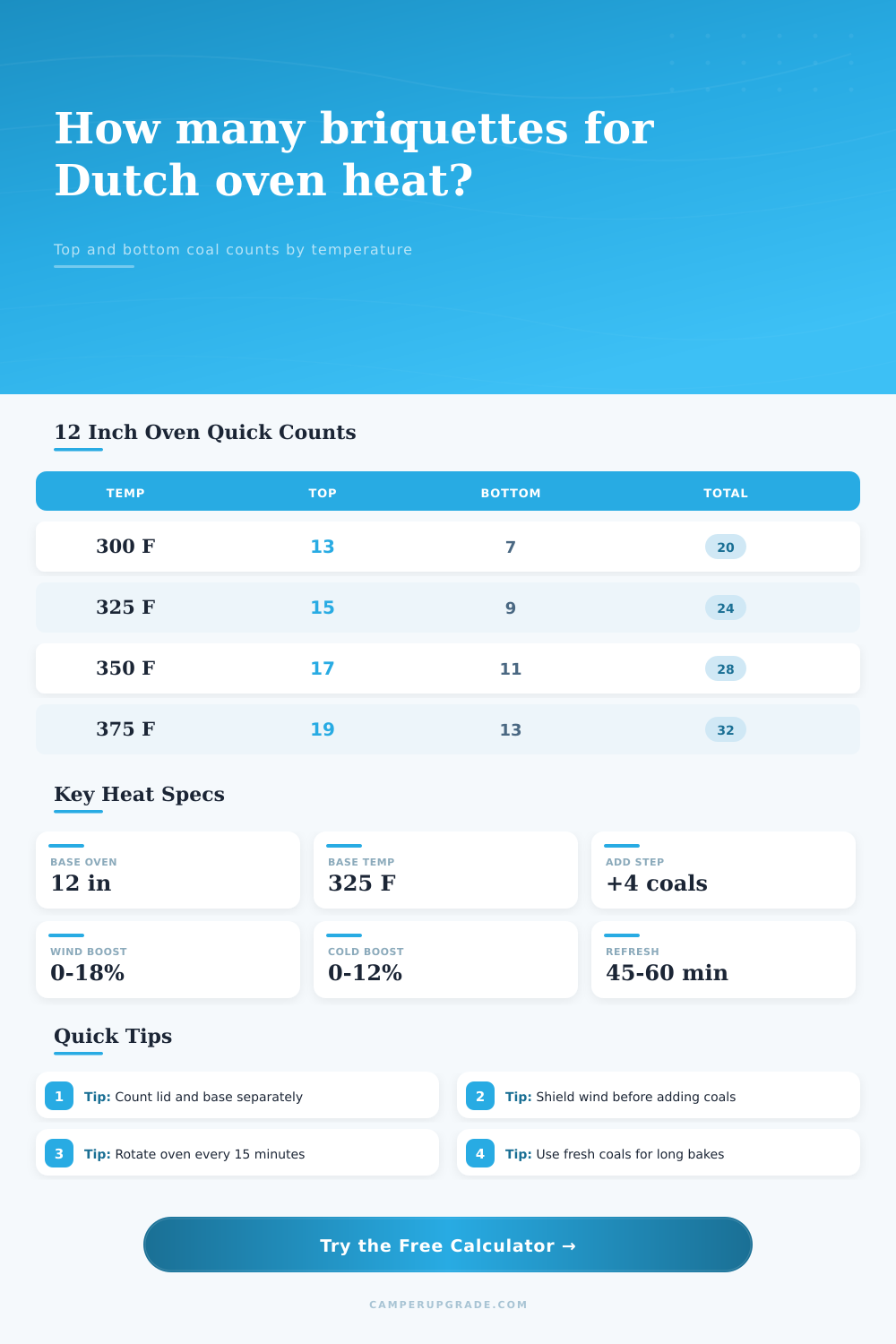
| 12 inch | 13 top / 7 bottom / 20 total | 15 top / 9 bottom / 24 total | 17 top / 11 bottom / 28 total | 19 top / 13 bottom / 32 total |
| 14 inch | 15 top / 9 bottom / 24 total | 17 top / 11 bottom / 28 total | 19 top / 13 bottom / 32 total | 21 top / 15 bottom / 36 total |
| 16 inch | 17 top / 11 bottom / 28 total | 19 top / 13 bottom / 32 total | 21 top / 15 bottom / 36 total | 23 top / 17 bottom / 40 total |
| Condition factor | Mild setting | Moderate setting | Hard setting | How calculator applies it |
|---|---|---|---|---|
| Outside temperature | 60–80°F: 0% | 35–59°F: +6% | Below 35°F: +12% | Raises the effective target heat before coal rounding. |
| Wind exposure | Calm: 0% | Breeze: +6% | Gusty: +18% | Adds extra active coals to replace heat stripped from the lid. |
| Elevation | 0–3000 ft: 0% | 3000–7000 ft: +3% | Above 7000 ft: +6% | Offsets slower cooking and lower boiling temperatures. |
| Food load | Light: -4% | Normal: 0% | Cold dense: +10% | Accounts for thermal mass inside the oven. |
| Lid and oven mass | Tight: 0% | Average: +4% | Leaky or cold: +8% | Compensates for weak seal, cold iron, or frequent lifting. |
| Briquette type | Count multiplier | Useful heat window | Ash behavior | Best camp use |
|---|---|---|---|---|
| Standard charcoal briquette | 1.00x | 45–55 minutes | Moderate ash | General baking and dinners. |
| Premium long-burn briquette | 0.92x | 55–70 minutes | Lower ash | Long breads, roasts, and covered casseroles. |
| Hardwood lump equivalent | 1.12x | 35–50 minutes | Irregular ash | Fast heat when pieces are sorted by size. |
| Coconut shell briquette | 0.95x | 60–75 minutes | Fine ash | Long simmering with fewer refreshes. |
| Quick-light briquette | 1.08x | 35–45 minutes | Fast ash | Short campsite meals where fast ignition matters. |
| Mini briquette / small coal | 1.20x | 30–45 minutes | Fine ash | Small ovens and precise low heat control. |
| Common camp cook | Typical oven | Target temperature | Top / bottom balance | Starting count |
|---|---|---|---|---|
| Biscuits or rolls | 10 inch | 375°F | Hot lid, light bottom | 17 top / 11 bottom |
| Berry cobbler | 12 inch | 350°F | Classic bake | 17 top / 11 bottom |
| Pot roast | 12 inch | 325°F | Even roast | 14 top / 10 bottom |
| Camp lasagna | 14 inch | 350°F | Brown lid, steady base | 19 top / 13 bottom |
| Beans or stew | 16 inch | 325°F | More bottom heat | 14 top / 18 bottom |
| Cornbread crust | 10 inch | 400°F | Strong bottom | 15 top / 17 bottom |
Ever burn your bread on one side while leaving center raw? You freaked out, right? That’s because you view heat as a number instead of a moving balance.
Rather than guessing, how many coals do you need? How does environment affect it? How hot should I makes my oven? Instead of worrying about that, use the calculator to work out amount of coal for any oven size, desired temperature, and other factors.
How to Use the Coal Calculator
Cast iron is not hungry. Cast iron cares about geometry and mass. The classic rule: For baking, put three fewer coals on the bottom of pot than on top. The resulting gradient bakes the top surface first then the bottom (hopefully) second, without burning either. That’s what the tool does automatically, divides between these two mode.
But not all cooking are baking. Simmering beans? You want some bottom heat to push boil along without burning the bottom. The method selector immediately shifts the balance. Even a small change can changes a whole dish texture.
The variables can be weather. It’s the reason we have good plans ruined. You’re loading your coals when suddenly it’s cold out. Cold air leaks in around poor seals while wind blows and sucks heat off the lid. Those little things add up on the calculator with percentages to account for elevation, cold and wind. They are not little nuisances. These are big heat losses.
High elevations also reduces the boiling point of water. That means you need more time and even heat to melt away those tough piece of meat in your stew. To make up for this loss, it bumps number of coals a hair, so you don’t have to worry about thinking sea-level physics still apply.
You will also see a variety of briquette type. There’s standard charcoal, the baseline. Then there’s premium and long-burn which last longer and burn hotter (hence fewer required). Lump charcoal burns fast and hot (less even) different than the others. From here it’s up to filling the gaps. You get either more control or convenience. Want smaller coals? You’re going to have to use A LOT more volume per amount of heat held. This is where tool comes into play. It doesn’t treat a small coal as if it were a regular sized one.
Timing is just as important as the load itself. How long will those coals last? They does not last forever. Here’s what I can tell you: A typical briquette will provide usable heat for 45-60 minutes. That means you’re essentially cooking on ash after that point. So when do you add more? The calculator also accounts for reloads. It’ll estimate the number of extra coals necessary for second cycle. Plan to have those lit and standing by before first batch expires. Waiting until your oven cools down will ensure defeat.
You should of had some wiggle room. That’s why total light count includes a reserve. This isn’t an excess of fuel; it’s a guard against temperature changes.
For everyday baking, the reference tables gives you a snapshot of what’s needed. For example, a typical bake on a 12 inch oven at 350 degrees will use about 28 coals. That’s a beginning point. It will change depending on the fit of your lid. It will change if you’re opening it every five minutes to see what’s going on. Each time you open that oven door, you let heat escape. The tool is based off a closed system. You’ll need to compensate accordingly.
It’s all about the thermodynamics of camp cooking. Focus your heat and trap it inside your heavy cookware. The calculator provides a map but ultimately, you have to cross the terrain. Begin with its numbers. Observe color of the ash. Pay attention to the crackling sound. Tweak accordingly. Without knowing where to begin, you’ll make cold, dark and undercooked blunders. Instead, you’ll roast succulent meat and bake delicious bread. Rather than merely surviving dinner, you’ll enjoy it. Your fire follows the plan; the plan doesn’t follow the fire.