🏹 Bow String Length Calculator
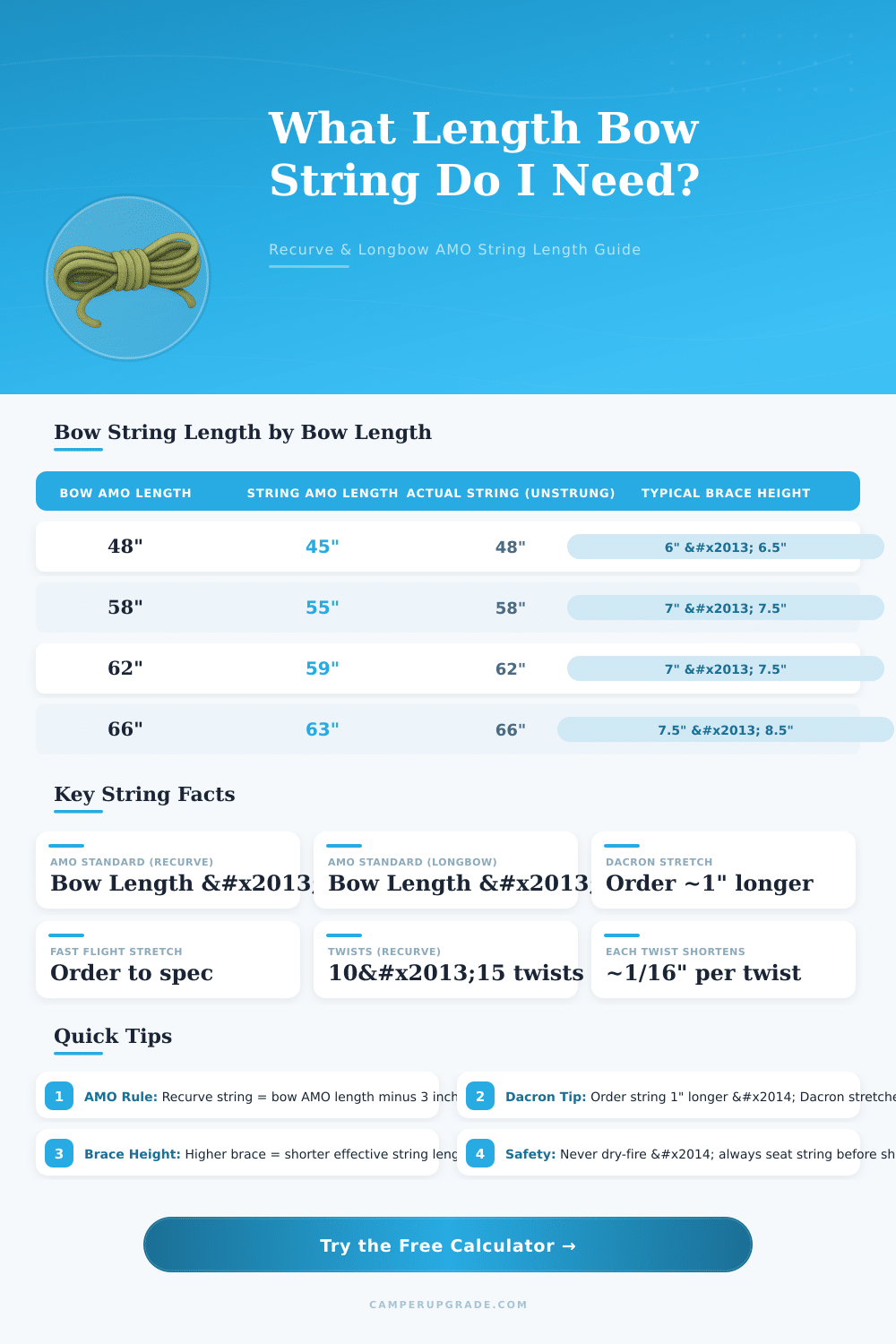
Find the correct AMO string length for recurve bows and longbows using the AMO/ATA standard formula.
✅ Your Bow String Results
| Bow AMO Length | String AMO Length | Actual String (Unstrung) | Typical Brace Height | Notes |
|---|---|---|---|---|
| 48" | 45" | 48" | 6" – 6.5" | Youth / short recurve |
| 54" | 51" | 54" | 6.5" – 7" | Youth / junior |
| 58" | 55" | 58" | 7" – 7.5" | Compact adult recurve |
| 60" | 57" | 60" | 7" – 7.5" | Youth / adult starter |
| 62" | 59" | 62" | 7" – 7.5" | Standard adult recurve |
| 64" | 61" | 64" | 7.5" – 8" | Mid-length recurve |
| 66" | 63" | 66" | 7.5" – 8.5" | Target / field recurve |
| 68" | 65" | 68" | 8" – 9" | Popular Olympic length |
| 70" | 67" | 70" | 8.5" – 9.5" | Olympic / tall archer |
| 72" | 69" | 72" | 8.5" – 9.5" | Very tall archer |
| Bow Length | String Length (AMO –4") | Actual String (Unstrung) | Typical Brace Height | Notes |
|---|---|---|---|---|
| 54" | 50" | 54" | 5.5" – 6.5" | Short/youth longbow |
| 58" | 54" | 58" | 6" – 7" | Short traditional |
| 60" | 56" | 60" | 6" – 7" | Compact traditional |
| 62" | 58" | 62" | 6.5" – 7.5" | Standard longbow |
| 64" | 60" | 64" | 6.5" – 7.5" | Popular traditional length |
| 66" | 62" | 66" | 7" – 8" | Hunting longbow |
| 68" | 64" | 68" | 7" – 8" | Tall archer longbow |
| 70" | 66" | 70" | 7" – 8.5" | English longbow style |
| 72" | 68" | 72" | 7" – 8.5" | Warbow / tall traditional |
| Bow AMO Length | Recurve Brace Height Range | Longbow Brace Height Range | Performance Notes |
|---|---|---|---|
| Under 58" | 6" – 7" | 5.5" – 6.5" | Lower brace = more power, less forgiving |
| 58" – 62" | 7" – 7.5" | 6" – 7" | Balanced speed and forgiving draw |
| 64" – 66" | 7.5" – 8.5" | 6.5" – 7.5" | Good all-round performance |
| 68" – 70" | 8" – 9" | 7" – 8" | Target archery standard range |
| Over 70" | 8.5" – 9.5" | 7" – 8.5" | Higher brace = quieter, more forgiving |
A bowstring connects the two ends of a bow and launches the arrow. It is one of the most important parts of any bow because it creates the energy needed to send the arrow flying toward its target The best bowstrings are light, strong and resistant against both friction and water. Weight is very important, especially in the center of the string.
Even one gram of added mass in the center can slow the arrow.
How to Choose a Bowstring
In the past, bowstrings were made from plant fibers, animal hides and sinew. Traditional bows were strung with linen, hemp, silk or even raw hide. Currently, almost all modern bows use synthetic materails instead.
When one chooses material for the string, the main decision is between polyester or polyethylene. Polyester is cheaper and more stretchy, which works better for traditional bows. Polyethylene is more lightweight and less stretchy, which makes the bow faster, but it also gives more shock to the bow.
For traditional bows with wooden risers, Dacron strings are a safer choice, because materials with higher performance can damage the riser. If the limb tips of the bow are strengthened, one can use Fast Flight string. If they are not strengthened, stay with B55 or Dacron for the safest way.
Because of the popularity of recurve bows and compounds, Dyneema (type of high modulus polyethylene) is a common choice. Some versions mix threads of Vectran or Gore with the Dyneema. BCY-X is another well known material.
D97 can be a bit gentler on the limbs compared to BCY-X, but it is still a high performance choice. Honestly, most modern string materials are quite a lot alike, and the differences between them are not always clear for every bow or shooter.
Pre-stretched strings are worth looking into. They save time, because one less needs to repeat set the peep sight. Some strings advertise zero rotation and do not need a break-in period.
Regarding the length, recurve bow strings are usually four inches shorter than the bow itself, while longbow strings are three inches shorter. There are also various styles of strings. The three main choices are Flemish twist string with two loops, endless string with two loops, or adjustable Flemish twist with one loop.
The adjustable version is very useful, because one can use it also for future bows.
The stock strings on entry-level bows are commonly bad Dacron, that continues to stretch over time. Replacing them with modern, no-stretch material can make a big difference. Signs that the string needs replacing are frayed fibers, permanent problems with tuning and the string being stretched out.