🏹 Bow Length Calculator
Find your ideal AMO/ATA bow length based on draw length and archery style
| Draw Length: | |
| Archery Style: | |
| Recommended Range: | |
| Notes: |
| Draw Length | Recurve (AMO) | Longbow (AMO) | Compound (ATA) | Traditional |
|---|---|---|---|---|
| 20" or less | 54–60" | 60–64" | 28–30" | 58–62" |
| 21–23" | 60–64" | 64" | 28–32" | 62–64" |
| 24–26" | 64–66" | 66–68" | 30–33" | 64–66" |
| 27–28" | 66–68" | 68–70" | 32–34" | 66–68" |
| 29–30" | 68–70" | 70–72" | 33–36" | 68–70" |
| 31" or more | 70–72" | 72"+" | 35–36" | 70–72" |
| Category | Length Range | Typical Draw Range | Best For |
|---|---|---|---|
| Short | Under 62" | Under 24" | Youth, small archers, tight spaces |
| Medium | 62–68" | 24–28" | Most adult archers, hunting |
| Long | 68" and over | 28" and over | Target, Olympic, tall archers |
| Bow Length | Typical Brace Height | Notes |
|---|---|---|
| 54–60" | 6.5–7.5" | Youth bows, shorter brace height |
| 60–64" | 7–8" | Short adult bows |
| 64–68" | 7.5–8.5" | Mid-length recurves and longbows |
| 68–70" | 8–9" | Standard adult recurves |
| 70–72" | 8.5–9.5" | Long draw, Olympic bows |
| 72"+ | 9–10" | Long longbows, very tall archers |
Find the right bow length more seriously than most, although many shooters do not notice that. If you choose something wrong, you will feel discomfort, your accuracy drops and you maybe even will feel pain On the other hand, a bow that fits your proportions shoots smoother, feels better in the hands and simply makes shooting more fun.
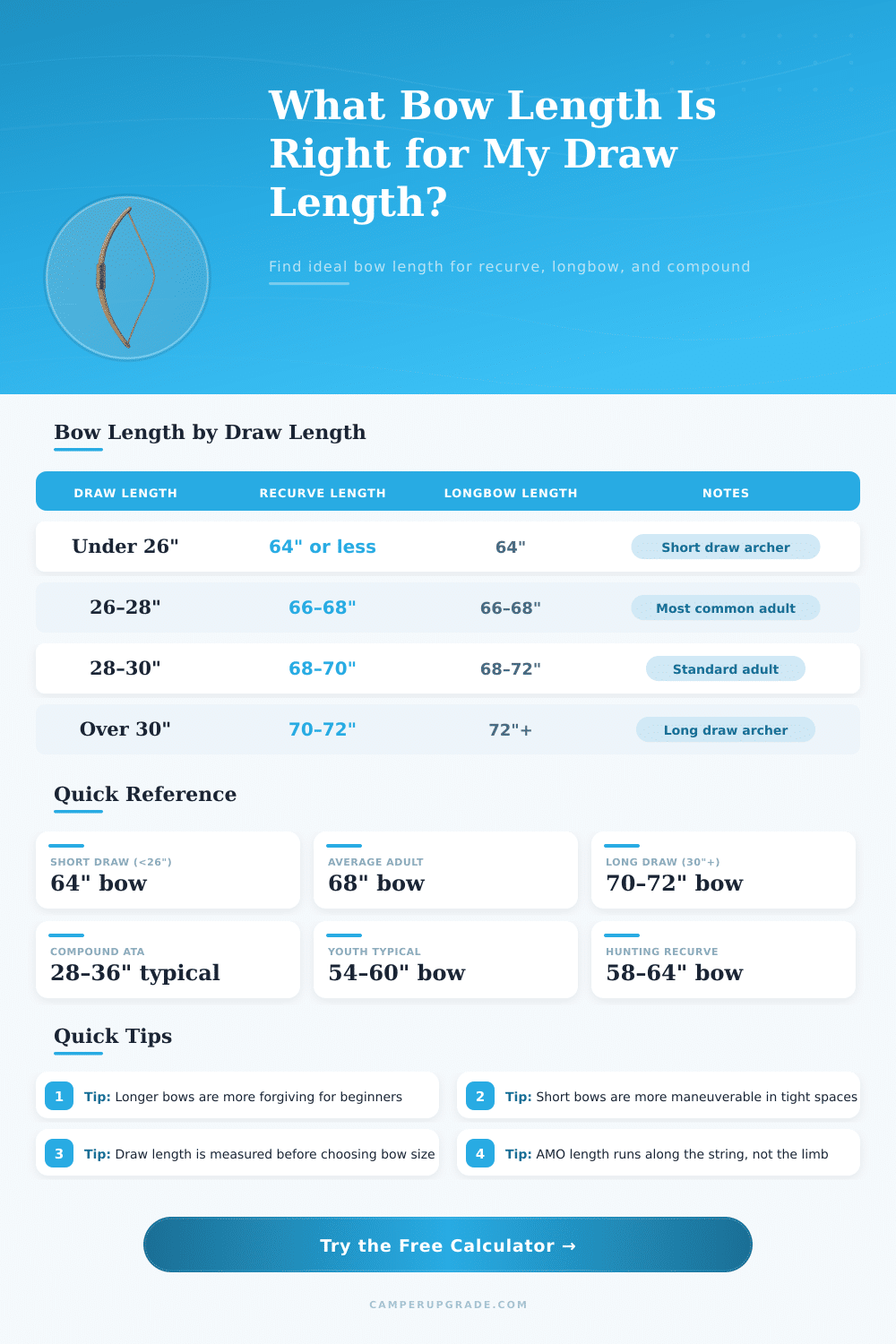
Here is the main thing, everything depends on your draw length, not your height. The basic rules are simple: if your draw length is around 24 inches, a 64-inch bow best works. If you draw between 25 and 27 inches, a 66-inch bow is the best choice.
Choose the Right Bow Length
When you reach 27 to 29 inches, you require a 68-inch bow. And if you draw 30 inches or more, then a 70-inch bow is what you serach.
In the world of Olympic recurve and barebow, one sees bows from 66 to 72 inches. For a 28-inch draw, a 68-inch bow becomes almost the standard choice for all. Even so, something interesting happens with Korean shooters…
They commonly favor 70-inch bows, regardless of their own draw length.
Here starts the importance of the combination of the riser and the limbs. Assume that you have a 25-inch riser. If you put on it long limbs, you get a 70-inch bow; medium limbs give 68 inches, and short limbs give 66 inches.
If you use a 23-inch riser, every choice drops by two inches. Moreover, changing limbs to another riser changes also the draw weight. For instance, 42-pound medium limbs on a 23-inch riser will weigh around 44 pounds and will measure roughly 66 inches.
Long bows usually shoot smoother and more accurately. Occasionally they even send the arrow more quickly. The problems start with short bows, your fingers feel pressed, because the angle of the string becomes sharper when you finish the draw.
A good rule is that the bow be at least twice longer than your draw distance. So, if you draw 28 inches, you require at least a 56-inch bow. For beginners, it helps to add another 2 to 4 inches as a buffer.
Hunters commonly favor short bows, because they are easier to move through dense woods. Some use bows as short as 54 inches, because they are very easy to transport. Others favor 60 to 64-inch recurve bows for hunting, because they feel comfortable even in brushy terrain.
One formula that always works is: double your draw length and add 2 inches for minimal comfort.
Here is something that commonly confuses folks: a string for a 68-inch bow does not measure 68 inches. Its standard length is around 164 centimeters, which is approximately 64.5 inches. Bow length and string length follow different standards, so always choose your string according to what is written on the bow.
Exactly determine your draw length before buying anything is decisive. Counting it by means of your wing span can err by one or two inches. Also your technique and your strength can alter your drawlength over time.