🏹 Bow Kinetic Energy Calculator
Calculate arrow KE, momentum, and downrange hunting suitability
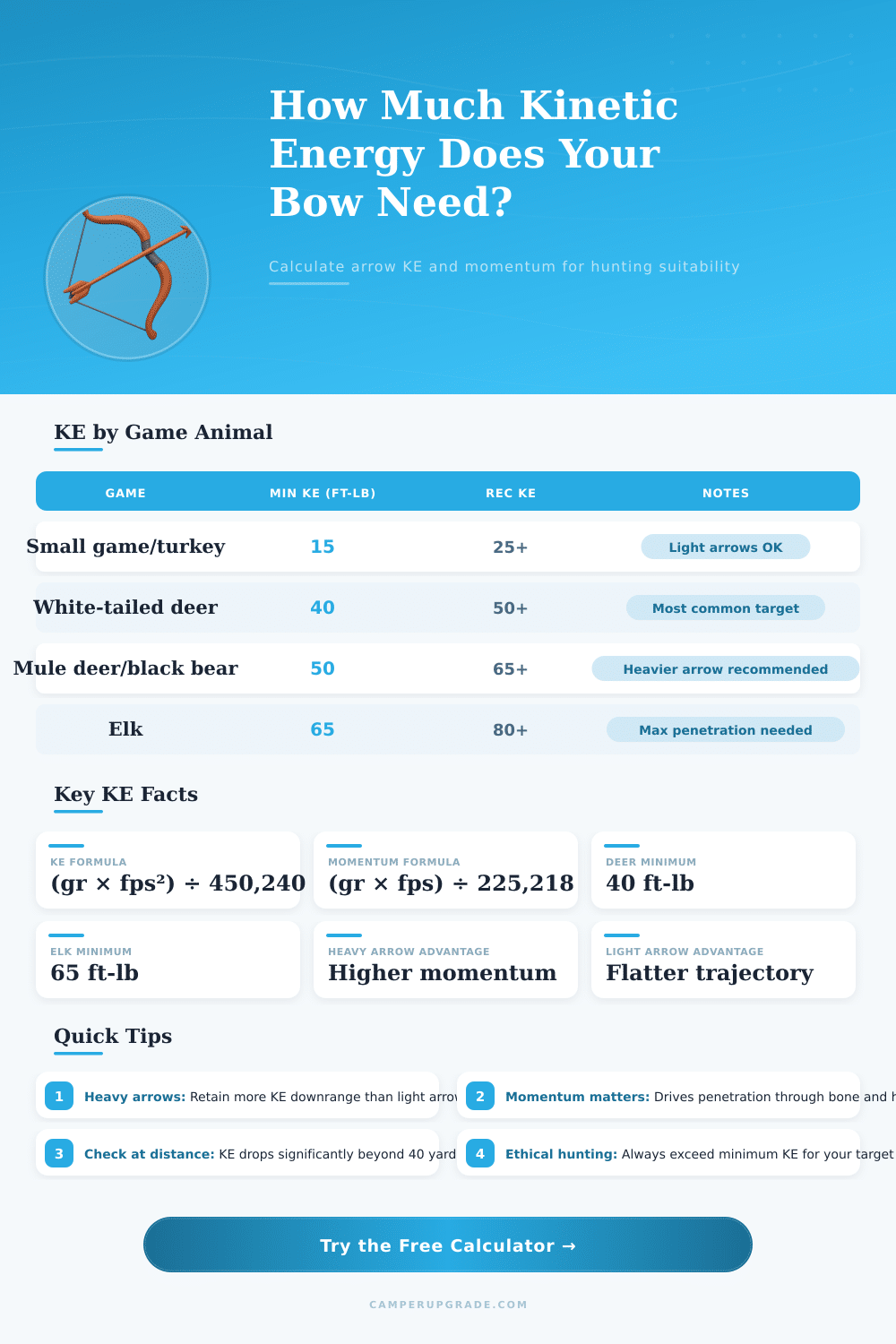
| Game Animal | Min KE (ft-lb) | Rec KE (ft-lb) | Notes |
|---|---|---|---|
| Small game (rabbit, squirrel) | 15 | 20+ | Light arrows, short range |
| Turkey | 15 | 25+ | Target vitals carefully |
| White-tailed deer | 40 | 50+ | Most common hunting target |
| Mule deer / black bear | 50 | 65+ | Heavier arrow recommended |
| Elk | 65 | 80+ | Max penetration critical |
| Moose / large bear | 80 | 100+ | Heavy arrow + high draw weight |
| Arrow Type | Speed (fps) | Weight (gr) | KE (ft-lb) | Momentum (slug-ft/s) | Best For |
|---|---|---|---|---|---|
| Light arrow | 330 | 300 | 72.5 | 0.440 | Target, small game |
| Medium arrow | 310 | 400 | 85.7 | 0.551 | Whitetail deer |
| Heavy arrow | 285 | 480 | 86.7 | 0.608 | Elk, bear |
| Super heavy arrow | 260 | 600 | 90.3 | 0.693 | Large game, max penetration |
Estimated values for a 70 lb compound bow. Actual results vary by bow and draw length.
Momentum (slug-ft/s) measures the arrow's resistance to deceleration on impact. A heavier, slower arrow may have similar or lower KE than a lighter, faster arrow — but higher momentum drives deeper penetration through bone, muscle, and hide. Many experienced big-game hunters prioritize momentum over raw KE for this reason.
Best practice: Use KE thresholds to meet minimum hunting requirements, then optimize momentum with heavier arrows for maximum penetration — especially on large or heavily built animals.
Kinetic energy is simply the power that an arrow carries while it flies. When the arrow hits something, that energy moves to the target. That is the basic force of the impact, it determines how hard the arrow hits In bowhunting, kinetic energy is measured in foot pounds, which is the energy needed to push one pound weight through a distance of one foot.
Imagine kinetic energy as a hammer and the arrow as the nail. The kinetic energy does the work, pushing the broadheads through skin, muscle and bone. Many hunters focus only on the speed of the arrow, but speed is only one part of the calculation.
Kinetic Energy of an Arrow
The word “kinetic” itself means “by means of motion, do active work.” Energy exists in many forms and can often change from one form to another. In bows, energy is stored in the limbs and cams when one draws it back. Later, during the shot, that stored energy moves to the arrow as kinetic energy.
To count the kinetic energy, two variables are needed: the weight of the arrow in grains and its speed in feet per second. Chronographs can measure the speed, or one can estimate it according to the specs of the bow. There are even online calculators where one simply puts in those numbers.
The formula is to multiply the arrow weight by the square speed, then divide that by 450,800.
heavier arrows and higher speed both increase the kinetic energy. A heavier arrow slows the flight because of the extra weight, but it adds more kinetic energy to the hit. Usually, a bow becomes a bit more efficient with a heavier arrow.
Everything that moves has kinetic energy; so, the heavier the combination of arrow and broadhead is while it still flies quickly, the more energy it carries. That can be a bit confuused, because bows always change and new bows shoot more quickly.
The fast part of kinetic energy does not depend only on how quickly the arrow leaves the bow. It is about the speed of the arrow when it actually hits the target. Like this, the kinetic energy at the launch and the energy at the impact can be different numbers.
A bow with a long power stroke pushes the arrow for a longer time, giving it more kinetic energy even with the same draw weight as another bow. Efficiency also is important. If a compound bow stores 100 joules but shoots an arrow with 80 joules, it could be less efficient than a recurve bow that stores 50 joules and delivers 45 joules to the arrow.
The potential energy of the bow stays the same between shots, but it changes how well it converts that energy to kinetic form.
Knowing the kinetic energy helps decide if the arrows have enough power for the game being hunted. Modern bows are much more powerful than old models when it comes to kinetic energy, so today one can do more with less drawforce.