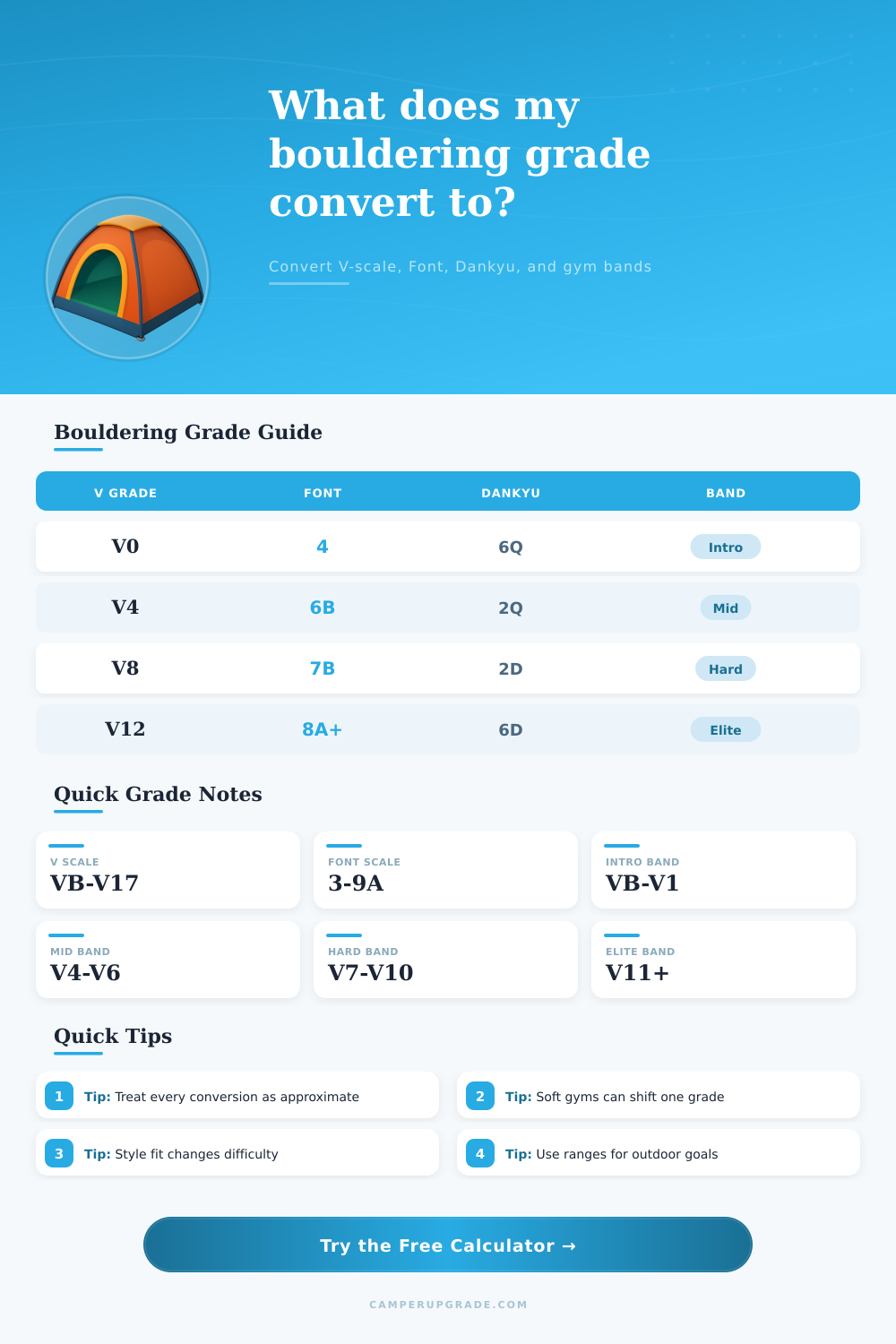
Bouldering Grade Conversion Calculator
Convert bouldering grades across V-scale, Fontainebleau, Japanese Dankyu, and practical gym color bands, then adjust the result for soft gyms, outdoor circuits, style fit, flash range, and project planning.
1.Grade presets
2.Conversion inputs
Note: Bouldering grade conversion is approximate. The V-scale and Fontainebleau scale are the strongest direct comparison, while gym color bands and Dankyu mapping vary by setter, region, and facility.
Conversion results
3.Grade band cards
4.Reference conversion tables
| V-scale | Fontainebleau | Japanese Dankyu | Practical band |
|---|---|---|---|
| VB | 3 | 8Q | Intro first boulder problems |
| V0 | 4 | 6Q | Intro basic gym and outdoor movement |
| V1 | 5 | 5Q | Intro plus steeper or more technical starts |
| V2 | 5+ | 4Q | Base common first outdoor goal |
| V3 | 6A | 3Q | Base technique and tension matter |
| V4 | 6B | 2Q | Middle specific beta and body position |
| V5 | 6C | 1Q | Middle sustained or powerful sections |
| V6 | 7A | 1D | Middle plus clear style demands |
| V7 | 7A+ | 2D | Advanced harder conditions and skin |
| V8 | 7B | 2D | Advanced project tactics matter |
| V9 | 7C | 3D | Advanced movement fit matters a lot |
| V10 | 7C+ | 4D | Advanced plus narrow beta window |
| V11 | 8A | 5D | Elite refined limit bouldering |
| V12 | 8A+ | 6D | Elite conditions become decisive |
| V13 | 8B | 7D | Elite elite outdoor benchmark |
| V14 | 8B+ | 8D | Elite plus world-class difficulty |
| V15 | 8C | 9D | Elite plus very rare grade |
| V16 | 8C+ | 10D | World elite cutting-edge level |
| V17 | 9A | 11D | World elite open-ended top end |
| Conversion use | Best input | Usual uncertainty | Calculator treatment |
|---|---|---|---|
| Gym to outdoor trip | Recent repeated sends | 1 to 2 V grades | Soft gyms reduce the baseline and widen the suggested range. |
| Outdoor area to outdoor area | Guidebook V or Font grade | About 1 grade | Outdoor baseline stays stable unless sandbag mode is selected. |
| Font circuit planning | Fontainebleau number and letter | Half to 1 grade | Font output is prioritized and warm-up range is shown below target. |
| Board benchmark | Board grade or repeated benchmark | 1 grade or more | Power style increases caution for slab or coordination transfer. |
| Competition set | Color band or setter range | Often broad | Color bands convert to a midpoint and show a wider grade spread. |
| Grade relationship | Suggested range | Typical use | Planning note |
|---|---|---|---|
| Warm-up | 3 to 5 V grades below limit | Movement prep and skin check | Stay easy enough to avoid burning power or fingertips. |
| Flash or quick send | 1 to 3 V grades below limit | Volume and confidence | Choose familiar style when visiting a new gym or area. |
| Session project | At limit to 1 grade above | Same-day attempts | Best for problems with clear beta and good conditions. |
| Multi-session project | 1 to 2 grades above | Longer term goal | Style fit, skin, and conditions can matter more than conversion. |
| Stretch project | 2 or more grades above | Limit practice | Use for moves, links, and skill development rather than send certainty. |
5.Conversion notes
On paper, boulder grades seem easy enough: a V6 is a V6. But when you wander into a new gym or visit a place for the first time, those grades gets slippery. What’s one person’s V6 can be another’s V7, and the European Fontainebleau scale tend to be a notch or two different than our more common V-scale in America. That can make a big difference if you’re setting reasonable goals for your season or even planning a trip.
Plug the system you are converting from, your current grade, and some information on how you got that grade into converter above. It will crunch numbers and provide an adjusted range for project, flash, and warm-up, rather than just one neat number.
How to Use the Climbing Grade Converter
There’s reason for the inputs: Grading doesn’t come off a table. What the grade really means in practice shift depending on situation. It changes when a problem play to your strength, when you have a soft gym set, or when you are sandbagging outside. While V- and Fontainebleau grades is closest on scale, it’s all about margins.
The calculator lowers your expectations if you’ve been climbing at a gym with softer than outdoor grading. It raise them if you’re going to an area where power doesn’t work as well as precise footwork, like many Font circuits does. Those tweaks won’t be right for everyone but they’ll prevent you from taking any one converted grade as gospel. This is why I put those reference tables on the page.
Not only do they display how color bands and Dankyu numbers aligns with V grades, but they help you remember that while one grade of drift is normal, two grades usually signals unusually soft or stiff grading. Typically two grades of drift mean there is some sort of style mismatch large enough to make it feel completely different, or they are using unusually stiff or unusually soft material. The calculator just lets you see this without guessing at it.
People get tripped up most often because they assume their strong grade are portable. Just because you can do a powerful V8 on a steep board doesn’t mean it translate to a V8 slab or a V8 coordination problem. The calculator has a small feature called a personal fit setting that tries to reflect this reality by nudging the project range up or down to match your style better. It’s a small correction but could of keep you from stacking too many problems of same sort in a single session.
When used correctly, the tool transforms grade conversion into a quick planning exercise rather than a guessing game. Choose your starting grade. Consider where that grade came from. Compare it to the recommended range of grades for both long project and warm-ups. It’s not intended to be a replacement for repeated sends or local knowledge; rather, the output provide a more defined starting place than a static chart.