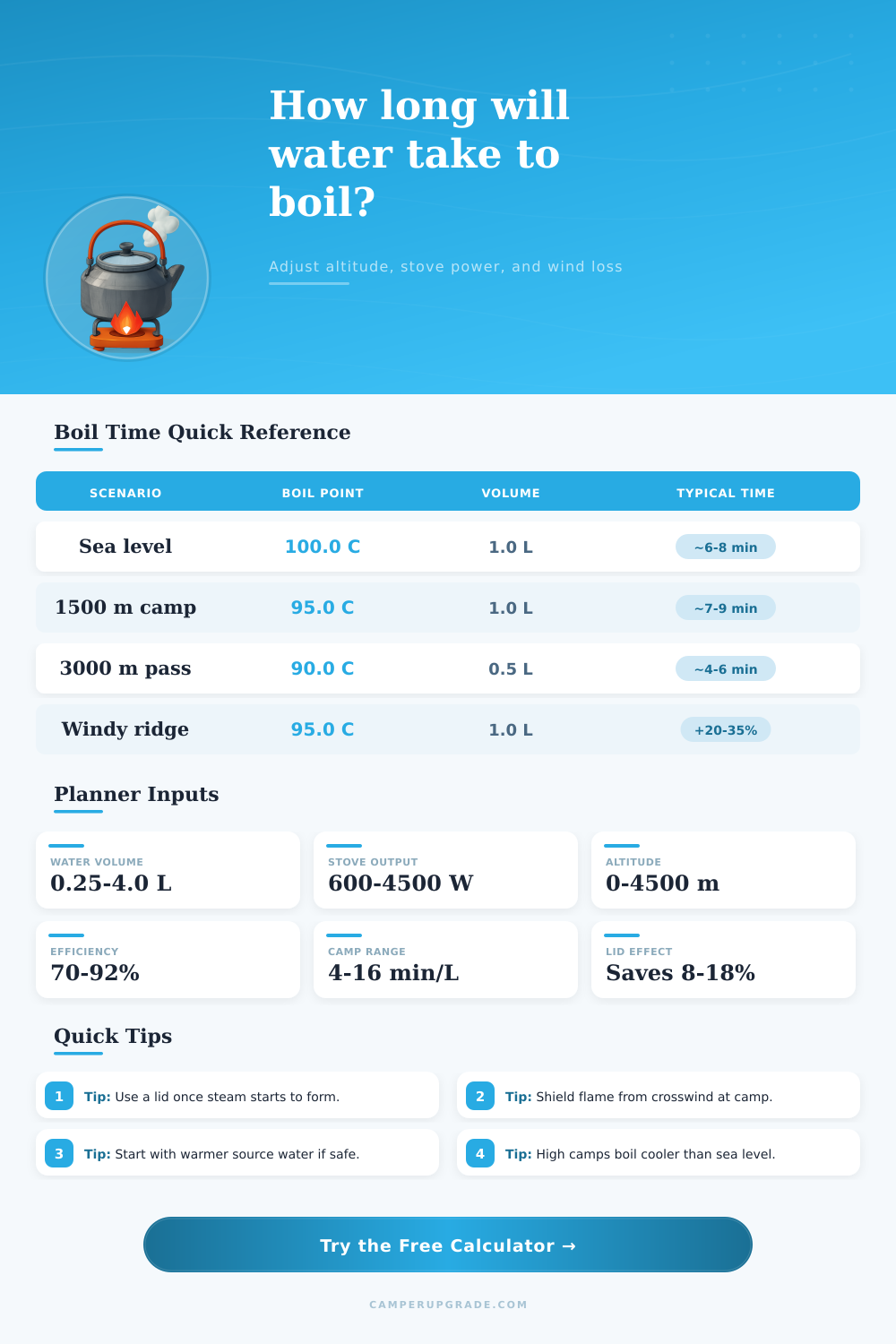
Time to Boil Water Calculator
Estimate boiling point and heating time with altitude, stove output, efficiency, lid use, and wind exposure for realistic camp planning.
🏕️Camp Presets
⚙Boil Inputs
📊Boiling Snapshot Grid
📘Boil Time Reference Tables
| Altitude | Pressure | Boiling Point | Boiling Point |
|---|---|---|---|
| 0 m (0 ft) | 101.3 kPa | 100.0 C | 212.0 F |
| 1000 m (3281 ft) | 89.9 kPa | 96.7 C | 206.1 F |
| 2000 m (6562 ft) | 79.5 kPa | 93.4 C | 200.1 F |
| 3000 m (9843 ft) | 70.1 kPa | 90.0 C | 194.0 F |
| 4000 m (13123 ft) | 61.6 kPa | 86.3 C | 187.3 F |
| Stove Type | Altitude Power Loss | Best Use | Planning Note |
|---|---|---|---|
| Canister Gas | 3.5% per 1000 m | Fast general camp boils | Use windscreen and warm canister |
| White Gas | 2.3% per 1000 m | Cold and high routes | Stable output at altitude |
| Alcohol | 4.8% per 1000 m | Ultralight low volume boils | Longer time in wind and cold |
| Wood Gasifier | 5.5% per 1000 m | No fuel canister trips | Output swings with fuel quality |
| Induction/Electric | 0% direct loss | Hookup or large inverter | Efficiency depends on cookware |
| Water Batch | Energy to 100 C | At 1200 W Effective | At 1800 W Effective |
|---|---|---|---|
| 250 mL | 84 kJ | ~1.2 min | ~0.8 min |
| 500 mL | 167 kJ | ~2.3 min | ~1.5 min |
| 1.0 L | 335 kJ | ~4.7 min | ~3.1 min |
| 2.0 L | 670 kJ | ~9.3 min | ~6.2 min |
| Camp Scenario | Water + Altitude | Effective Output | Boil Time |
|---|---|---|---|
| Solo tea break | 0.5 L at 1800 m | 1350 W | ~3.8 min |
| Two meal pouches | 0.8 L at 2200 m | 1280 W | ~6.0 min |
| Family pasta pot | 2.5 L at 900 m | 1700 W | ~12.6 min |
| Sterilize batch | 1.0 L at 3000 m | 900 W | ~11.5 min + hold |
Water boils at a more lower temperature at high altitudes due to the lower air pressure at high altitudes. Water boils at 100 degree Celsius at sea level. However, as individuals climbs higher mountains, the boiling point of water decreases.
For every 1,000 meter that individuals climb, the boiling point of water decreases by approximately one degree Celsius. As a result of the boiling point of water decreasing at high altitudes, the temperature of the boiling water is also lower. Because the temperature of the water is lower, it takes longer for foods to cook as the foods require a certain amount of heat to cook, regardless of the boiling point of the water.
Why water boils at lower temperature on high mountains and how to boil faster
Wind is another factor that can play a role in how quick the water reaches a boil. The wind can play on the efficiency of the stove that is being use for heating the water. For instance, the wind can scatter the heat from the pot that is being used to heat the water.
Additionally, the wind can also reduce the heat output of stoves by up to one-third. To avoid the negative effects of the wind, the individuals should use a windscreen or find a shelter spot for there cooking stove. Finally, the individuals should always use a lid on the pot to allow the water to reach the boiling point more quick.
Using a lid can save the individual between 8 and 18 percent of the time that it would otherwise take to boil the water. The type of fuel that the individual uses and the type of stove that the individual uses will also play a role in how quickly the water comes to a boil. For instance, canister stove can lose power at high altitudes.
This is due to the fact that the gas that is contain within the canister loses pressure as the temperature of the gas drops. Canister fuels can lose around 3.5 percent of their output for every 1,000 meters of altitude that is gained. To avoid this issue, individuals can store their fuel canister in a warm location, such as their pocket or sleeping bag.
Additionally, alcohol stove are also common cooking stoves for outdoor adventurers. However, alcohol stoves can lose 5 percent of their power for every 1,000 meters of altitude gained. Therefore, white gas fuel is considered to be better for these type of high altitudes and for melting snow, since white gas contains more heat energy then alcohol fuel.
The material out of which the pot is made can also play a role in how efficient the stove is for boiling water. Metals like aluminum are considered to be the most efficient for stovetops because they allow the water in the pot to perform clean burns. In contrast, cast iron pot are thought to be less efficient than aluminum pots.
This is due to the high thermal mass of the cast iron; the high thermal mass means that the cast iron stovetop absorbs a significant amount of heat energy for itself. In addition to the materials use to create the stovetop, the individual should also ensure that the size of the stove flame matches the size of the bottom of the pot. If the stove flame is too small for the pot, the heat will escape the sides of the pot.
This waste of heat can reduce the efficiency of the stove by up to 10 percent. The temperature of the water that is to be boiled is another factor for the individual to consider. If the water that is use to cook food is starting from a temperature of cold water from a stream, for instance, the stove will take longer to heat the water to the boiling point than if it started from warmer water.
Therefore, to save time boiling water at high altitudes, the individual should use water that is already warm. Additionally, another factor for the individual to consider is the volume of water. To heat two liter of water requires more energy than twice the amount of energy that is required to heat one liter of water.
Finally, another consideration for the individual is the fact that water that is boiling at high altitudes will not become as hot as boiling water is at sea level. This is due to the fact that water boils at a lower temperature at high altitudes. Therefore, if the individual is preparing foods that require boiling water, those foods may not cook properly unless additional time is allowed for such foods to cook.
Finally, if the individual intends to use the boiling water to sterilize the water to remove pathogens, such as bacteria or viruses, the water will need to be maintain at a boil for a longer period at high altitudes to ensure the sterilization of the water.