⚓ Boat Anchor Size Calculator
Estimate anchor weight, rode length, and safety margin from your boat, bottom, and anchoring conditions.
🎤Anchoring Presets
⚙Boat And Anchor Inputs
Use the loaded length overall, not the brochure hull length.
Include fuel, water, people, and cruising gear.
Measure depth where the anchor will actually hold.
Use vertical height from waterline to roller or cleat.
Use the highest likely rise during the set.
Typical values range from 4:1 to 10:1.
Total deployable rode after knots, joins, and snubbers.
📋Anchor Size Comparison Grid
📘Reference Tables
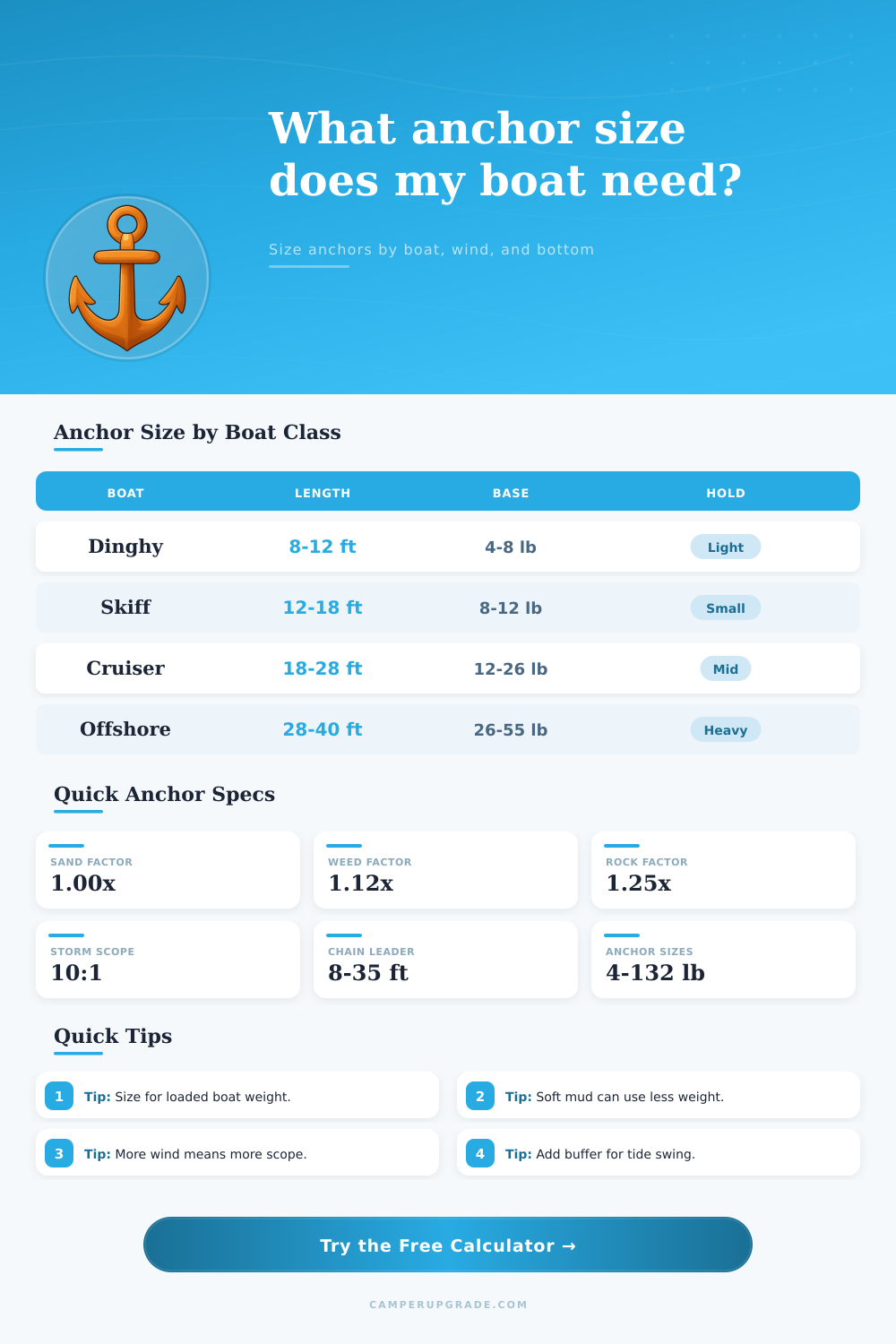
| Boat class | Length band | Loaded weight | Advisory anchor |
|---|---|---|---|
| Dinghy or tender | 8-12 ft | 500-1200 lb | 4-8 lb |
| Small skiff | 12-18 ft | 900-2200 lb | 8-12 lb |
| Center console | 18-26 ft | 2000-6000 lb | 12-22 lb |
| Cabin cruiser | 24-32 ft | 5000-12000 lb | 16-33 lb |
| Sailboat | 24-36 ft | 5000-14000 lb | 20-40 lb |
| Pontoon boat | 20-30 ft | 2500-7000 lb | 16-30 lb |
| Catamaran | 28-42 ft | 6000-18000 lb | 26-55 lb |
| Trawler | 30-45 ft | 10000-30000 lb | 33-70 lb |
| Bottom type | Size factor | Scope bias | Holding note |
|---|---|---|---|
| Sand | 1.00x | 1.00x | Baseline hold |
| Soft mud | 0.95x | 0.95x | Often sizes lighter |
| Clay | 1.03x | 1.00x | Can need harder set |
| Weed or grass | 1.12x | 1.10x | More scope helps bite |
| Gravel or shell | 1.15x | 1.08x | Watch for skate risk |
| Rock or rubble | 1.25x | 1.20x | Needs extra reserve |
| Coral or hardpan | 1.28x | 1.25x | Use conservative sizing |
| Anchor style | Best bottom | Weight feel | Use case |
|---|---|---|---|
| Fluke / Danforth | Sand, mud | Lighter | Fast bite, flat stow |
| Plow / CQR | Mixed seabeds | Medium | Classic all-around choice |
| Claw / Bruce | Sand, weed | Medium | Good reset behavior |
| Scoop / Rocna | Sand, mud | Efficient | High holding per pound |
| Mushroom | Mooring only | Heavy | Permanent installation |
| Grapnel | Spare / tender | Light | Not ideal for main anchor |
| Condition | Scope target | Chain leader | Rode note |
|---|---|---|---|
| Protected lunch stop | 4:1 to 5:1 | 8-12 ft | Short, calm set |
| Moderate day stop | 5:1 to 6:1 | 10-18 ft | Balanced setup |
| Overnight bay | 6:1 to 7:1 | 12-25 ft | Extra swing room |
| Exposed anchorage | 7:1 to 8:1 | 15-30 ft | Use more reserve |
| Storm readiness | 8:1 to 10:1 | 20-35 ft | Build every margin |
An anchor is a tool that boat uses to secure themselves to a seabed. An anchor must be sized correct when compared to the boat that is to be anchored so that the anchor will not drag on the seabed when the boat is exposed to environmental force. Environmental forces, such as wind, waves, and currents will exert a force on the anchor that could drag the boat towards shore, creating a potentially dangerus situation for the boat and those on board.
In order to calculate the size of the anchor that should be used for a boat, the displacement of that boat must be calculated. The displacement of a boat is the total weight of the boat when it is fully loaded with individuals, fuel, coolers, and any other item that may be on the boat. The empty weight of the boat should not be used to calculate the anchor size.
How to Choose the Right Anchor for Your Boat
For instance, a boat that weighs 7,000 pounds when it is empty may weigh more significently when it is loaded. That additional weight must be accounted for in the calculation of anchor size. The profile of the boat will also play a role in the sizing of the anchor for that boat.
For instance, boats with a wider beam, such as catamarans, will experience stronger winds due to the width of the boat. Boats like pontoon boats tend to float higher above the water, which also causes them to catch more wind. Thus, the anchor should be sized in a way that compensate for this “windage” of the boat.
If the size of the anchor is not accounted for windage, the wind will pull on the boat and the wind will pull the anchor out of the seabed. The type of seabed upon which the boat will anchor will impact the size of the anchor that is used. For instance, sandy seabeds will allow the anchor to bury itself deeply into the seabed; thus, sandy seabeds provides good “holding power” to the anchor.
Seabeds composed of mud will also allow the anchor to easily sink into the seabed, allowing for the use of a lighter anchor when anchoring on muddy seabeds. In contrast, gravel and rock seabeds are harder surfaces that will cause the anchor to skid on the seabed. Additionally, if the seabed is comprised of coral or hardpan, a larger anchor with more rode will be needed to effectively secure the boat.
The rode is the line that connects the anchor to the boat. There are different types of rode that can be used, such as all-chain rode or rope rode. All-chain rode is heavy and remains on the seabed, but requires a long length of chain to ensure proper functioning of the rode.
Rope rode is lighter than chain rode, but has the potential to stretch. The length of rode that is used should be calculated to the depth of the water in which the boat is to be anchored. This ratio is referred to as the scope.
For instance, if the water is 10 feet deep, a certain length of rode will ensure that the anchor remains flat to the seabed. A scope of 5:1 would mean that five times the depth of the water will be used as rode length. However, if the weather is to be windy, 7:1 or 10:1 scope would be used to ensure that the wind does not pull the anchor out of the seabed.
When determining the size of the anchor that will be used for the boat, it is important to avoid using the specifications listed in the boats brochure. Brochures will likely use the empty weight of the boat to calculate the size of the anchor that should be used. Additionally, it is important to not skip the inclusion of the chain leader to the rode.
The chain leader will ensure that the anchor is designed to bury itself into the seabed. If the chain leader is skipped, the anchor may not bury into the seabed as it should. Finally, it is important to include a 10 to 30 percent reserve in the size of the anchor.
This added percentage will ensure that there is a safety margin in case of gusts of wind that may encounter the boat. When anchoring the boat, specific techniques should be used to ensure the boat is secured. For instance, the boat should be moved slow so that the anchor can be felt digging into the seabed.
Additionally, you should back the boat down to test the anchor. Furthermore, a snubber should be utilized so that shock loads upon the anchor are reduced, so that the anchor will not be pulled out of the seabed. Finally, it is recommended that the boat carries a spare anchor to be used in the case that the primary anchor becomes stuck to the seabed.