Bivy Sack Size Calculator
Estimate bivy length, shoulder girth, footbox clearance, headroom allowance, gear space, condensation gap, fabric stretch, and packed volume class from your sleep system.
⛺Bivy Fit Presets
⚙Sleeper, Pad, Bag, and Bivy Inputs
The calculator treats the bivy as a soft enclosure around the pad and lofted bag, then adds length, headroom, gear volume, condensation clearance, and fabric behavior.
🧮Bivy Sizing Formula Cards
Length
height + pad + endsOverall length follows the taller of sleeper height or pad length, then adds head, foot, and gear allowance.
Girth
body + loft + padShoulder girth is estimated from body width, bag loft, pad thickness, movement, and condensation gap.
Footbox
loft + toe gapFoot clearance protects insulation from pressing against the bivy end panel during wet nights.
Packed Size
fabric area + classFabric style, dimensions, head shape, and gear room estimate a practical packed volume class.
🧵Bivy Fabric and Spec Grid
📊Bivy Size Reference Tables
| Bivy class | Typical length | Shoulder girth | Best use |
|---|---|---|---|
| Emergency sack | 80-84 in | 58-64 in | Backup warmth |
| UL bivy | 82-86 in | 60-68 in | Tarp camping |
| Wide bivy | 86-90 in | 68-74 in | Wide pads |
| Hooped bivy | 86-92 in | 68-78 in | More headroom |
| Winter bivy | 88-94 in | 74-84 in | Bulky loft |
| Pad size | Width | Length | Bivy note |
|---|---|---|---|
| Short mummy | 20 in | 48-66 in | Lower volume |
| Regular mummy | 20 in | 72 in | Most UL bivies |
| Regular wide | 25 in | 72 in | Needs wider girth |
| Long wide | 25 in | 77-80 in | Check length |
| Rectangular wide | 30 in | 78 in | Roomy shell |
| Condition | Condensation gap | Headroom add | Why it matters |
|---|---|---|---|
| Dry alpine | 1-1.5 in | 3-4 in | Less moisture |
| Normal camp | 2 in | 4-6 in | Breathing pocket |
| Humid forest | 2.5-3.5 in | 6-8 in | Damp shell risk |
| Winter frost | 3-4 in | 7-10 in | Protect loft |
| Emergency only | 0.5-1 in | 1-3 in | Short duration |
| Fabric type | Stretch | Breathability | Pack class |
|---|---|---|---|
| Emergency film | 0% | Low | Tiny |
| Coated nylon | 1-2% | Low-medium | Small |
| WPB laminate | 0-2% | Medium | Small |
| Soft WPB face | 2-4% | Medium-high | Medium |
| Mesh upper | 4-6% | High | Tiny-small |
💡Bivy Fit Tips
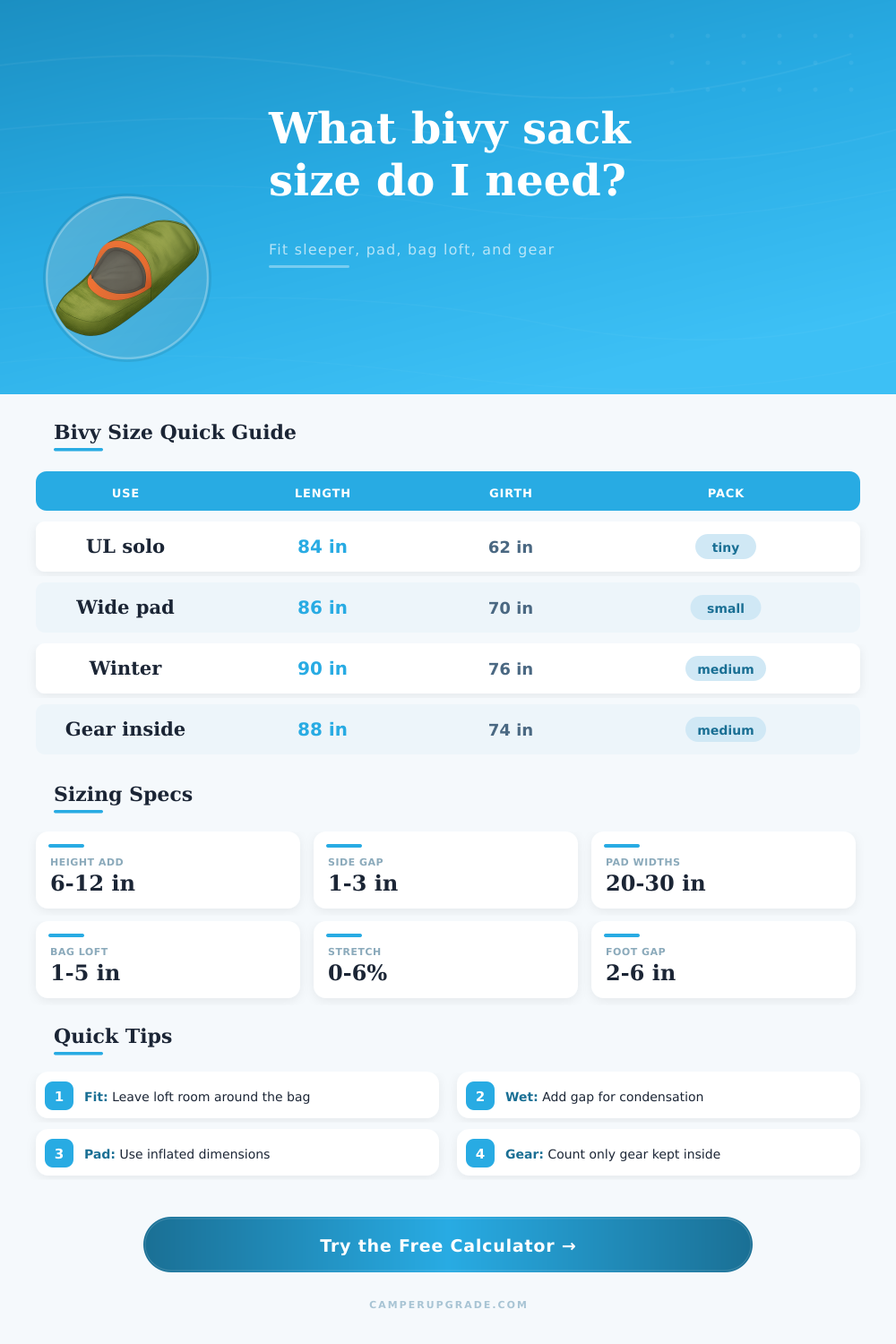
Choosing an bivy sack is a process of match a bivy sack to a specific sleep system. A bivy sack should not be chose based only on the smallest size of sleeping bag or bivy sack. A bivy sack that is too small may allow the bivy sack to press against the sleeping bag’s loft, which will cause the sleeping bag’s loft to lose it’s warmth and cause the sleeping person to feel clammyly.
A bivy sack that is too large will add unnecesary weights to the persons pack, and will take up too much space in a sleeping persons pack. The user should choose a bivy sack such that it provide enough room for the sleeping person to roll up in the sleeping bag without the bivy sacks fabric touch the sleeping bag. The length of the sleeping bivy sack must be enough to cover the longest part of the sleeping system.
How to Pick the Right Bivy Sack Size
For most people, the longest part of the sleeping system are themselfs; their body. However, in some cases, the longest part of the sleeping system may be their sleeping pads. Furthermore, individuals may have sleeping gear that they wish to include in their bivy sack, such as boots or a water filter.
In these cases, an individual will need to calculate the length of the sleeping bivy sack to determine how much extra length the bivy sack will need beyond there sleeping system and sleeping gear. By calculating the length requirement for their sleeping system, an individual will know how much extra length the sleeping bivy sack will need to provide for the sleeping persons feet, preventing them from guess at how long the sleeping bivy sack should be. The girth of the bivy sack must account for many different factor.
The girth of the sleeping bivy sack must account for the sleeping persons shoulders, the sleeping bags loft, and the sleeping pads thickness. Furthermore, there must be a small air gap between the sleeping bag and sleeping bivy sack to allow the sleeping person to breathe and to allow condensation to not touch the sleeping bag’s insulation. Additionally, since people who sleep on their side will require more space in their sleeping bivy sack than those who sleep on their back, their sleeping bivy sack should account for this.
Finally, in wet weather, or if the sleeping bag being use has extra loft for winter sleeping, the sleeping bivy sack girth will need to be larger to account for this extra thickness. Footbox clearance is the vertical measurement of the sleeping bivy sack. The sleeping person should ensure that there is sufficient vertical space above the sleeping bag’s footbox.
Much of the moisture that condenses within the sleeping bag will collect in this vertical space above the sleeping bag’s footbox. If the sleeping bivy sack provides extra length for the sleeping person’s feet, the sleeping bivy sack will shed moisture from the sleeping bag downward, rather than allowing the condensation to collect at the sleeping bag’s footbox. A bivy sack with a hooped design will provide more headroom and more volume at the foot end of the bivy sack than a bivy sack that do not contain a hoop.
Fabric stretch and condensation clearance are two factors that will affect the way that a bivy sack function. Some bivy sacks has a fabric that contains a small amount of stretch, and a bivy sack with stretch in the fabric will feel larger than a bivy sack with flat fabric. Condensation clearance is important to ensure that the insulation within the sleeping bag remain dry.
If there is a gap between the sleeping bag and the bivy sack, the insulation will remain lofty. If there is no gap between the sleeping bag and the bivy sack, the moisture will migrate into the sleeping bag and it will lose warmth. Reference tables can help to indicate the differences between winter bivy sacks and ultralight bivy sacks in terms of length and girth.
These tables will not contain the rules for each type of bivy sack, but they will show whether the bivy sack is of a standard or extreme size for a sleeping system. People often attempt to choose the size of the bivy sack by measuring their previous sleeping system. However, the sleeping pad and sleeping bag may have change.
Therefore, there is a decision to make about whether the weight of a larger bivy sack is worth the comfort that it will provide or whether less weight and less sleeping sack room are preferred. A calculator can show the cost of each bivy sack choice in terms of length, girth, and the packed size of the bivy sack. Based off the result of the calculator, the consumer can compare that result to the bivy sack models that they intend to purchase.
The consumer can measure the actual bivy sack model, and the behavior of the fabric when wet can be consider. The shape of the bivy sack can also be considered when buying a bivy sack model. Although the bivy sack may appear to be the correct size, the shape may be incorrect for the sleeping system.
The goal in purchasing a bivy sack is to find a bivy sack that will provide protection for the sleeping system without interfere with the sleeping system. The bivy sack should be small enough to pack easy but provide enough room for sleeping in changing weather condition. By selecting a bivy sack that fulfills each of these requirement, the bivy sack will function correct for the sleeping system on the ground.