Binocular Field of View Calculator
Compare angular field, linear field, apparent field, distance width, eye relief, close focus, edge sharpness, and hand-held stability for binocular specs.
Field of view estimate
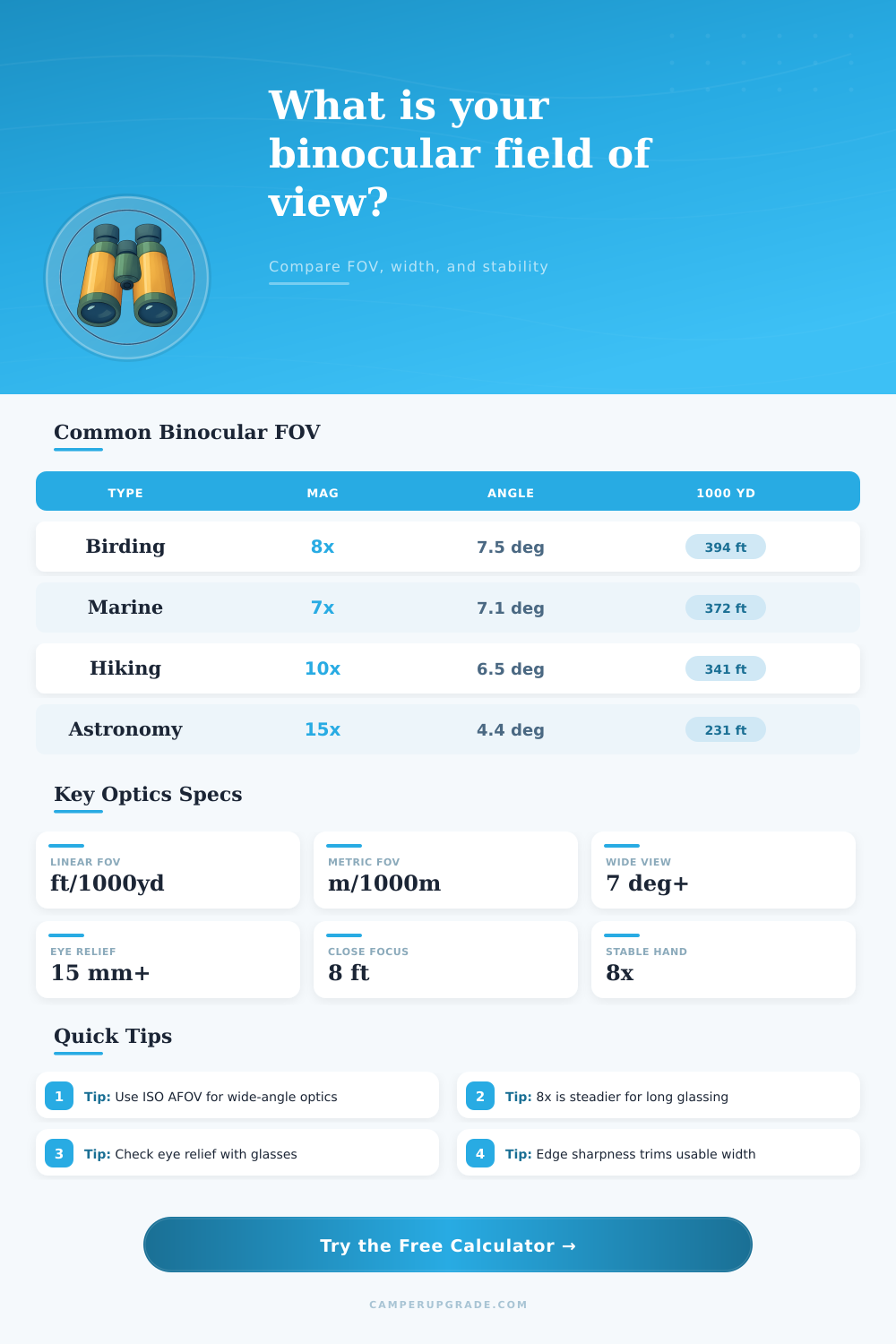
| Angular FOV | ft at 1000 yd | m at 1000 m | Typical impression |
|---|---|---|---|
| 4.0° | 210 ft | 69.9 m | Narrow high-power view |
| 5.0° | 262 ft | 87.5 m | Moderate 12x view |
| 6.0° | 315 ft | 105.1 m | Common 10x field |
| 7.0° | 367 ft | 122.8 m | Wide general view |
| 8.0° | 420 ft | 140.5 m | Very wide 8x field |
| 9.0° | 472 ft | 157.4 m | Extra-wide scanning |
| Apparent FOV | View feel | Common examples | Tradeoff |
|---|---|---|---|
| Under 50° | Tunnel-like | Compact economy optics | Easy edges, narrower view |
| 50-59° | Standard | Many 8x and 10x models | Balanced design |
| 60-64° | Wide angle | Premium birding models | Needs good edge correction |
| 65°+ | Immersive | Wide 8x32 or 8x42 | Edges reveal optical quality |
| Binocular type | Common spec | Typical FOV | Best fit |
|---|---|---|---|
| Compact trail | 8x25 | 330-360 ft | Light hiking kit |
| Birding standard | 8x42 | 375-425 ft | Fast wildlife scanning |
| All-around reach | 10x42 | 315-360 ft | Open country detail |
| Marine classic | 7x50 | 350-395 ft | Boats and low light |
| Astronomy large | 15x70 | 220-250 ft | Tripod-supported sky view |
| Spec cue | Comfort target | Watch point | Calculator effect |
|---|---|---|---|
| Magnification | 7x-8x hand-held | 12x+ magnifies shake | Main stability driver |
| Exit pupil | 4-6 mm | Small pupils need alignment | Low-light context |
| Eye relief | 15-20 mm | Short relief clips edges | Comfort adjustment |
| Close focus | 6-10 ft | Long focus misses nearby detail | Use-case note |
| Edge sharpness | 80% or better | Soft edges reduce usable field | Usable width estimate |
Field of view is another important measurement for binoculars. Field of view determines how much of a scene a person can see through the binoculars without have to move the binoculars themselves. Additionally, field of view help to determine how quickly a person can find a subject that they are interested in watching again if the subject movements within the scene.
Finally, field of view can help to determine whether a persons view is open and expansive or whether the view are narrow. Field of view can be expressed in two different ways: in degrees or in the measurement of how many feet at a thousand yards can be viewed through the binoculars. Field of view is a critical factor in the selection of binoculars because it is more important than the magnification number for the binoculars.
Field of View for Binoculars
There is different ways to measure the field of view with the binoculars. For instance, angular field of view measures the angle of what the binoculars can view, while the linear field of view is the angle expressed as a width. Additionally, the apparent field of view is the angle of how wide the view appears to the viewer when viewed through the binoculars.
Because these measurements is different from one another, a person must understand the difference between angular field of view and linear field of view. This calculator allows a person to move between these two measurement because the calculator will calculate the trigonometry for the person. A person does not typically view objects at a thousand yard.
Thus, this calculator also allows a person to input the distance that the person wishes to view the object at. For instance, if the object of interest is a shoreline that is three hundred yards away, the calculator will provide an estimation of the number of feet of the shoreline that can be viewed. Additionally, if the object of interest is a ridgeline that is two mile away, the calculator will calculate the number of feet of that ridgeline that can be viewed at a distance.
Each different distance have a different field of view, thus, this adjustment allow the person to calculate the different distances that they may view an object at. Finally, many binoculars do not have sharp edges; the center of the binocular lens may be very sharp, but the edges may appear blurry. If a viewer decides on a binocular that has blurry edges, the field of view will be less than the indicated field of view for that pair of binoculars.
Stability is another factor that can be considered when viewing objects with binoculars. Stability becomes more important with higher magnification. High magnifications allow viewers to see objects at a distance larger on the viewers retina.
However, high magnifications also allow high tremors and shaking of the viewer’s eyes to become larger on the retinal image of the viewer’s eyes. Thus, an eight power binocular may be more stable than a ten power binocular, allowing viewers to see larger fields of view with the eight power binocular. This factor in the calculator calculates the stability of the binoculars, which takes into consideration the magnification, the size of the lenses, the eye relief for viewers with vision problem, and the support for the binoculars (rail mounted to vehicle, standing in the wind, etc.).
Eye relief and close focus is another factor that may have an impact upon the field of view that a person selects with the binoculars. For instance, with short eye relief, individuals that wear glasses may have difficulty viewing the entire field of view. Additionally, if the close focus distance with the binoculars is long, then the viewer will be unable to view objects that are close to the binoculars.
Both of these factor will be considered in the design of this calculator to allow individuals to compare different binocular lenses. For example, a viewer may decide that they want to have a field of view that is somewhat narrow because they want a closer viewing distance with the binoculars. As with any other measurement, there is a relationship between the magnification with the binoculars and the field of view.
For instance, if a binocular has a lower magnification, it will have a wider field of view. An eight-by-forty-two binoculars will have a field of view of between seven and eight degrees; however, a fifteen-by-seventy binoculars will have a field of view of only four and a half degree. Thus, a high magnification will make the field of view seem narrow.
Viewers may think that a wide field of view is the best, but if the field of view is wide the binocular lens will have trouble focusing on the edges of the objects with high magnifications. The exit pupil is related to field of view. A large exit pupil will allow a viewer to see bright objects in low light conditions.
However, large exit pupils require large lenses for the binoculars. Additionally, large lenses for the binoculars will lead to the binoculars being heavy for the viewer. The stability score for the binoculars may help viewers understand the tradeoffs between a large exit pupil and high magnifications.
Edge sharpness is related to the field of view of the binoculars. Field of view is only as good as the sharpness of the edges of the lenses for the binoculars. For instance, if a binocular has a field of view of eight degrees, but the edges are blurry, the viewer may only be able to view six degrees of the object with the binoculars.
This factor will be considered in the design of this calculator to allow viewers to compare binocular lenses that have the same headline field of view for the object of interest. Finally, the relationship between the real field of view and the apparent field of view is another factor that may be considered when viewing with binoculars. For instance, the real field of view can be estimated by multiplying the magnifications by the angular field of view; however, the ISO tangent method will return a more accurate calculation of the real field of view.
Both of these methods will be provided in this calculator. Finally, the decision of which binoculars to purchase is dependent upon the activity that the viewer will use the binoculars for. For instance, a birder may want a binocular with a wider field of view and close focus for viewing birds in trees.
A hunter may use binoculars with higher magnifications to view the ridgeline from a distance. A boater may require a large exit pupil for viewing the horizon on the water. Each of the factors considered in this calculator may help to determine the different activities that an individual may perform with a pair of binoculars.
Thus, with the information provided in each field, when the viewer enters the typical viewing distances and lighting into the calculator, the calculator will provide recommendations for binoculars based off the viewers need. The goal is not to have the largest field of view for the viewer’s binoculars, but to have a field of view that is usable in the various conditions in which that viewer may use those binoculars.