Binocular Exit Pupil Calculator
Compare binocular brightness, twilight factor, wasted light, transmission-adjusted output, eye relief fit, and low-light suitability from real magnification, objective, prism, coating, and observer pupil data.
🔭Binocular Presets
Your Binocular Brightness Snapshot
⚙Optics And Observer Inputs
📊Optics Spec Comparison Grid
📘Reference Tables
| Exit pupil range | Typical binocular examples | Best viewing conditions | Practical brightness note |
|---|---|---|---|
| 2.0 to 3.2 mm | 8x25, 10x25, 10x30 | Bright day, travel, stadium, casual scouting | Compact and sharp in daylight, but less forgiving at dusk. |
| 3.5 to 4.5 mm | 8x32, 10x42, 12x50 | Day hiking, general wildlife, ridge scanning | A strong all-around range when weight and size matter. |
| 5.0 to 5.5 mm | 8x42, 10x50, 11x56 | Dawn, dusk, forest shade, mixed camping use | Often the sweet spot for low-light handheld binoculars. |
| 6.0 to 7.1 mm | 7x42, 7x50, 8x56 | Marine use, dark sky scanning, very dim conditions | Can waste light if your eye pupil is smaller than the exit pupil. |
| Observer condition | Bright daylight pupil | Dusk pupil | Dark-adapted pupil |
|---|---|---|---|
| Under 40 years | 2.5 to 3.5 mm | 5.0 to 6.0 mm | 6.5 to 7.5 mm |
| 40 to 60 years | 2.4 to 3.2 mm | 4.3 to 5.3 mm | 5.2 to 6.3 mm |
| Over 60 years | 2.2 to 3.0 mm | 3.6 to 4.7 mm | 4.5 to 5.5 mm |
| Glasses wearer | Same pupil range | Same pupil range | Needs adequate eye relief to use the full beam |
| Binocular size | Exit pupil | Twilight factor | Common outdoor role |
|---|---|---|---|
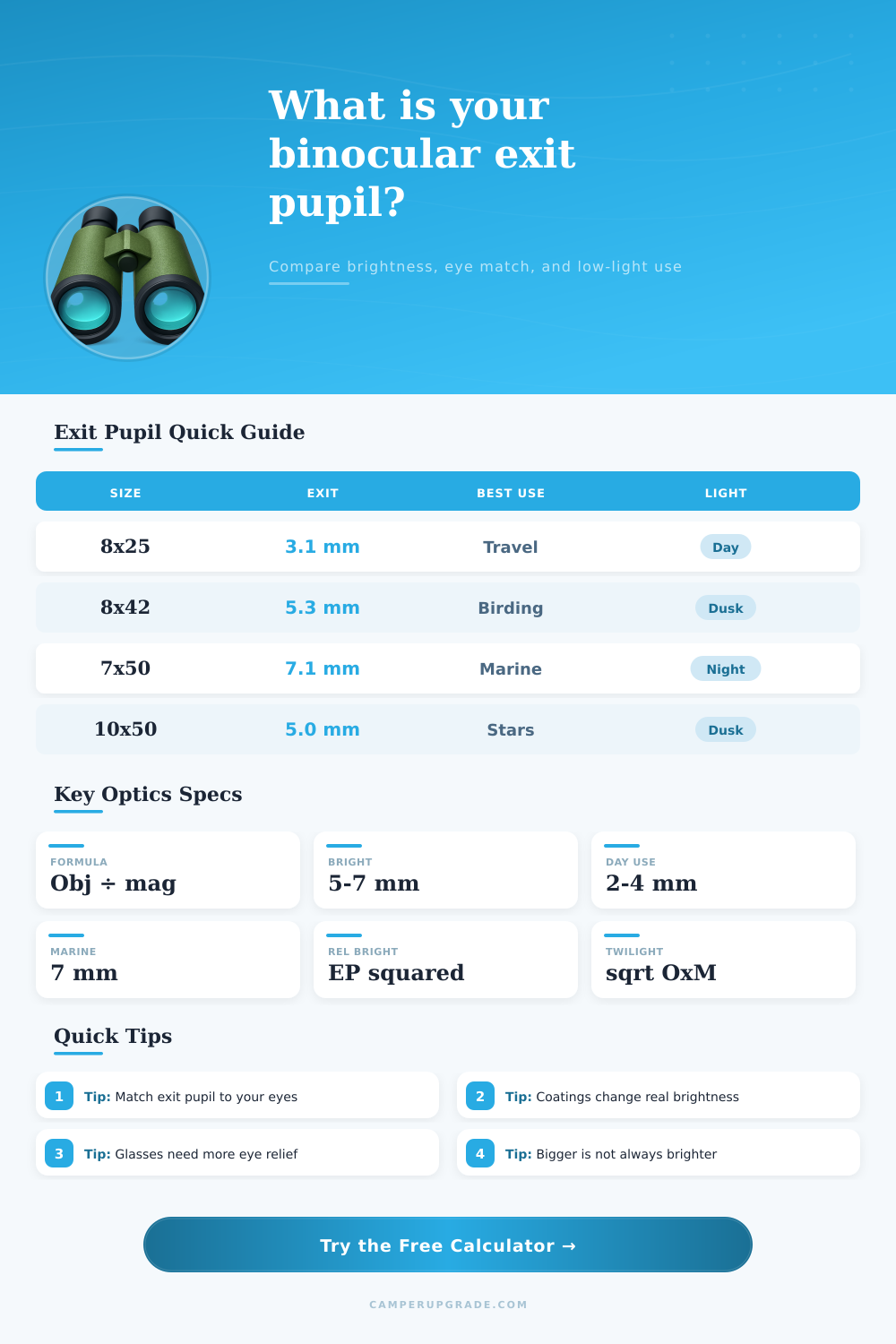
| 8x25 compact | 3.1 mm | 14.1 | Packable daytime travel and trail spotting. |
| 8x32 trail | 4.0 mm | 16.0 | Light birding, backpacking, and general campsite use. |
| 8x42 birding | 5.3 mm | 18.3 | Balanced handheld brightness for wildlife and shade. |
| 10x42 general | 4.2 mm | 20.5 | More reach with slightly less low-light forgiveness. |
| 10x50 astronomy | 5.0 mm | 22.4 | Good star field scanning with manageable handholding. |
| 7x50 marine | 7.1 mm | 18.7 | Stable view and large beam for boat motion and night watch. |
| 15x56 low-light | 3.7 mm | 29.0 | High detail at distance, usually best braced or mounted. |
| 20x80 astronomy | 4.0 mm | 40.0 | Tripod-mounted night sky detail and distant observation. |
| Spec or material | Typical range | Brightness effect | Calculator treatment |
|---|---|---|---|
| Coated optics | 70 to 78% transmission | Noticeably dimmer in shade and at dusk. | Uses 0.74 base transmission. |
| Fully multi-coated optics | 84 to 90% transmission | Good real-world contrast for camping and birding. | Uses 0.87 base transmission. |
| Dielectric roof prism | 88 to 94% transmission | High contrast in compact roof-prism bodies. | Adds prism efficiency to coating estimate. |
| Porro BAK4 prism | 85 to 92% transmission | Efficient light path and round exit pupils. | Uses a strong prism efficiency factor. |
| BK7 economy prism | Lower edge illumination | May show squared-off or dimmer exit pupil edges. | Applies a lower prism factor. |
💡Optics Tips
The exit pupil of binoculars are more important than marketing brochures make it out to be. The exit pupil is size of the beam of light that enters your eye from the binoculars. You might have some great optics, however, that doesn’t mean the image will be clear and sharp; it could look like you are viewing through a foged up window. Magnification power, lens size, etc., is all involved, but realy, does your eye take in the light beam created by device? To determine your exit pupil, simply divide diameter of your objective lens by your magnification. So in the case of an 8×42, the exit pupil equal 5.3 mm.
The figure tell you how well the optics match your eye’s own capacity for absorbing light. In other words: If your dark-adapted pupil is only 4 millimeters wide (which is common as we age), you’re missing that additional 1.3 millimeters of light on your iris. It’s falling out of your pupil and wasted. You’re not using that extra light gathering power. You’re missing the additional 1.3 mm of light on your iris. It’s falling out of your pupil and wasted. You’re not using that extra light gathering power.
Why Binocular Specs Are Not Everything
For example, novices tend to grab big objective lenses to see better at night because they wrongly think bigger is brighter. More glass can be good but what about how much light gets through? Clarity is also impacted by transmission. Lens coatings and even prisms absorbs some of the light before it enters eyepiece. Uncoated lenses reflect light internally. Also, cheap BK7 prisms are not as good at getting light into your eye than higher end BAK4 models. These factors is all included in the calculator with a relative brightness number that is closer to real life. Quality of coatings does matter especially at dusk.
Another metric that confuses people is twilight factor, a measure that multiplies objective size times magnification to roughly predict detail resolution under low light conditions. The bigger the number, the greater the separation of fine details like water ripples or bird feathering. But the metric neglect comfort. If your binoculars has high magnification, even though they might resolve more details holding them in your hands makes the image shake. To use that twilight factor well, you’d should of want to hold the binoculars with a steady support, or reduce power. The calculator considers all those things at once, so you don’t get stuck buying some glass that’s too shaky to hold.
Physical comfort is also important. Eye relief matters because short eye relief require you to jam your eyes into eyecup to get the full field of view. This leads to limited vision and discomfort that causes headaches. With longer eye relief, the light cone reaches your eye even if you are wearing eyeglasses. Moddern binoculars generally provide about 15 millimeters of eye relief, while serious users may seek something nearer 20 millimeters for comfortabley viewing without squinting.
The tables for use cases categorize them not only according to specs but also according to the light they’re used in. For example, narrower exit pupils is better suited for day hikes, since you’ll have bright sun narrowing your vision already. Larger beam sizes work well for marine and dusk environments, where pupils are wider open. And astronomy applications needs both stability (magnification) and light gathering.
You want to adjust to your body and the situation at hand. But there is no need to get lost in technical terms, binos are personal tools. Pupil size vary with your age. Eyeglasses require different amounts of eye relief. Shaky hands limit how much magnification you can use. Feed those factors into the calculator, then let it do the math: What pair of binos will reveal the owl in the dark? Buying based off specs on paper ceases; instead you buy what’s going to light up your retina, view. That restores sightlines from hazy windows to clear ones.