Bikepacking Gear Weight Calculator
Total your bikepacking load, compare front-center-rear distribution, and estimate how the setup will handle before you roll out.
Bikepacking Weight Results
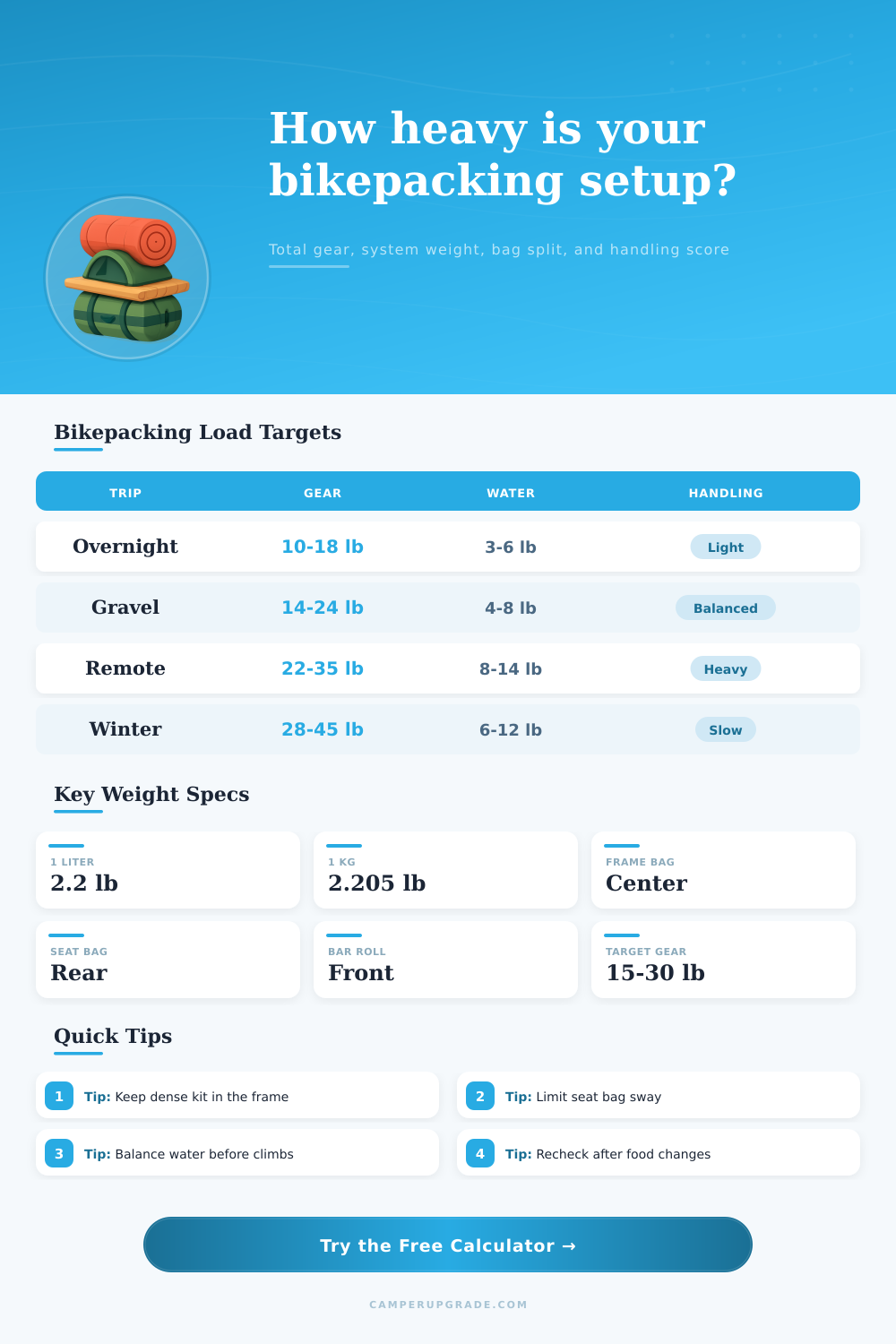
| Trip style | Typical gear-only load | Water planning range | Handling target |
|---|---|---|---|
| Sub-24 overnighter | 10-18 lb / 4.5-8.2 kg | 1.5-3 L near refill points | Light, quick steering |
| Weekend gravel | 16-26 lb / 7.3-11.8 kg | 2-4 L depending on heat | Balanced, stable on descents |
| Remote desert segment | 24-38 lb / 10.9-17.2 kg | 4-7 L or more when needed | Heavy but centered |
| Technical singletrack | 12-22 lb / 5.4-10.0 kg | 1.5-3 L kept low | Low rear sway, light bars |
| Cold or winter route | 28-45 lb / 12.7-20.4 kg | 2-5 L plus melt plan | Slow steering accepted |
| Load zone | Good share of carried gear | Watch point | Best items |
|---|---|---|---|
| Front / handlebar | 15-30% | Too much slows steering | Shelter, quilt, puffy layers |
| Center / frame | 35-55% | Limited volume fills fast | Water, food, tools, stove |
| Rear / seat | 20-40% | High dense load can sway | Sleep kit, clothing, light bulk |
| Unsprung fork load | 0-20% | Rough terrain feels harsher | Water, dry bags, compact kit |
| Body-carried load | 0-10% | Fatigue rises quickly | Vest water, snacks, layers |
| Category | Light range | Common range | Heavy range |
|---|---|---|---|
| Shelter | 1-2.5 lb / 0.5-1.1 kg | 2.5-4.5 lb / 1.1-2.0 kg | 4.5+ lb / 2.0+ kg |
| Sleep kit | 2-3.5 lb / 0.9-1.6 kg | 3.5-6 lb / 1.6-2.7 kg | 6+ lb / 2.7+ kg |
| Repair/tools | 1-2 lb / 0.5-0.9 kg | 2-4 lb / 0.9-1.8 kg | 4+ lb / 1.8+ kg |
| Food per day | 1-1.4 lb / 0.5-0.6 kg | 1.4-2.2 lb / 0.6-1.0 kg | 2.2+ lb / 1.0+ kg |
| Water | 2.2 lb per liter | 4.4-8.8 lb for 2-4 L | 11+ lb for 5+ L |
Bikepacking trips depends on how the bike feels when the gear is attach to the bike. Weight is a primary factor that determines whether the bike feel easy to ride or whether it feel difficult to ride. A bike setup may track cleanly through the corners but may feel like it is dragging a heavy load behind it.
This is often experienced when riding on rough gravel or when riding up a hill. Bike trippers often begin to plan their trips by weighing the bike and the bags that they will use on the trip, but often guess at the weight of the remaining gear that they will need to transport on the trip. The gear that will be transported on the trip isnt often all located in a single pile on the bike.
How Gear Weight Affects Bike Handling
For instance, some of the gear such as water, food, shelter, and sleep kit have different densities and are often placed into different locations on the bike. Consequently, a heavy seat bag may cause the bike to sway but a lighter frame bag wont cause the bike to sway. Bulky gear placed on the handlebars may slow the bikes steering.
In each of these examples, the interaction between the gear and the bike can be difficult to determine solely from examining the gear. In each of these cases, it is helpful to utilize the calculator that is provided to separate each of the variables and score the result. The inputs for the calculator are each important in that they represent the decisions that will need to be made while on the trail.
Weight will include the racks and bags that will remain on the bike. Rider weight will be an input so that the percentage of the riders body weight that the gear represents can be seen. The frame bag is the best location for items that are the most densest.
The seat and handlebar bags require a compromise between the volume of the bags and the handling of the bike. Water and food are variables because their weight will change during the ride but their weights at the beginning of the ride and at the end of the ride can be factored into the calculator. Shelter and sleep kits tend to be both bulky and light and can be placed on the handlebars (along with the remaining gear) without negatively impacting the steering of the bike.
Each choice of terrain for which the rider will ride is important in that the same load will behave differently on a road than on sand or singletrack terrain. The placement of water is important due to the way in which it will affect the balance of the bike. Food should be placed near the center of the bike to avoid moving the load too far forward or too far back of the bike.
Each of these variables is compared to the terrain for which the bike will be ridden, and the result of this comparison is the handling score. The handling score will indicate whether the gear will make the bike feel light, balanced, or heavy on the trail. Those who plan their bike trips without using the calculator often make common mistakes.
For instance, many who plan their bike trips place dense items into the seat bag which can make the bike feel unstable when descending hills. Additionally, many who plan their trips load their shelter and sleeping gear into the handlebar bags which may make the bike feel vague when turning on technical terrain. Finally, many who plan their trips without the calculator may load six liter of water for example when there are refill points every twenty miles.
Thus, the bike will be carrying excess weight when climbing hills. However, the calculator isnt a replacement for human judgment; it is only a tool that makes it easier for trippers to make decisions about their gear when they are beginning to ride their bikes. However, on the trail, there are a variety of changes to the gear that are beyond the parameters of the calculator.
For instance, the weight of food and water will decrease on the trail as the rider consumes them. Thus, the bike may feel differently after the rider has consumed food and water during the day. Additionally, if the weather changes, the rider may need to bring layers or a rain jacket that was not originally part of the plan.
Finally, mechanical issues with the bike may require the rider to have a heavier gear of tools on the bike than were originally planned. Thus, the calculator score is only a starting point for the rider and not a final verdict. If the score is in the fair or heavy range, for instance, the rider may want to move all dense items to the frame bag or reduce the amount of water that is transported.
Reference tables provide insight into the weights that are associated with each type of bike trip. Overnight bike trips tend to be the lightest in weight due to the shorter distances that need to be biked. For those who ride segments of the bike that are more remote from the starting location, there will be more weight due to the fact that the gear that will be needed for long periods without the ability to refill will be transported on the bike.
Finally, winter trips may require more gear of the type that increases the bulk of the bike and increases the total weight of that gear which will impact the handling of that bike. It is helpful to use the calculator once with the weight that is thought to be needed for the trip, but then again a second time with the lightest weight that will be carried in the middle of the trip. The difference between these two weights can indicate whether the bikes handling will be consistent or variable along the trip.
With regular use of the calculator in this way, trippers will learn to balance the gear so that both the center of the load is within a comfortable range and that the percentage of the body weight of the rider that the gear represents is low. Using the calculator in this manner can be used as a running check. For example, a rider can use the calculator to determine if placing water in the frame bag will help with the handling of the bike on the desert section of the trip.
Additionally, the weight of the shelter may be moved to the handlebar prior to a descent of similar technical terrain. Finally, the weight in the seat bag can be moved prior to a climb of hills. Consequently, the bike that a tripper rides stops existing as a collection of bags and becomes a system that can be tuned in advance of hitting the trail.
Regular use of the calculator will eventually result in the numbers that are calculated indicating the same handling of the bike that is experienced on the trail.