Bike Rack Tongue Weight Impact Calculator
Estimate how rack weight, bike load, mounting distance, lever arm multiplier, trailer tongue weight, receiver rating, payload, and safety margin interact before you tow.
🚲 Bike And Rack Presets
⚙ Load And Geometry
Trailer rear racks reduce tongue weight by leverage; vehicle hitch racks add payload at the hitch.
Metric entries are converted internally to pounds, feet, and inches.
Use the distance from the trailer axle group center to the coupler.
Measure to the center of the loaded bikes, not the bumper face.
A longer rack center increases bending moment even when actual pounds stay the same.
The calculator compares equivalent load against the rating after subtracting this reserve.
Rack And Bike Load
0
lb actual loadTongue Weight After Rack
0
lb at couplerReceiver Equivalent Load
0
lb with lever armSafety Margin
0
lb remaining📊 Comparison Grid
📐 Receiver Load Reference
| Receiver Or Mount | Typical Vertical Rating | Best Use | Check Before Loading |
|---|---|---|---|
| RV bumper clamp | 100–150 lb | Light two-bike carrier | Bumper welds and frame support |
| 1.25 in receiver | 150–200 lb | Road or kids bike racks | Rack compatibility and anti-wobble load |
| 2 in receiver | 300–500 lb | Platform racks and heavier bikes | Lowest rating among hitch, rack, and vehicle |
| Frame-mounted RV receiver | 200–350 lb | Trailer rear rack setups | Rear overhang leverage and tongue percentage |
| Extended ball mount rack | Varies widely | Vehicle hitch plus trailer | Extension derating and combined tongue load |
📏 Lever Arm Multiplier Table
| Rack Center Behind Pin | Rating Arm Used | Multiplier | 150 lb Actual Load Feels Like |
|---|---|---|---|
| 12 in | 12 in | 1.00x | 150 lb equivalent |
| 18 in | 12 in | 1.50x | 225 lb equivalent |
| 24 in | 12 in | 2.00x | 300 lb equivalent |
| 30 in | 12 in | 2.50x | 375 lb equivalent |
⚖ Tongue Weight Shift By Trailer Geometry
| Rear Load Center | Axle To Coupler | Shift Per 100 lb | Meaning |
|---|---|---|---|
| 4 ft behind axle | 14 ft | −29 lb TW | Small rear leverage |
| 6 ft behind axle | 14 ft | −43 lb TW | Noticeable balance change |
| 8 ft behind axle | 14 ft | −57 lb TW | Common travel trailer concern |
| 10 ft behind axle | 14 ft | −71 lb TW | High leverage setup |
🚲 Common Bike And Rack Loads
| Setup | Typical Rack Weight | Typical Bike Load | Total Before Accessories |
|---|---|---|---|
| Two road bikes on hanging rack | 25–35 lb | 44–56 lb | 69–91 lb |
| Two mountain bikes on platform rack | 45–60 lb | 60–76 lb | 105–136 lb |
| Four family bikes on tray rack | 65–85 lb | 95–130 lb | 160–215 lb |
| Two e-bikes with ramp | 50–75 lb | 110–150 lb | 160–225 lb |
💡 Practical Checks
Check that all tires is at the correct pressure. The mirrors are properly adjusted. Is the trailer hooked up and loaded? Are the bike stowed and the car packed? Yep.
You’re ready, but make sure your weight distribution is right so you stay steady on road. You’re good. You are ready to hit open road.
Why Bikes on Your Trailer Change Your Weight
But then you find yourself halfway to the campground realizing the steering is float or feeling light. The crosswinds aren’t bothering the trailer but now it’s starting to wander a bit. You start slowing down…you know what’s going on here.
That added weight of those bike out back has changed how your tow set-up works. And now the weight isn’t being distribute correctly. Weight is something most folks consider linearly. Rack weighs 50-pounds, then it takes 50-pounds off the tongue, right? Nope.
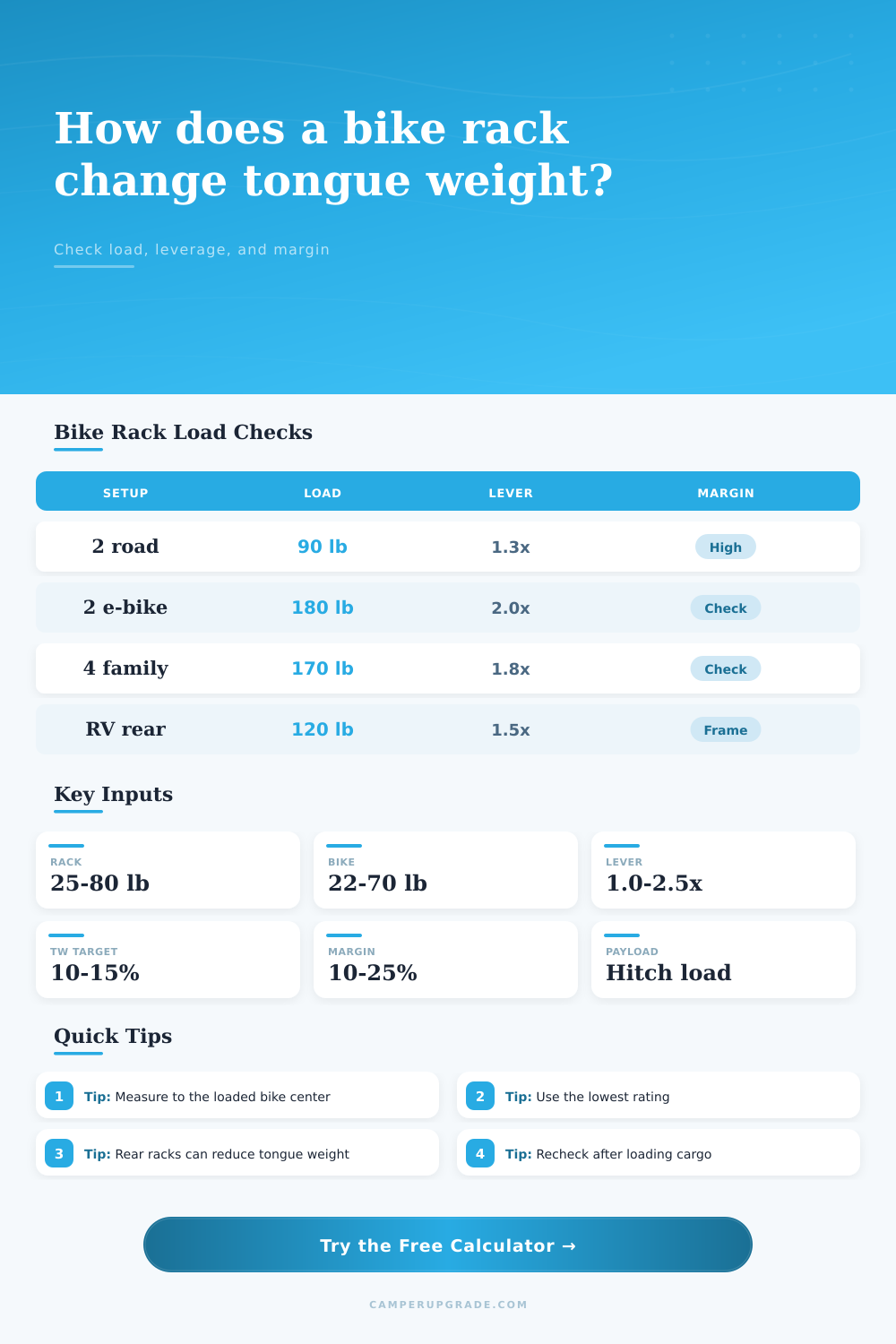
The difference here is leverage; much more than weight. Because we mount our racks behind the axles, we’ve just built a see-saw. The axle is the fulcrum. One end is the tongue and the other end is the rack. For every foot the rack sits behind the axle, it multiplies the impact on the tongue weight.
That’s what all those fields are for on the calculator: axle position and mounting distance. It does the math for you for the moment arm so you don’t need to draw imaginary vector forces in your head while being in driveway.
Where do you put it? Put it on the tow vehicle hitch and it weighs down the car. It pushes the car down but doesn’t mess with balance of the trailer. Put it on the trailer bumper and it raises the tongue. A couple dozen pounds isn’t nothing, right? Nope.
Not if you’re hanging on the edge of the recommended minimum tongue weight of 10% or less. When your trailer tongue weight goes below that mark, the trailer gets unstable. Then all that happens is the hitch rise up. There’s no force pulling it back down. There are no sway bars to dampen the movement. It is just a trailer bouncing around like a pendulum waiting for something to knock it over.
However there’s another twist. What folks don’t realize is that the receiver rating isn’t absolute. When they rate a three hundred pound receiver with a two inch opening, it’s because of where they apply that load from the hitch pin. The farther out you go from the hitch pin, the more the weight is multiplied by the length of the rack. That’s why a load centered twenty four inches behind the pin is going to double the force on the hitch tube versus one at twelve inches.
The hitch rating calculator factors in that multiplier based off what you tell it. It asks how far away is the rating distance from the hitch pin and also the center point of your rack. So if you’re within the hitch weight limit but beyond the structural limit, that’s what it computes. Your metal doesn’t give a hoot about the scale number. Your metal cares about torque.
This issue becomes worse with e-bikes. Each weighs upwards of 60 lbs. Two bikes on a tow platform extending back two feet from the rear axle will swing a lot of weight away from the tongue. Plus, they may be pushing your SUV’s payload capacity.
To get an idea of how much this impacts your vehicle, the tool asks for avg bike weight and number of bikes. It shows you the remaining safety margin against your vehicle’s payload and your receiver rating individually. This means the system is risky if it has little room for error. A change in coolers or moving a water jug could make a big difference. This stress is explained and laid out in the reference table on the page.
The bottom line is that RV bumpers are brittle. Bumpers with frame mounts are tougher, but they obeys the same rules of leverage. Understanding prevents catastrophic failure. A large hitch can be trusted. A hitch’s geometry is more difficult to trust.
Take one last glance around before departure. Make sure they’re balanced from side-to-side. Get out the scales and check the tongue weight (if possible). Is the rack holding? Little imbalances have a turning force that opposes the trailer tire action. It’s a bit of drag on performance. Your feel gives you confirmation. Your eyes tell you the math-based baseline.
It’s all about the margin in towing. Every risk, no matter how small, adds up until it isn’t. You will eventually fall into it. Once you understand the tipping point of where shifting your weight at the back changes everything, you’ll never be there again.
Hitching up. Loading the bikes. Packing the car. You will know exactly what they are doing to the ride this time. It feels solid out on the road. Straight. Gear not moving. Now we’re talking.