Bike Crank Length by Inseam Calculator
Estimate a practical crank length from cycling inseam, bike style, cadence preference, mobility, and your current crank so the result is useful on a real bike.
⚡Quick rider presets
📏Rider and bike inputs
This calculator gives a fit starting point. Final crank choice should respect frame clearance, available chainring options, pedaling feel, and any professional bike-fit guidance.
Your crank length estimate
🚴Common crank size landmarks
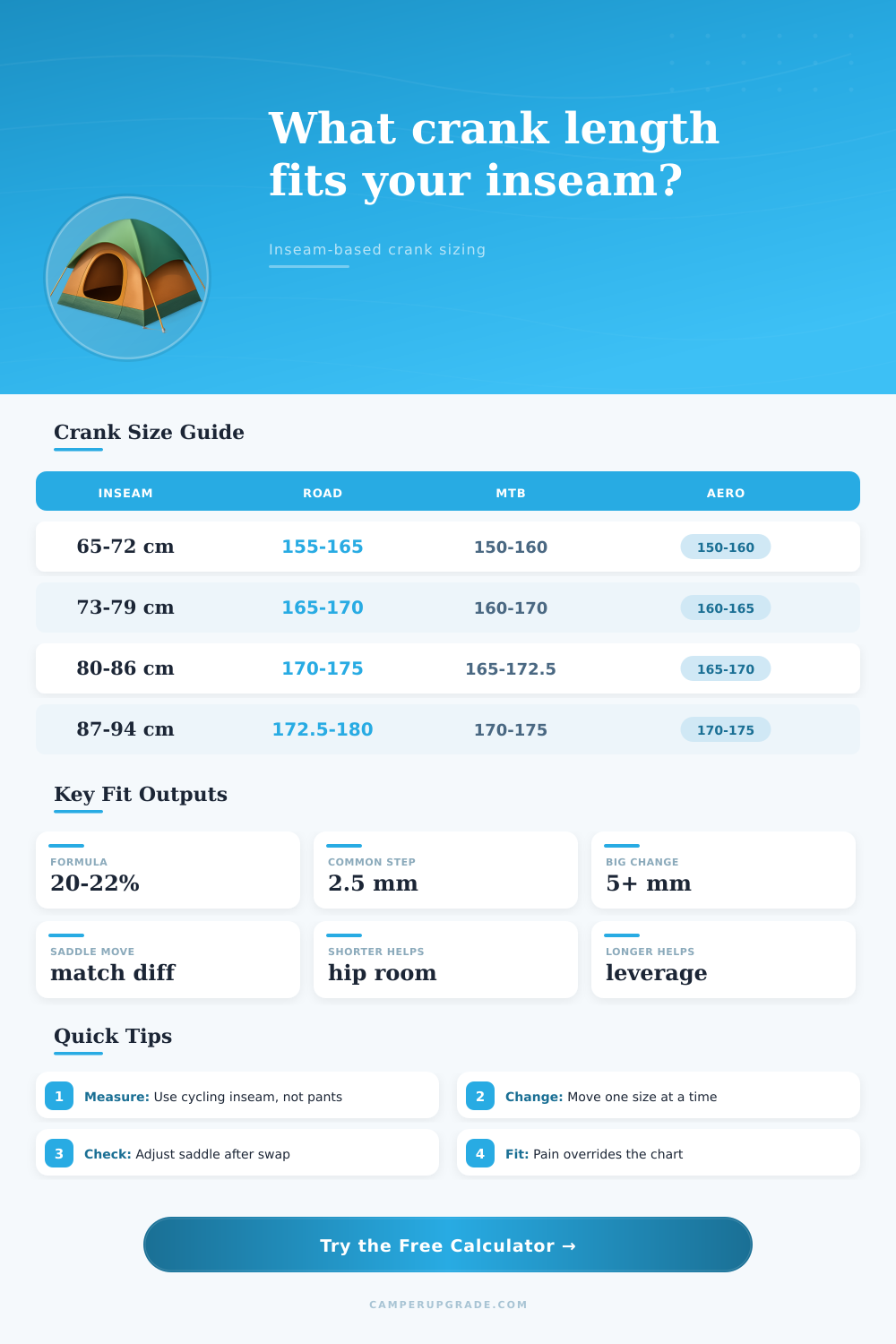
📊Inseam to crank length reference
| Cycling inseam | Balanced road | Spin, aero, knee relief | Leverage or track |
|---|---|---|---|
| 25-27 in / 64-69 cm | 150-160 mm | 145-155 mm | 155-165 mm |
| 28-30 in / 71-76 cm | 160-167.5 mm | 155-165 mm | 165-170 mm |
| 31-33 in / 79-84 cm | 167.5-172.5 mm | 165-170 mm | 172.5-175 mm |
| 34-36 in / 86-91 cm | 172.5-177.5 mm | 170-175 mm | 175-180 mm |
| 37-39 in / 94-99 cm | 175-180 mm | 172.5-177.5 mm | 177.5-185 mm |
| Bike context | Typical bias | Why it changes | Watch point |
|---|---|---|---|
| Endurance road | Balanced | Comfortable range for seated riding and climbing. | Do not chase long cranks if cadence drops. |
| Triathlon / TT | Shorter | Shorter circle can open the hip at the top of the pedal stroke. | Recheck saddle height and front-end comfort. |
| Mountain bike | Shorter | Improves pedal clearance and helps technical cadence changes. | Very short cranks may require easier gearing. |
| Track sprint | Longer | Some riders prefer leverage and a planted standing effort. | Banking clearance and cadence ceiling matter. |
| Loaded touring | Balanced to short | Long days reward smooth motion and knee comfort. | Pair shorter cranks with low climbing gears. |
| Crank change | Saddle height start | Pedal circle change | Fit meaning |
|---|---|---|---|
| Same length | No starting change | No change | Keep fit coordinates and evaluate feel. |
| 2.5 mm shorter | Raise saddle 2.5 mm | 5 mm smaller circle | Small hip and knee relief, usually easy to adapt. |
| 5 mm shorter | Raise saddle 5 mm | 10 mm smaller circle | Noticeable spin change and more top-stroke room. |
| 7.5+ mm shorter | Raise by the difference | 15+ mm smaller circle | Recheck reach, cadence, gearing, and saddle fore-aft. |
| Longer crank | Lower by the difference | Larger pedal circle | More leverage feel, but more knee and hip travel. |
| Measurement detail | Good method | Common error | Effect on result |
|---|---|---|---|
| Cycling inseam | Book pressed firmly upward while standing against wall. | Using clothing inseam from jeans or shorts. | Can miss by 1-3 cm, enough to change a crank size. |
| Height | Measure barefoot at the same time as inseam. | Using old license or shoe-on height. | Only affects proportion adjustment, not base formula. |
| Current crank | Read the stamped number on the inside of the crank arm. | Assuming every complete bike came with 172.5 mm. | Changes the saddle cue and swap advice. |
| Bike type | Choose the position you actually ride most often. | Choosing race settings for relaxed commuting. | Can push the recommendation too short or too long. |
💡Practical fit notes
How does a bike feel underneath? It has everything to do with crank length. When correct, it provides a smooth pedal stroke, keeping your knees comfy and your hips open on long rides. If the length is wrong, you will feel it immediately through hip pinching or extra effort within the first hour.
Oftentimes this can be due to matching the cranks to your true leg length versus what was on the bike at purchase. Not your pant size but rather your inseam is critical. Stand barefoot with a book pressed firmly upward between your legs and measure from the floor to the top edge of the book. This will be the baseline for any reasonable crank selection.
How to Choose the Right Crank Length
Enter this into the calculator along with your height, how you typically ride and other clues such as rocking at the bottom of the stroke or front knee pressure. The calculator do the rest, taking into account fit, hip mobility, cadence preference and more. There are those additional inputs because crank length isn’t an isolated concept.
A rider grinding through low gears on gnarly trails is going to require more leverage than someone spinning their legs like a hamster wheel on smooth pavement, so that’s why high-cadence riders can often runs shorter cranks. An aggressive aero position or tight hips will also skew the recommendation shorter (a smaller pedaling circle offers more real estate at the top of your stroke). Depending on how those variables line up, one inseam can generate two different response.
That’s why in the bike type table on the page, you see a general pattern of crank length for different styles of bike. Triathlon setups are generally short. Mountain bikes tend to be short as well. Tall road bikers and track riders stays at the long end of the spectrum.
Changing the length affects things as well (the tables display this). For every five millimeters your crank length changes, the pedaling circumference change by ten millimeters, which means you normaly have to adjust your saddle height to match. This is the rule the calculator use for its automatic calculation and that way you don’t have to guess where the initial adjustment goes either.
Riders typically shift their crank sizes gradually with little more than a two point five millimeter jump. That’s usually manageable. If you do want to jump larger, give it several test rides. Then double check how your gear feels and how your saddle fits in that new setup. You should of checked if the pedaling feel naturaly good first.
You don’t want to get hung up on any particular formula. You want to be in a comfort zone where your body can turn the pedals comfortabley without fighting the bike’s geometry. But that’s not where it really comes down to: How does it feel now? Is the rhythm better? Is my hip comfortable? Does it produce consistent power in various levels of effort? Was it worth changing?
If yes, then go for it! If not, you can always reverse the adjustment. The next size up isn’t very far (a couple of millimeters).