🧗 Big Wall Climbing Days Calculator
Estimate route days from pitch count, hauling, bivies, and weather slack
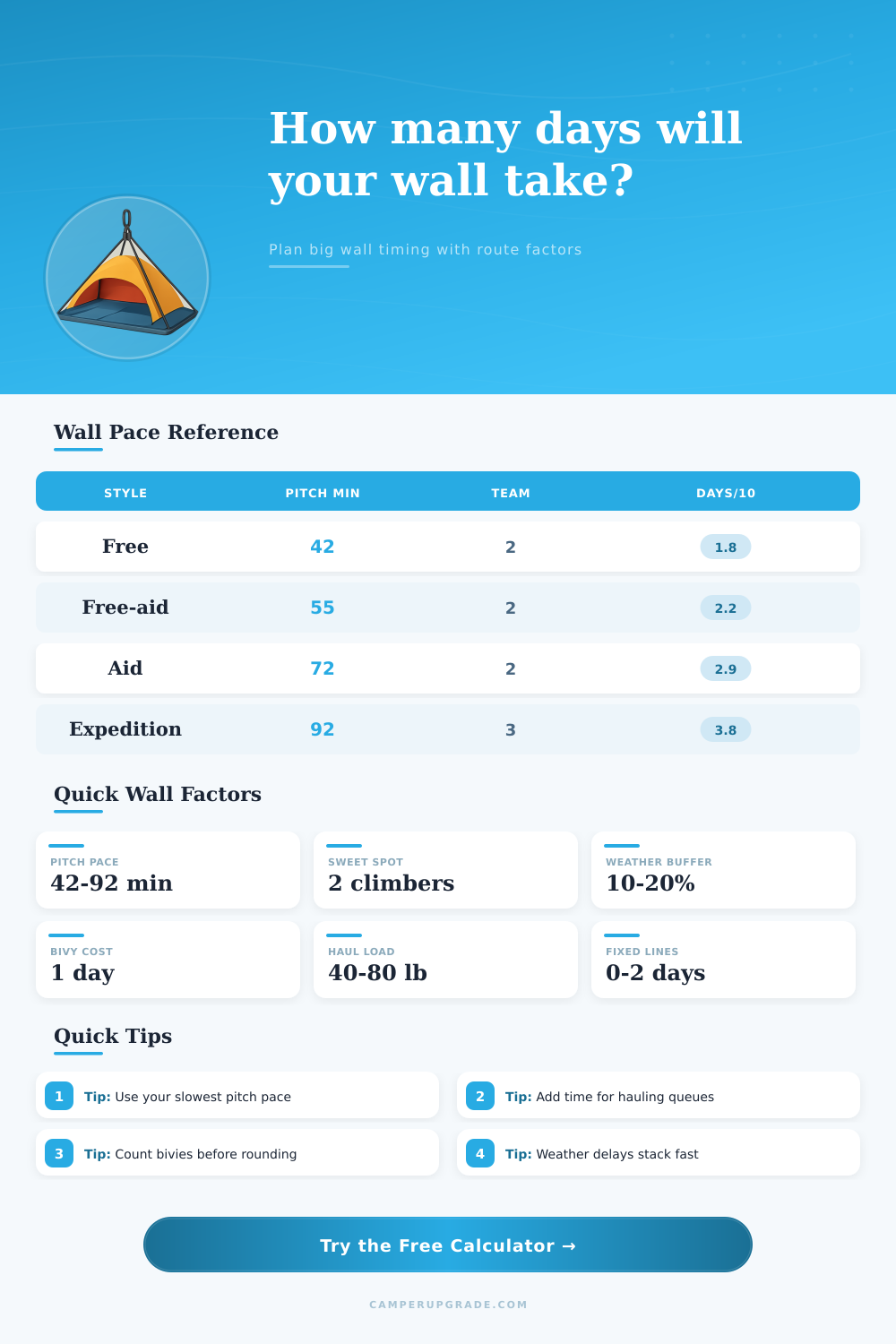
| Style | Base Min | Team Sweet Spot | Typical Days/10 Pitches |
|---|---|---|---|
| Free | 42 min | 2 climbers | 1.8 days |
| Free + aid | 55 min | 2 climbers | 2.2 days |
| Aid-heavy | 72 min | 2 climbers | 2.9 days |
| Expedition | 92 min | 3 climbers | 3.8 days |
| Factor | Fast | Baseline | Slow / Heavy |
|---|---|---|---|
| Terrain | 0.93 clean | 1.00 tech | 1.27 mixed |
| Team | 1.00 pair | 1.10 trio | 1.22 four |
| Experience | 0.88 sharp | 1.00 solid | 1.24 alpine |
| Load | 0.92 light | 1.00 std | 1.18 heavy |
| Route | Pitches | Pitch Length | Typical Days |
|---|---|---|---|
| The Nose | 31 | 100 ft | 3-5 |
| Freerider | 33 | 100 ft | 3-5 |
| Zodiac | 16 | 90 ft | 2-4 |
| Moonlight | 14 | 95 ft | 1-3 |
Big wall climbing involve careful mathematical planning due to the many different variable that affect the length of the climb. The variable to consider include the climbing speed of the team, the weight of the haul bag, the number of bivouies require to complete the route, and the number of people in the climbing team. Each of these variable will impact whether the climbing team can complete the climb in a few days or whether they will require many extra days to complete the entire route.
The climbing speed of a team is one of the main variable to consider when planning a big wall climb. The type of climbing that is to be performed can change the climbing speed of a team. For instance, climbing team can climb faster on free climbing routes than on aid climbing routes.
How to Plan a Big Wall Climb
Additionally, the quality of the rock also impact the speed at which a climbing team can travel along its route; poor quality rock may require the climbers to move more slow than on routes with higher quality rock. The second main variable to consider for planning a big wall climb is the weight of the haul bag. Teams with a light haul bag can move faster along there route than teams that have a heavy haul bag.
The haul bag may contain item like water, portaledges, and other climbing gear. Heavy haul bags may reduce the ability of the climbers to move along their route, and may also reduce the number of days that a climbing team has to complete each transition of there route. The third main variable to consider is the number of bivouies that is required for the route.
Any number of bivouies will add to the total length of the climbing team’s trip; each bivouy will take the climbers an entire day to complete. A climbing team may have to bivouy for a number of reasons, such as to take a break to rest. However, if a bivouy is required, the climbing team will require additional days to reach the top of the mountain.
Bivouy days may be reduced, for instance, by the use of fixed ropes; however, the installation of these fixed ropes will take some of the climbing team’s initial days. The fourth main variable to consider is the size of the climbing team. A climbing team with few member may move faster along the route than a team with many members.
For example, a climbing team with two member may move faster than a team of four; the larger team may take more time to communicate with each other along the route. In planning the climb, it is also necessary to include a buffer for weather in the planned schedule. For instance, the climbing schedule may include a buffer for bad weather; the climbing team may have to wait for good weather in order to continue upwards on the mountain.
Using a ten percent buffer for bad weather may allow a climber to handle a few light day of bad weather; however, they may want to use a percentage like 20% to allow for significant storm. If there is no buffer for bad weather in the schedule, the team may find themselves stranded on the mountainside during the dark. In order to calculate the schedule that will be used for the climb, an individual may divide the estimated total effort hours to climb the route by the number of daylight hours that the climber will be available to climb.
Additionally, the calculated schedule will also account for the number of hours required for bivouies and the weather buffer. For instance, for popular climbs like The Nose, the number of pitches on the route, the time spent climbing, hauling, and on transitions will all be calculated to determine the total time for the climb; if the total effort hours for the climb is greater than the available daylight hours, bivouies will have to be scheduled. One of the most common mistake in big wall climbing schedule calculations is to use the time that it takes to complete the fastest pitches on a route.
However, climbers should not use such times for scheduling a climb; it is more likely that the climbers will move more slow on the route due to the pitches that are of higher difficulty; instead, the use of a more realistic time to complete each pitch of the route will allow for better planning of the trip. Additionally, other factor that may reduce the speed at which the climbing team can travel along the route, such as a heavy haul bag, should not be under-estimated. Finally, the method that will be used to descend the mountain may impact how many hour a climber has left after descending from the mountain.
For instance, rappelling off the mountain may take less hours than walking off the mountain over difficult terrain. Through careful consideration of all of these different factor, an individual could of create a realistic plan for their big wall climbing journey.