🌲 Beech Firewood BTU Calculator
Estimate usable heat from beech stacks by species grade, moisture, split shape, and stove efficiency.
Use a fresh split if you want the most realistic reading.
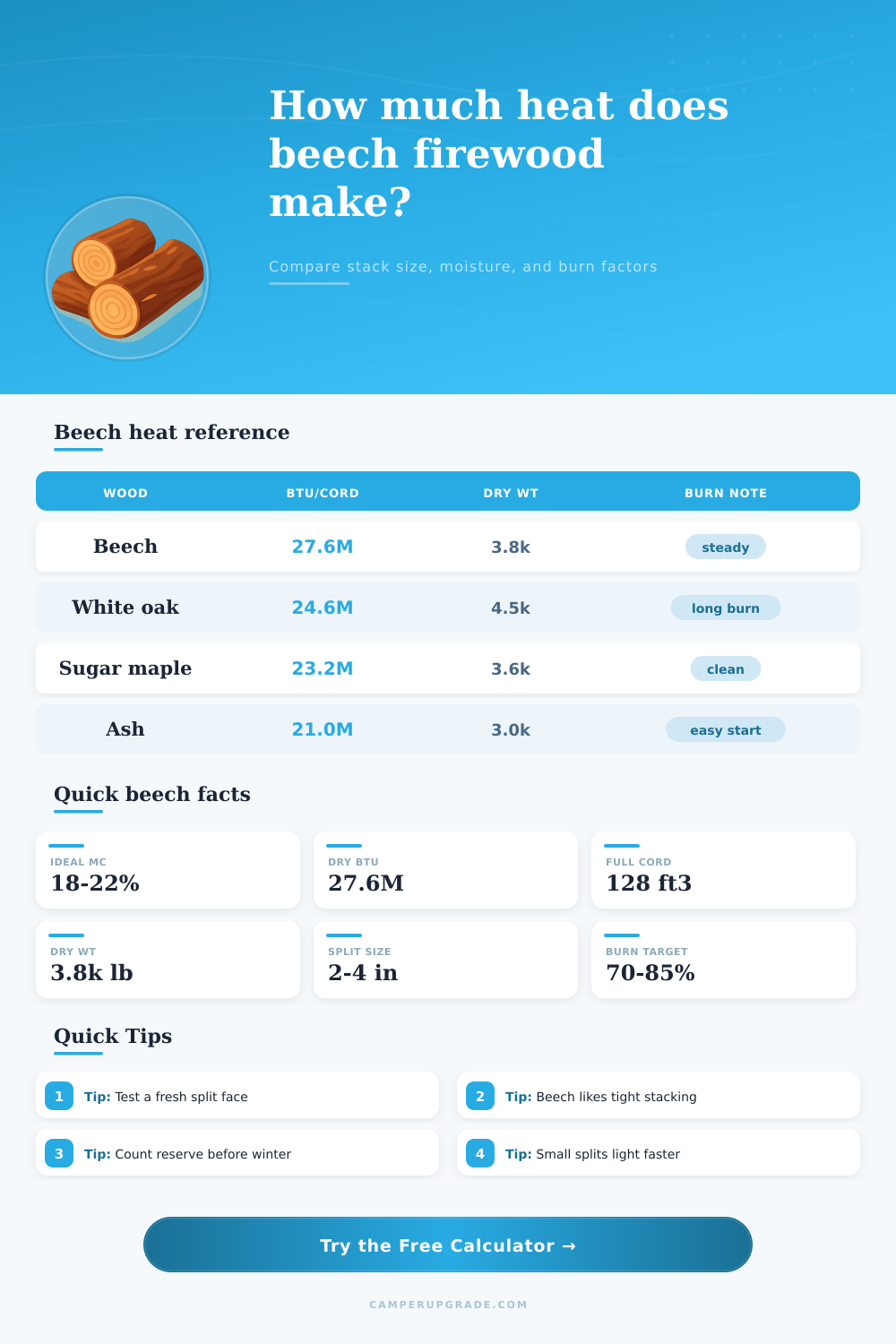
| Wood | BTU/cord | Dry wt | Heat note |
|---|---|---|---|
| Beech | 27.6M | 3.8k lb | Dense, even heat |
| White oak | 24.6M | 4.5k lb | Long, steady burn |
| Sugar maple | 23.2M | 3.6k lb | Clean, reliable heat |
| Hickory | 27.8M | 3.9k lb | Hot and steady |
| Ash | 21.0M | 3.0k lb | Easy startup wood |
| Birch | 20.9M | 3.1k lb | Quick ignition |
| Cherry | 20.0M | 2.8k lb | Moderate heat |
| Pine | 16.0M | 2.2k lb | Fast-start softwood |
| Moisture | Dry frac. | Net BTU/lb | Use case |
|---|---|---|---|
| 0% MC | 1.00 | 8600 | Oven dry |
| 10% MC | 0.91 | ~7600 | Very dry |
| 20% MC | 0.83 | ~7000 | Good stove fuel |
| 30% MC | 0.77 | ~6300 | Still wet |
| 40% MC | 0.71 | ~5700 | Greenish stack |
| 60% MC | 0.63 | ~4700 | Fresh split |
| 80% MC | 0.56 | ~4000 | Recently cut |
| 100% MC | 0.50 | ~3400 | Very green |
| Condition | Factor | Behavior | Best use |
|---|---|---|---|
| Rounds / unsplit | 0.94 | Slow drying | Outdoor stack |
| Chunky splits | 0.98 | Moderate airflow | Long burns |
| Standard splits | 1.00 | Balanced burn | General heat |
| Small splits | 1.03 | Faster ignition | Shoulder season |
| Kindling | 0.92 | Quick flash | Fire start |
| Tight stack | 1.02 | Less void space | Dense cord |
| Normal stack | 1.00 | Typical pack | General use |
| Loose stack | 0.95 | More air gaps | Quick dry |
| Depth | Sq ft / cord | m² / m³ | Note |
|---|---|---|---|
| 12 in | 128.0 | 11.9 / 2.4 | Face cord depth |
| 16 in | 96.0 | 8.9 / 2.0 | Common stove split |
| 18 in | 85.3 | 7.9 / 1.8 | Mid-depth stack |
| 20 in | 76.8 | 7.1 / 1.6 | Large split shelf |
| 24 in | 64.0 | 5.9 / 1.5 | Deep winter rack |
| 30 in | 51.2 | 4.8 / 1.2 | Wide yard pile |
| 36 in | 42.7 | 4.0 / 1.0 | Round-stack scale |
| 48 in | 32.0 | 3.0 / 0.8 | Big storage pile |
| Project | Area | Cords | Use case |
|---|---|---|---|
| Cabin starter rack | 8 x 4 x 16 | 0.44 | Weekend heat |
| Small woodshed bay | 10 x 4 x 16 | 0.55 | Short season load |
| Garage backup wall | 12 x 5 x 16 | 0.83 | Backup storage |
| Long winter rack | 16 x 5 x 16 | 1.11 | Primary heat stack |
| Metric shed run | 3.0 x 1.4 x 0.4 | 0.47 | Metric planning |
| Round pile | 10 ft dia x 4 ft | 0.98 | Irregular pile |
| Face cord row | 12 x 4 x 12 | 0.38 | Shallow stack |
| Reserve cord | 18 x 4 x 16 | 1.00 | Full season load |
Beech is another hardwood that can be used for heating homes. Beech wood is known for providing even heat to a homes in which it is burned. Beech wood is a very densly type of wood.
Because of the density of beech wood, beech releases a great deal of energies over a long period of time. For these reasons, beech wood are often used to start fires that must last overnight to heat the homes of individual. Because of the high amount of water content of beech wood when it is freshly cut, people must season beech wood prior to its use as fuel.
How to Dry and Store Beech Wood for Heating Your Home
Seasoning beech wood mean allowing the beech wood to dry so that the moisture content within the wood can decrease. Within the seasoning process, it is necessary to aim for a moisture content of the beech wood of 18% to 22%. This moisture content within beech wood will allow it to release the most amount of heat.
If the moisture content of beech wood is too high, most of the heat from the beech wood will be used to evaporate the water within the wood. For instance, if the moisture content of the beech wood is 40%, the stove will release less heat than if the wood was dried to only 20%. This is due to the fact that the stove will use some of its energy to boil the water containing within the wood.
Thus, it is important to season the beech wood to ensure that the wood is dry before its burned. Another step in preparing beech wood for seasoning is to ensure that the beech wood is stacked in the correct manner. One option is to stack the beech in tight row.
This allows for more beech wood to be stored in a specific area. The other option is to store the beech in loose piles. Loose piles of beech wood allow for more air to reach the wood, which will dry the beech wood at a more fast rate.
Another way to measure the amount of beech wood that you intend to season is to use a cord measurement. A cord of beech wood is 128 cubic feet of wood. Additionally, it is also helpful to split the beech wood into smaller piece.
The pieces of beech should be between 2 and 4 inch in thickness. The reason for splitting the beech into these sizes is that smaller pieces of beech has more surface area exposed to the air. This will allow them to season at a faster rate.
Stoves have varying amount of efficiency. Some stoves release more heat than others. Moddern stoves typically release more heat from the same amount of beech wood than older stoves did.
This is because efficient stoves use most of the gases released from the beech wood to create heat. Thus, if you have an inefficient stove, you will need to use more beech to heat your home to the same temperature as you would with an efficient stove. The amount of heat that your home will require will change depending on the insulation of the house and the size of the house.
If your home requires a high amount of heat, you will need to store more beech wood than you would for a home that dont require as much heat to maintain a comfort temperature. It is important to ensure that you have enough beech wood to last through the winter month. One mistake that many people make is to estimate the amount of beech wood that is needed for the winter.
This is referred to as “eyeballing” the amount of beech wood. However, eyeballing the amount of beech wood will not lead to an accurate measurement of the volume of beech wood that you have. Instead, it is important that you measure the volume of beech wood that you have using actual measurement.
Additionally, you should ensure that you have a reserve amount of beech wood. Typically, a reserve of 10% to 15% of the total amount of beech wood that you plan to store for the winter is all that is necessary. Some of the beech may become rotten prior to seasoning, and you will not be able to use that portion of the beech wood.
Thus, if you plan your beech wood well in advance for the winter months, you can ensure that you have enough to last through the winter.