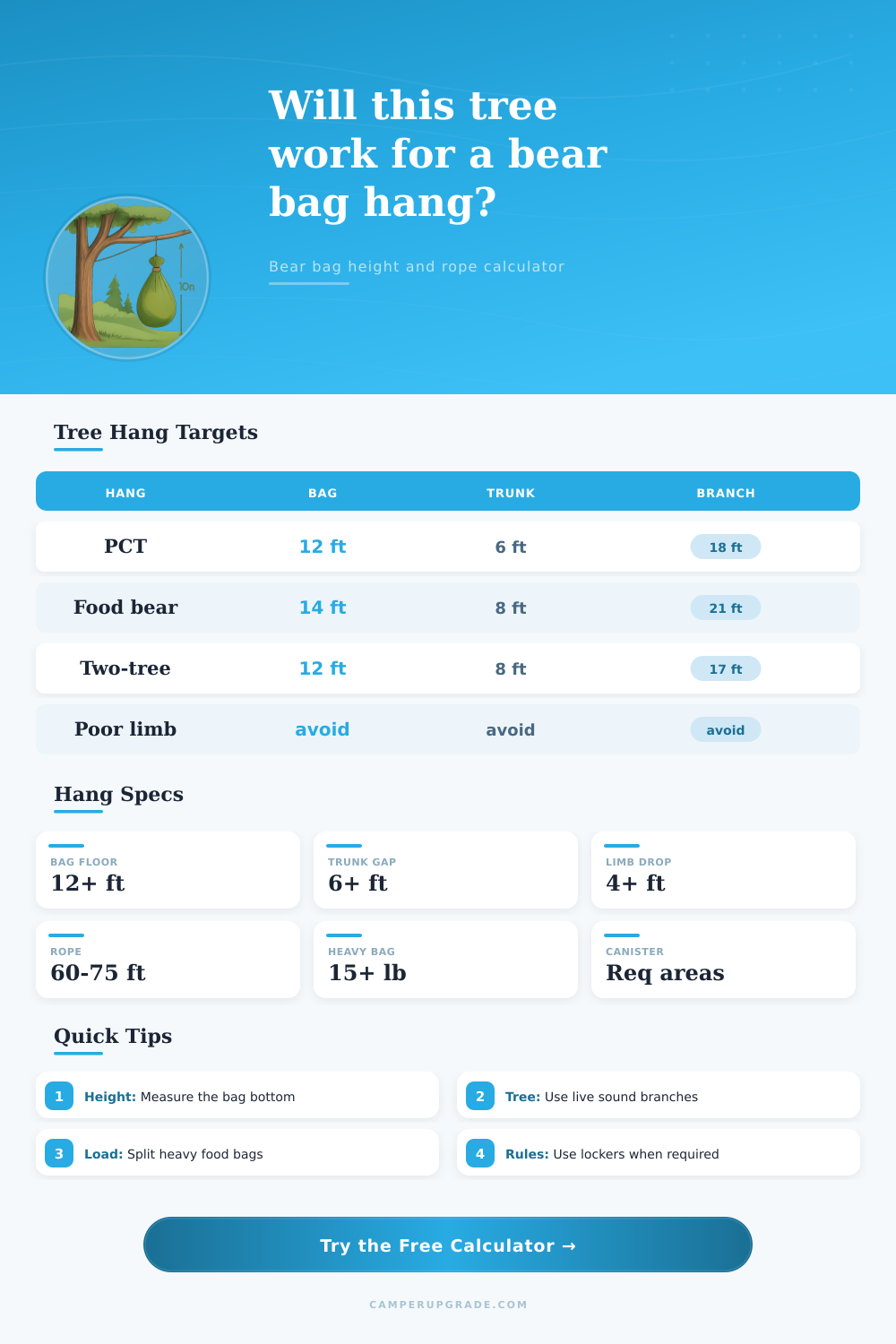
Campsite Tree Hang Bear Bag Height Calculator
Estimate whether a campsite tree can place a bear bag high enough, far enough from the trunk, below the limb, and within the rope length you actually packed.
This planner checks geometry and practical campsite risk. Always follow posted food-storage rules and use lockers or canisters where required.
Bear bag height result
| Storage situation | Bag bottom target | Trunk target | Best choice |
|---|---|---|---|
| Normal black bear country | 12 ft / 3.7 m | 6 ft / 1.8 m | PCT hang, canister, or locker. |
| Food-conditioned bears | 14 ft / 4.3 m | 8 ft / 2.4 m | Locker or canister is usually better. |
| Rodent and small animal protection | 10 ft / 3.0 m | 5 ft / 1.5 m | Hang works when bear pressure is low. |
| Strict storage order | Follow posted rule | Follow posted rule | Use required device or facility. |
| Canister-required zone | Hang is not enough | Hang is not enough | Approved canister or food locker. |
| Rope carried | Typical use | Where it struggles | Calculator note |
|---|---|---|---|
| 40 ft / 12 m | Short emergency limb | High or far branches | Often fails PCT geometry. |
| 50 ft / 15 m | Solo moderate tree | Two-tree spans | Needs efficient branch choice. |
| 60 ft / 18 m | Common backpacking length | Very high limb with long tail | Good default for many PCT hangs. |
| 75 ft / 23 m | High or distant branch | Extra bulk | Useful for hard campsite trees. |
| 100 ft / 30 m | Group and two-tree setups | Throwing and tangles | Best when spans are long. |
| Branch sign | Use it? | Load guidance | Field check |
|---|---|---|---|
| Live 6+ in limb | Strong candidate | Good for heavier bags | Look for cracks near trunk. |
| Live 4 to 6 in limb | Typical candidate | Best under 15 lb / 7 kg | Watch flex while lifting. |
| Small live limb | Light loads only | Split food or pick another tree | Excess bend lowers the bag. |
| Dense conifer limb | Case by case | Can tangle cord | Inspect for deadwood hidden in needles. |
| Dead or cracked limb | Avoid | Do not load | Move to another tree or storage option. |
| Food load | Practical hang | Sag tendency | Better move |
|---|---|---|---|
| Under 8 lb / 4 kg | Easy solo bag | Low | Single PCT hang is manageable. |
| 8 to 15 lb / 4 to 7 kg | Normal trip bag | Moderate | Use sound limb and slick cord. |
| 15 to 25 lb / 7 to 11 kg | Heavy pull | High | Split into two bags before dark. |
| 25+ lb / 11+ kg | Hard to raise safely | Very high | Use locker, canister, or multiple hangs. |
| Odor items | Count with food | Varies | Include trash, toothpaste, and cookware residue. |
More times than not you’ll try to hang your food out of reach and it becomes an issue because the numbers don’t work. You pick a hopeful-looking tree, tie your rope up there and realize that the bag can be reached…or that the branch won’t support the load. The aggravation sets in because you’re thinking about this as a single number instead of a series of related measures whose proportions changes based on any one factor.
The branch height is not the important dimension. The important dimension is the bottom of the bag where it rests with the weight in place. You must also add the amount it drops below the limb, the height of the bag above that, and any sag in the rope before it reaches its final position with the weight in the bags. You might have a limb that measured 12 feet on paper but dropped a few inches when the rope settled and your bags was filled with food. That will decide if this setup really gives you the clearance you need or only looks like it does at meal times.
Why Simple Measurements Are Not Enough
How far the bag is from the tree trunk also matters in this situation. If a bear wants the bag hanging right below the branch, he might climb up the trunk and stretch all the way over to get it. The closer the bag are from the trunk, the more likely this will happen. Once you input the drop you can achieve below the limb (drop) and how far horizontally you want it away from the tree (horizontal gap), the calculator does the math for you. Remember, those are both clearances and they work together. So when you improve one, you’ll frequently find yourself with something still vulnerable because you haven’t improved the other.
You can’t underestimate how far the rope has to go. It’s never really a straight vertical drop. When you measure the distance from one side of the tree to the other, you have to account for how much the rope goes out, down to the bag, and back up to attach to the tree. Then, you have to include the length going down again to the tail and the toggle. If you’re using a method that involves a line between two trees, or some sort of counterbalance, all of that add additional length that needs to be thought about.
The stretch of the cord also comes into play (all cords stretch under load). And that stretch varies depending on what kind of material you are using. Paracord and webbing will behave different than slick utility cord, and that means your choice of line is part of this calculation. The heavier the food gets, the harder it is to pull, but food weight isn’t the only factor. A larger load will tend to sag. It will lower the final bag position. In some cases, it will stress a weak limb. A lot of folks opt for two smaller bags instead of wrestling with one big load. You have an easier time getting them up. There is also less risk of an awkward lift ruining your evening setup.
The other thing people don’t think about is slope in the ground underneath where your bag hangs from. If the ground rises beneath the hang point, it’ll make your actual height less, even though the branch and drop haven’t changed. On a downslope its the opposite. You can input this adjustment into the calculator to reflect what is really below the bag instead of assuming flat ground. This affects the final clearance number.
The page lays out the reference tables for what those targets should of be based off the situation. There are tables for normal black bear country; tables for food-conditioned bear country; tables for areas where canisters are mandated; etc. When you choose your storage pressure, the calculator will adjust the targets to match so they’re in line with the rules you’re actualy subject to versus one random set of rules across the board.
The geometry side doesn’t tell all; there’s also the matter of branch condition. Even if the clearance and height measurements appear acceptable, a good-sized live limb will still flex; or break (under load). Obvious hazards include dead or cracked limbs, but even small live limbs can bend enough to drop the bag several inches once the weight settles. It flags this type of risk, allowing you to weigh its value before continuing further with your search for a suitable tree or switching to a different storage option.
Measuring twice then committing to the throw is by far the best practical habit to protect most of our trips. Check the branch height, the trunk gap you can actualy achieve, the drop you can maintain below the limb, and the total rope path your method requires. Then measure the distance from the bottom of the final bag to the target. If it lines up, that’s when the hang usually holds for the night without any surprise adjustments in the dark.