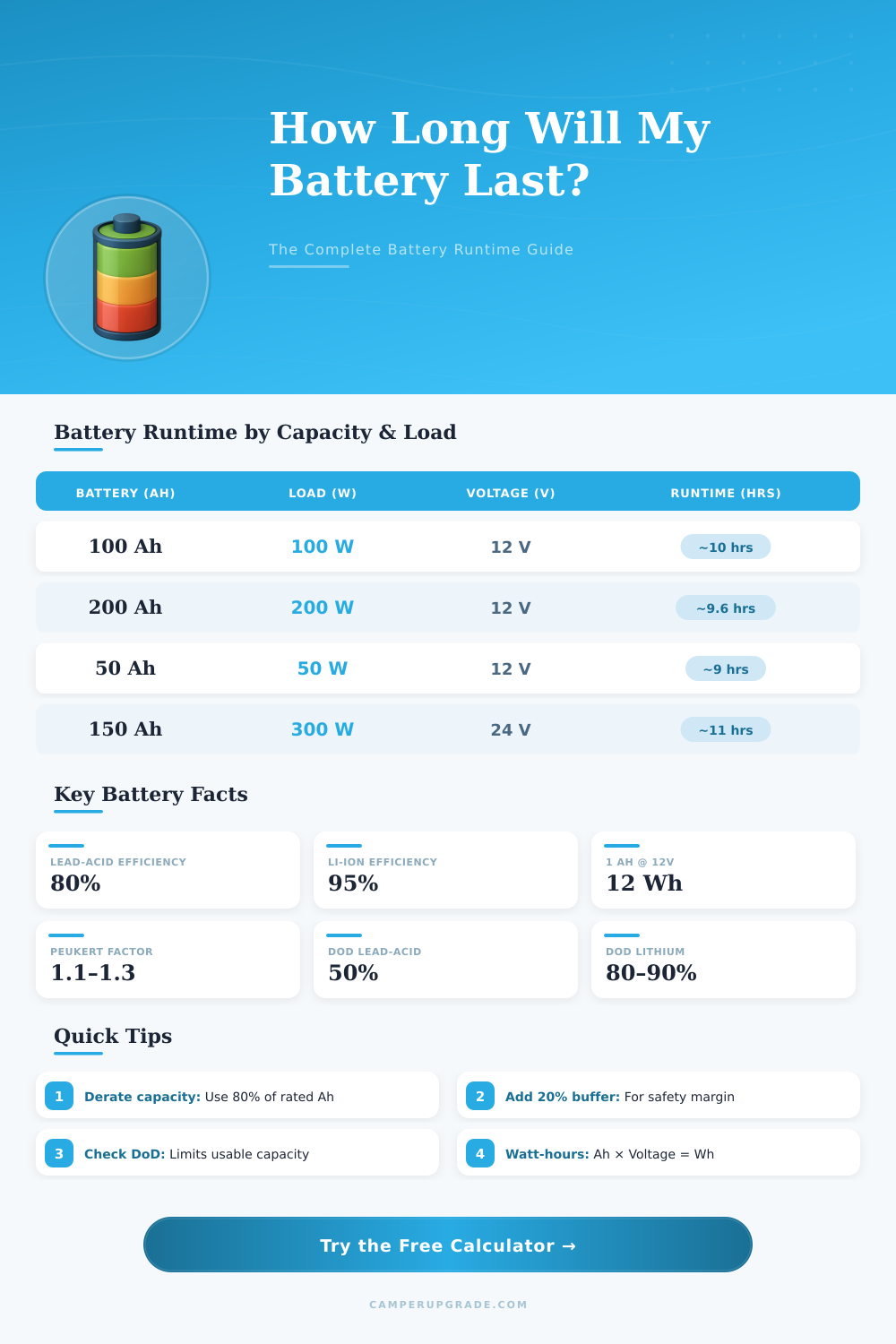
🔋 Battery Runtime Calculator
Calculate exactly how long your battery will last based on capacity, load, and battery type
| Battery (Ah @ 12V) | Load (Watts) | Runtime (hrs) — Li-Ion | Runtime (hrs) — Lead-Acid |
|---|---|---|---|
| 50 Ah | 50 W | ~8.5 hrs | ~4.3 hrs |
| 100 Ah | 100 W | ~8.5 hrs | ~4.3 hrs |
| 100 Ah | 200 W | ~4.3 hrs | ~2.2 hrs |
| 200 Ah | 100 W | ~17 hrs | ~8.6 hrs |
| 200 Ah | 400 W | ~4.3 hrs | ~2.2 hrs |
| 400 Ah | 500 W | ~6.8 hrs | ~3.5 hrs |
| 100 Ah | 500 W | ~1.7 hrs | ~0.86 hrs |
| 150 Ah | 300 W | ~4.3 hrs | ~2.2 hrs |
| Capacity (Ah) | Voltage (V) | Watt-Hours (Wh) | Metric (kWh) |
|---|---|---|---|
| 10 Ah | 12 V | 120 Wh | 0.12 kWh |
| 50 Ah | 12 V | 600 Wh | 0.60 kWh |
| 100 Ah | 12 V | 1,200 Wh | 1.20 kWh |
| 100 Ah | 24 V | 2,400 Wh | 2.40 kWh |
| 100 Ah | 48 V | 4,800 Wh | 4.80 kWh |
| 200 Ah | 12 V | 2,400 Wh | 2.40 kWh |
| 200 Ah | 24 V | 4,800 Wh | 4.80 kWh |
| 400 Ah | 48 V | 19,200 Wh | 19.2 kWh |
| Appliance | Typical Draw (W) | Daily Use (hrs) | Daily Consumption (Wh) |
|---|---|---|---|
| LED Light Bulb | 10 W | 6 hrs | 60 Wh |
| Phone Charger | 5–25 W | 2 hrs | 10–50 Wh |
| Laptop | 45–100 W | 8 hrs | 360–800 Wh |
| Mini Fridge | 80–150 W | 24 hrs (cycling) | 500–800 Wh |
| TV (32") | 35–80 W | 5 hrs | 175–400 Wh |
| CPAP Machine | 30–60 W | 8 hrs | 240–480 Wh |
| Ceiling Fan | 15–75 W | 8 hrs | 120–600 Wh |
| Space Heater | 750–1500 W | 4 hrs | 3,000–6,000 Wh |
| Inverter Type | Typical Efficiency | Loss Factor | Effective Wh (100 Wh input) |
|---|---|---|---|
| Modified Sine Wave | 85% | ×0.85 | 85 Wh out |
| Pure Sine Wave (budget) | 88–90% | ×0.89 | 89 Wh out |
| Pure Sine Wave (quality) | 92–95% | ×0.93 | 93 Wh out |
| Premium Inverter | 96–98% | ×0.97 | 97 Wh out |
Calculating battery runtime involve a few simple math steps because battery runtime depend upon the relationship between the energy stored in the battery and the energy use by the appliance. To calculate how long a battery will last, first calculate the energy capacity of the battery in watt-hours. Battery capacity are measured in amp-hours, but this does not account for voltage.
To find the energy in watt-hours, multiply the capacity in amp-hours by the voltage of the battery. For example, a 100 amp-hour battery at 12 volts have 1200 watt-hours of energy. At 24 volts, that same battery has 2400 watt-hours of energy.
How to Calculate How Long a Battery Will Last
Divide the watt-hours of the battery by the wattage of the appliance to find the number of hour that the battery will provide power to the appliance. Batteries dont last for an amount of time calculated due to the energy lost by the battery during the conversion of chemical energy to electrical energy. Lead acid batteries lose 20% of they energy to this process, while lithium batteries lose less energy, typicaly 5% or less.
Additionally, deep discharging batteries to zero percent can damage the battery. Lead acid batteries should not be discharged to less than 50% of their capacity, as deep discharging these batteries does cause the formation of lead sulfate crystals, which reduce the capacity of the lead acid battery. Lithium batteries can be discharged to 80% or 90% of their capacity, meaning they can release more of their store energy than lead acid batteries.
Inverters can also impact battery run time. Appliances require alternating current (AC) to operate, but batteries delivers direct current (DC). Inverters change DC to AC, but they use some of the batterys energy in the process.
High quality inverters can be up to 95% efficient in changing DC to AC power, while cheaper inverters may only be 85% efficient. High wattage appliances also use more energy from the battery. For instance, high wattage appliances may draw high amperage from the battery, which can lead to voltage sag and overheating of the batterys wire.
Environmental factors and battery age can also have an impact based off battery run time. At cold temperatures (below 32 degrees Fahrenheit), lead acid batteries can lose up to 20% of their capacity, as well as lithium batteries. Batteries also lose capacity over time.
Batteries loses 1% to 2% of their capacity every year of use. Due to these factors, it is recommended to include a buffer in the calculated run time for batteries. A buffer of 10% to 20% of the calculated run time is typicaly recommended.
Batteries come in different chemical composition and are used for different purposes. Lithium batteries are often more expensive than lead acid batteries, but they last longer. Lead acid batteries are less expensive, but have less capacity and last less time when deeply discharged.
If an appliance will be deeply discharged often, use a lithium battery. If an appliance will not be deeply discharged often, use a lead acid battery. Batteries can be used to provide power to a number of appliances.
For example, you can calculate the total wattage of all appliances that will be used daily. Mini-fridges will not cycle on for long periods and will not draw their peak wattage constantly. However, appliances like laptops and CPAP machines will draw their specify wattage.
Adding the wattage of all appliances to be powered will determine the total draw of the battery. If the total draw is underestimated, the battery will run out of power too soon. To ensure accuracy in calculating the total draw of appliances, a watt meter can be used to measure the draw of each appliance.
Determining the total daily watt hours that will be drawn from the battery will allow for the calculation of the number of days that a battery will provide power to the appliances. Additionally, other factor that can impact the life of the battery can also be accounted for when calculating the battery runtime.