Battery Parallel Capacity Calculator
Estimate total amp hours, usable watt hours, runtime, and current per battery for an RV, van, camper, or off-grid battery bank wired in parallel.
🔋Battery Bank Presets
⚙Parallel Capacity Inputs
📊Wiring And Battery Spec Grid
🧪Chemistry Reference Table
| Chemistry | Typical usable DoD | Parallel note | Best fit |
|---|---|---|---|
| Flooded lead acid | 45% to 50% | Needs ventilation and watering access | Serviceable RV house banks |
| AGM lead acid | 50% | Low maintenance, but still dislikes deep cycling | Weekend and moderate loads |
| Gel lead acid | 50% | Charge voltage must be tightly controlled | Low-current auxiliary banks |
| LiFePO4 | 80% to 90% | Use batteries with compatible BMS limits | High-cycle camper power |
| Lithium ion | 70% to 85% | Requires correct BMS and charge profile | Purpose-built packs |
🔧Parallel Wiring Table
| Wiring detail | Why it matters | Calculator input | Practical check |
|---|---|---|---|
| Equal branch length | Reduces current hogging between batteries | Lower imbalance derate | Same gauge and same route |
| Diagonal takeoff | Improves sharing on small banks without busbars | Lower cable resistance spread | Main positive and negative at opposite ends |
| Positive busbar | Gives each battery a similar electrical path | Lower branch mOhm | Each branch lands individually |
| Branch fusing | Limits fault current from one battery into another | Does not add capacity | Fuse near every positive terminal |
| Matched batteries | Old or undersized units can carry uneven current | Lower derate percent | Same model, age, Ah, and state of charge |
📋Battery Bank Preset Table
| Preset | Bank setup | Typical load | Reserve idea |
|---|---|---|---|
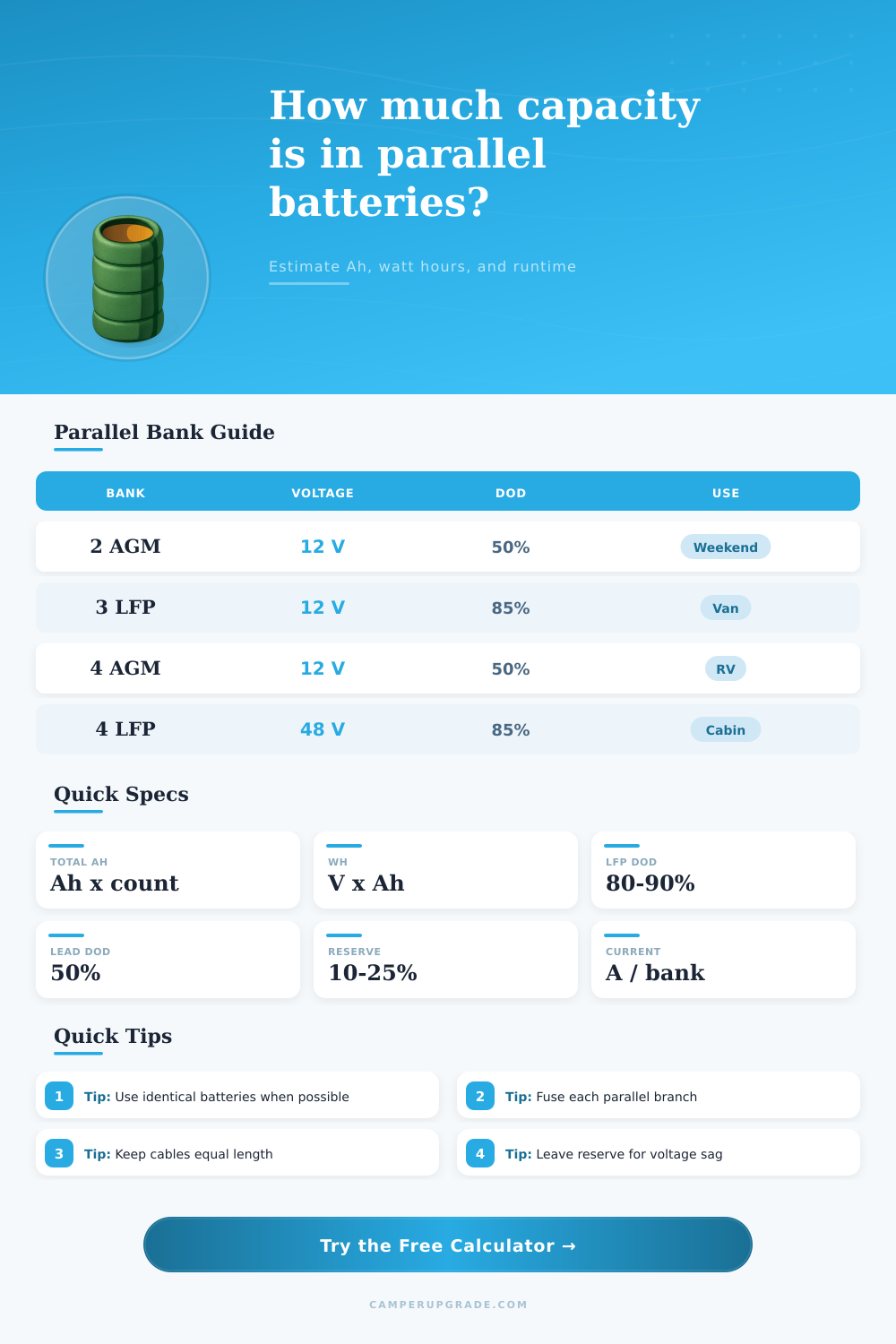
| Weekend 2 AGM | 2 x 100 Ah at 12 V | Lights, fan, small fridge | 15% to protect voltage |
| Van 3 LiFePO4 | 3 x 100 Ah at 12.8 V | Fridge, laptops, fan | 10% with good monitoring |
| RV 4 lead acid | 4 x 100 Ah at 12.6 V | Water pump, furnace fan | 20% for cold nights |
| High-load inverter | 4 x 200 Ah at 12.8 V | Large inverter DC draw | 10% plus cable checks |
| 48V cabin bank | 4 x 100 Ah at 51.2 V | Efficient higher-voltage loads | 10% to limit low-voltage cutoff |
⚡Voltage Drop And Load Sharing Table
| Total load | 2 batteries | 4 batteries | Branch check |
|---|---|---|---|
| 10 A | 5 A each | 2.5 A each | Easy for most house banks |
| 40 A | 20 A each | 10 A each | Check fuse and cable size |
| 100 A | 50 A each | 25 A each | Use short, equal, heavy cables |
| 200 A | 100 A each | 50 A each | Busbars strongly preferred |
💡Parallel Bank Tips
This calculator estimates DC-side battery capacity. Verify cable size, fusing, charger settings, BMS limits, and manufacturer wiring rules before building or changing a battery bank.
Building a battery bank for your RV or camper require you to make several decisions about how to provide enough stored energy for the appliances that you will use. You will need enough stored energy to power your lights, refrigerator, fans, and inverter battery bank. If you dont have enough stored energy in your battery bank, your appliances may not be able to operate until you have finished use them.
Most individuals make the mistake of only considering the battery rating for the batteries that will form your battery bank, but that single battery rating do not consider the way in which the batteries will be wired together to form a battery bank. One of the ways of increasing the capacity of your battery bank is to wire the batteries in parallel to one another. Wiring batteries in parallel will not change the voltage that the battery bank provide.
How to Size a Battery Bank for Your RV
Instead, each battery that you add in parallel will add to the total amp hour rating of the battery bank, but the voltage will remain the same. The total capacity, however, may be less than the total of the amp-hour ratings indicate on each battery. Each battery may wear different due to age, temperature, and the length of the cables that connect them to the remainder of the battery bank.
In order to find the accurate capacity for your battery bank, you can use a battery bank calculator. The battery bank calculator will ask for the voltage that you plan to use in your battery bank, the amp-hour value of one battery, and the total number of batteries that will be used in your battery bank. Additionally, you will have to enter the depth of discharge setting for the batteries that you will be using.
For lead acid batteries (flooded, AGM, and gel types), you will have to limit the depth-of-discharge to 50% of the batteries capacity. If you use lithium iron phosphate batteries, you can discharge the batteries to 80% or 90% of there total capacity. The calculator will allow you to adjust for the type of batteries that you own.
Additionally, there is a derate field and a reserve field within the calculator. The derate percentage should be set to 5% or 10% because no batteries are perfect in their share of electrical loads from the battery bank. Some batteries may be of higher quality than others, and they may age differently.
Additionally, you can use the reserve percentage to hold back some of the batteries capacity for use in cold temperatures or to compensate for the voltage sag that may occur with the battery bank. Additionally, battery monitors are not perfect in their measurements of the batteries voltage, so using a reserve percentage to hold back some of the batteries capacity is a good idea. Next, the calculator will calculate the runtime of the battery bank based on the load profile that you select.
If you select a steady DC load, the battery bank will last for a different amount of time then if you select the inverter load profile that is use for power tools or compressors. That time will represent the number of hours that the battery bank will last during cloudy weather or during camping trip without access to an electrical power source. This information will allow you to decide if the battery bank that you have selected is of the correct size for your needs.
In order to ensure that your battery bank functions properly, each battery must have the same length cables connected to it. Otherwise, the battery with the shorter or thicker cables will work harder for the remainder of the battery bank, and will age at a faster rate. The battery bank calculator will indicate the current-per-battery that the batteries will have to provide, but the length of the cables will determine if that current-per-battery value is realistic.
Using a busbar at the negative or positive branch points will help to even out the current that pass through each battery branch. Many individuals move away from daisy-chaining batteries because of the use of the busbar. Additionally, within the battery bank calculator is a chemistry reference table that indicates the care that is required for each type of battery.
Flooded batteries will require that you provide ventilation for the batteries, as well as periodically adding water to the batteries. Lithium battery packs will require the use of a battery management system to handle the current of the battery bank. Using the wrong depth-of-discharge setting will shorten the life of the batteries very quickly.
Due to the many factors noted above, people often make a number of mistake when they attempt to build a battery bank. For instance, individuals often do not ensure that each battery in the battery bank has the same length and gauge of cables connected to it. Furthermore, many people do not ensure that each battery is the same age, and use an old battery with a relatively new battery.
Finally, many people do not allow for some head start in the capacity of the batteries to account for cold weather or starting the inverter. These types of mistake can be made with the battery bank calculator, but they are visible to the individuals that use the battery bank calculator. Finally, you can use the battery bank calculator to compare the size of two different battery banks that can be used to supply the same load.
Each battery bank may have a different derate or depth-of-discharge setting that must be used due to the different type of batteries that are used. Additionally, it is possible to determine if the battery bank that is built will allow for comfortable run-times, and to ensure that each battery bank will have the same percentage of its capacity available for each battery. In creating a battery bank, the goal is to have enough capacity that your appliances will not have to start a generator to supply power to those devices, or to leave the location to which they travel.
These battery bank calculators will provide the information necessary to reach that goal.