Battery Cycle Life Calculator
Estimate RV battery cycle count, service years, lifetime energy, and capacity fade from chemistry, depth of discharge, temperature, and charge habits.
Battery Life Estimate
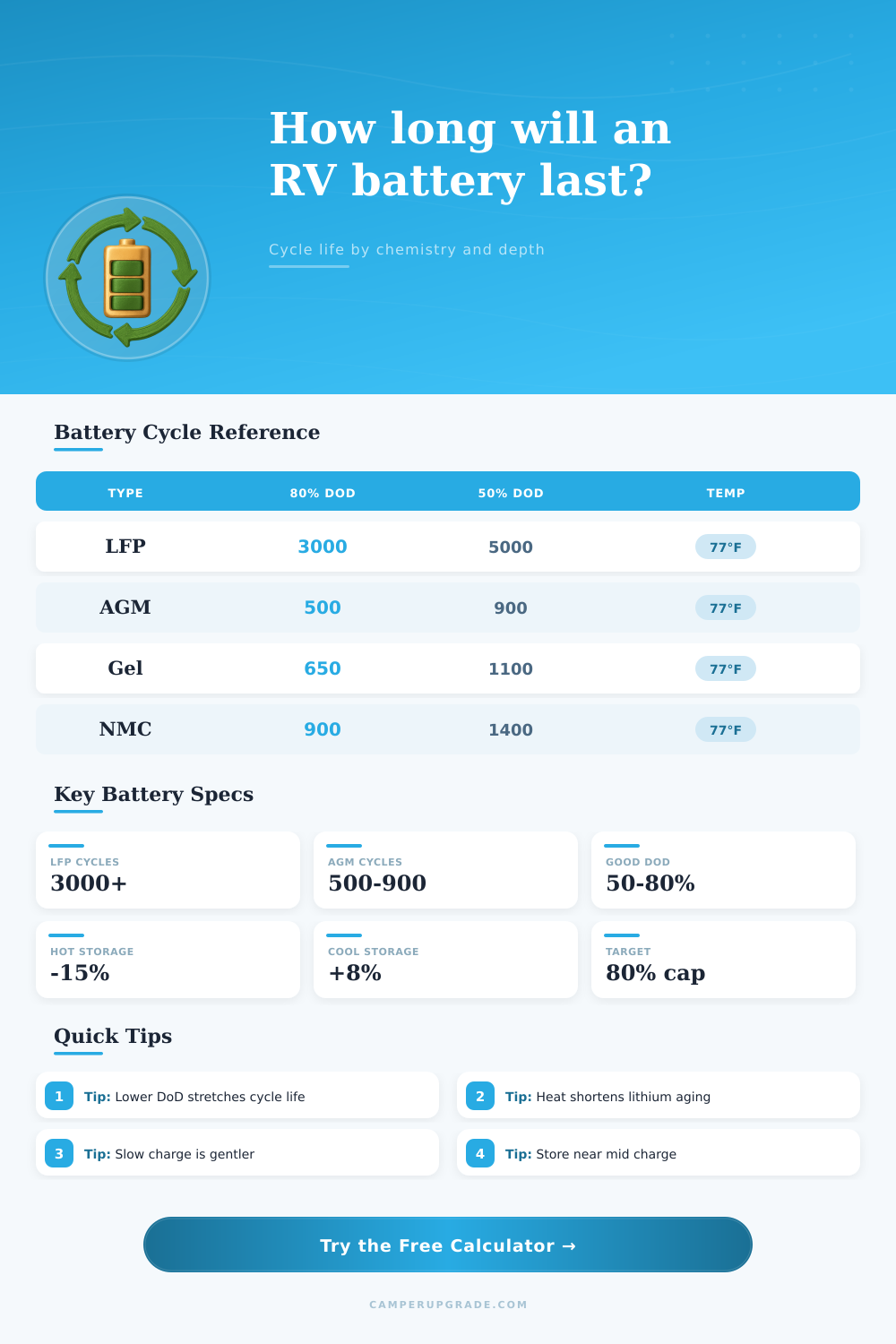
| Chemistry | 50% DoD Cycles | 80% DoD Cycles | Typical RV Notes |
|---|---|---|---|
| LiFePO4 / LFP | 5000 | 3000 | Strong fit for repeated boondocking and solar cycling. |
| Lithium NMC | 1400 | 900 | Common in portable stations where compact size matters. |
| AGM sealed lead | 900 | 500 | Cycle life falls quickly with deep daily discharge. |
| Gel sealed lead | 1100 | 650 | Good low-current behavior when charge voltage is controlled. |
| Flooded lead acid | 750 | 400 | Maintenance and full recharge matter for longevity. |
| Lead carbon AGM | 2000 | 1200 | Handles partial-state cycling better than standard AGM. |
| Sodium-ion | 3200 | 2000 | Useful reference for new cold-capable camper banks. |
| Dual-purpose marine/RV | 550 | 300 | Built for mixed starting and light house loads. |
| Average DoD | LFP Multiplier | Lead Multiplier | Use Case |
|---|---|---|---|
| 30% | 1.65× | 1.55× | Solar float, light lights and fans. |
| 50% | 1.30× | 1.25× | Balanced daily camper use. |
| 70% | 1.08× | 1.05× | Typical boondocking night cycle. |
| 80% | 1.00× | 1.00× | Published deep-cycle reference point. |
| 90% | 0.78× | 0.70× | Frequent heavy inverter use. |
| 100% | 0.58× | 0.45× | Reserve-only or emergency discharge. |
| Condition | Cycle Effect | Calendar Effect | Calculator Treatment |
|---|---|---|---|
| 32-50°F operating bay | +3% | +4% | Cooler storage reduces calendar fade. |
| 50-68°F interior | +5% | +8% | Gentle range for most chemistries. |
| 68-86°F moderate | 0% | 0% | Baseline spec-sheet reference. |
| 86-104°F warm compartment | -10% | -18% | Heat speeds chemistry aging. |
| 104°F+ hot compartment | -22% | -35% | Large penalty for long hot storage. |
| RV Battery Scenario | Bank Size | Weekly Cycles | Depth Target |
|---|---|---|---|
| Weekend trailer lights, pump, fridge controls | 100-200 Ah at 12 V | 1-2 | 40-60% |
| Solar boondocking with inverter cooking | 300-600 Ah at 12 V | 5-7 | 60-85% |
| Full-time van with DC fridge and laptop | 200-400 Ah at 12 V | 5-7 | 50-80% |
| Travel trailer AGM bank on shore charger | 200 Ah at 12 V | 1-3 | 35-55% |
| Portable station for camp kitchen loads | 1-2 kWh pack | 2-5 | 60-90% |
Batteries are consumable products, so they don’t last forever, no matter what size or how many you have. They degrades with use, and also with time. That’s why most of us RVers is more interested in their cycle life than their absolute capacity. Yes, you may be carrying two hundred amp hours, but if you’re draining down deep every night in a hot compartment, then they’ll lose that juice far quicker different than the spec sheet indicates.
By taking into account where and how you live, as well as your habits, this calculator translates all those complex chemistry numbers into real-world years of use. It’s the difference between being prepared for three years on the road vs. You discover at mile four-hundred that your battery bank are dead.
How to Make Your RV Battery Last Longer
While this is the easiest tool to ignore as an off-grid camper, depth of discharge is the single biggest tool for controlling longevity. Yes, lithium iron phosphate chemistry will perform better during deep cycles than lead acid; yes, even LFP cells won’t perform well if they are forced to go all the way down to absolute zero again and again.
By putting in a multiplier based off how deep you go each day, the tool knows. Pulling out seventy percent of your capacity? Mathematically, that stress show up in the calculations. Only pulling out fifty percent of your capacity? Maybe not.
I know a lot of owners who drastically underestimate what they actualy draw while thinking they’re only drawing fifty percent because they’ve never seen the voltage drop. That means faster degradation then expected. Better to play it safe.
Another factor nobody thinks about till it’s too late is temperature. Whether in storage mode or actively in use, higher temperatures accelerates chemical breakdown. Keeping them out of direct sunlight and engine heat will make a noticeable difference on overall battery lifespan. The calculator accounts for this variable as well to give you a realistic estimate instead of some idealized lab value. You do not have to maintain perfectly controlled conditions, but a cool storage environment help maintain cell integrity over the long haul.
The other thing is the charging patterns matter subtly yet significantly to how long your energy supply lasts. For example, although fast charging might feel good when pulling into a camp site, constantly doing this will create heat and internal resistance which wears down the plates over time. Charging gently is easier on the chemistry and gets you more cycles out of the same set of physical part. That’s not to say you’ll never want to charge quickly; it simply means if you make it your regular charging habit, it will shorten the overall life of your investment. People tend to go crazy focusing on how much juice they draw but forget that how they replace it matters equally as much to its overall life.
What about all that stuff we don’t use through the off season? Off-season storage gets ignored altogether too often. While some batteries can handle it, lithium banks actualy prefer a mid-range state rather than sitting at full charge. Some like to be topped off every month or two. Others will develop damage if they’re never topped off from dead. Lithium banks want to spend more time in the middle range to avoid over stressing each cell’s voltage, whereas lead acid really doesn’t like to be run down to nothing and then stored deep discharged as the hardened sulfation is forever damaged.
The tool takes into account how long your RV sits stored and what percentage of the way charged it is, giving you a true view of total annual wear. Not only does it tell you what happens with engine running, it tells you what happened (and shouldn’t happen) when you shut it all off for the winter.
Knowing this stuff lets you make better decisions about what type of batteries work best for you based on how you actualy live your life, not some fantasy camping trip. Some chemistries is far better suited to deep cycles and light use while other types will excel if you’re doing heavy daily usage with shallow discharges. You’ll see where each chemistry falls in terms of baseline expectation from those reference tables, then you can plug in your own values into them.
The point is not to maximize cycle count. Instead, you should of match the battery to your lifestyle and know it will deliver the most reliabel power from the very start until the end of its life.