Battery Capacity Loss by Temperature Calculator
Estimate how cold or hot battery temperature changes usable amp-hours, watt-hours, discharge-rate derating, heater consumption, and runtime for RV, van, overland, and campsite power systems.
Full formula breakdown
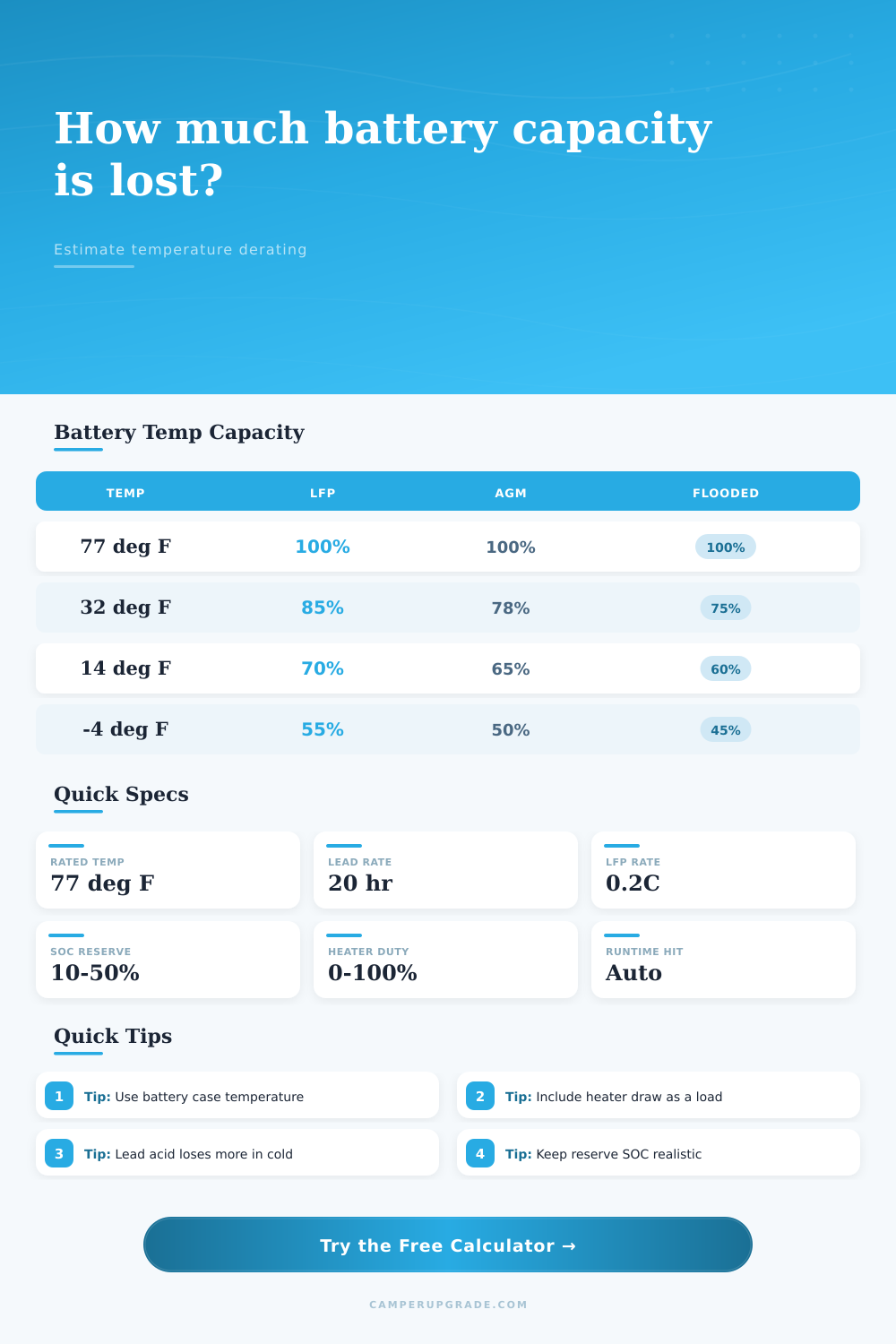
| Battery case temperature | LiFePO4 | AGM | Flooded lead acid | NMC lithium |
|---|---|---|---|---|
| 113°F / 45°C | 93% | 90% | 88% | 92% |
| 95°F / 35°C | 98% | 97% | 96% | 97% |
| 77°F / 25°C rating point | 100% | 100% | 100% | 100% |
| 50°F / 10°C | 95% | 90% | 88% | 96% |
| 32°F / 0°C | 85% | 78% | 75% | 88% |
| 14°F / -10°C | 70% | 65% | 60% | 75% |
| -4°F / -20°C | 55% | 50% | 45% | 60% |
| Chemistry | Rated test basis | Typical Peukert exponent | Calculator rate behavior |
|---|---|---|---|
| LiFePO4 | 0.2C or manufacturer rating | 1.03 | Small penalty at high loads, capped boost at light loads. |
| AGM lead acid | 20-hour rate | 1.15 | Large inverter or furnace loads reduce practical Ah. |
| Flooded lead acid | 20-hour rate | 1.20 | High draws and cold weather combine strongly. |
| Gel lead acid | 20-hour rate | 1.12 | Slightly lower rate hit than flooded batteries. |
| Lead carbon AGM | 20-hour rate | 1.10 | Better high-rate behavior than basic lead acid. |
| NMC lithium station | Pack rating | 1.05 | Low Peukert effect; electronics limits may dominate. |
| Battery type | Common full start | Common reserve stop | Usable window |
|---|---|---|---|
| LiFePO4 house bank | 95% to 100% | 10% to 20% | 75% to 90% |
| AGM deep cycle | 100% | 50% | 50% |
| Flooded lead acid | 100% | 50% to 60% | 40% to 50% |
| Gel lead acid | 100% | 50% | 50% |
| Lead carbon bank | 100% | 40% to 50% | 50% to 60% |
| Portable power station | 100% | 5% to 15% | 85% to 95% |
| Load item | Typical draw | Runtime effect | Calculator input |
|---|---|---|---|
| Internal battery heater pad | 2 to 8 A at 12 V | Can preserve lithium function but consumes Ah. | Heater amps and duty cycle |
| External heated battery box | 1 to 6 A average | Raises case temperature and adds load. | Temp offset plus heater duty |
| Propane furnace fan | 3 to 10 A | Often the largest overnight cold-weather DC load. | Main DC load draw |
| 12 V compressor fridge | 1 to 5 A average | Lower duty in cold weather, higher in heat. | Main DC load draw |
| Small inverter appliance | 100 to 600 W | Converts to DC amps using system voltage and efficiency. | Extra AC watts |
Corrected Ah = nominal Ah x battery count x temperature factor x discharge-rate factor x age factor.Usable Ah = corrected Ah x ((start SOC - reserve SOC) / 100).Total load A = main DC amps + (AC watts / voltage / inverter efficiency) + (heater amps x heater duty).Runtime hours = usable Ah / total load A.
If you’ve looked into van life, you’ll have read most of guides that tell you how many solar panels to buy, and few that discuss why your battery bank dissapears during cold weather. You planned out your battery bank well, did your math, and wake up at 77 degrees Fahrenheit to a fully charged battery. By midnight though, you’re watching your lights dim as your battery chemistry refuse to cooperate.
That’s where the physics comes in: the math is taken care of by calculator for whatever system you build, but learning the physics of it will save you some heartache down the road. Cold temperatures are particularly tough on lead acid batteries. You can’t draws out energy nearly as deeply or quickly than in the summer months because that chemical reaction within the cell slow. It’s not like LiFePO4 doesn’t fare well, either. A lithium battery at 32 degrees may provide 85 percent of what’s listed on label. That sounds small until you consider you are pulling energy from a heater and furnace fan at the same time. The margin for error dissapears quickly.
Why Your Battery Fails in Cold Weather
So how does it account for that? It adds a temp correction factor depending on the chemistry you choose. Also, don’t forget about Peukert’s Law, or rather what happens when you pull lot of current from your battery; it lowers effective capacity. This is a huge problem with lead acid batteries. When you’re running something like inverter, you’ll have less amp hours than indicated. The rate penalty will be accounted for in the calculator, providing you with more accurate picture of run time. Most people overlook this and only get 90% of what they was intending for their battery.
That brings up another wrinkle: Heaters. Newer lithium banks comes with a built-in heater that kicks on at certain temperatures. That’s awesome for protecting the battery, but the heater itself will pull current. On a 12-volt setup, a 5-amp heater is a continuous drain and subtracts from your available power. To compensate for that, you can enter the heater’s duty cycle into the calculator. The calculator let you input the heater’s duty cycle to account for this. You’ve sacrificed some run-time for heat control, which is a valid tradeoff but something to plan for.
Reserves matter. Not all batteries can be run down to zero. Some will damage themself if drained completely. Most lead acid types should of have at least a 50 percent reserve. Lithium can often go deeper, though. The calculator has a place for setting a reserve percentage so that the time estimate takes into account only amount of the battery you can safely use. Don’t set it too low or you’ll get optimistic results and shorten the life of your investment. Know where you draw the line.
Batteries degrade as they age, too. That new battery doesn’t hold a charge like a three-year-old battery. The age-related capacity loss option lets you include this. If you’re aware your bank has degraded by 10% over time, then the calculation will account for that in the outcome. Just like running around with a low fuel warning light lit up, ignoring age is a gamble.
It asks for your ambient temperature, nominal voltage and amp hours when plugged in and it outputs a realistic runtime and a corrected capacity. It will tell you exactly when you will run out of juice to maintain your reserve limit. Use this number as your guide, not the marketing specs on the box which are based off ideal conditions that never realy exist in a camper.
The page includes reference tables comparing various chemistries so you can understand why lithium usually wins in extreme cold even though it costs more upfront. The best defense against the worst case is planning for it. Take some time and run scenarios using the calculator. How long will your batteries lasts if the inverter draws more? What about a cooler night? It uncovers the weak links in your power chain before you find yourself sitting there in the dark.
A large but unknown battery bank isn’t as useful as knowing what your battery bank can handle. Begin with the math, believe the numbers, and leave the heater running.