Battery Bank Wiring Calculator
Plan RV battery series count, parallel strings, usable watt-hours, inverter surge current, voltage drop, fuse size, and main cable gauge.
Battery bank wiring estimate
| Target bank | 6V batteries | 12V batteries | What changes |
|---|---|---|---|
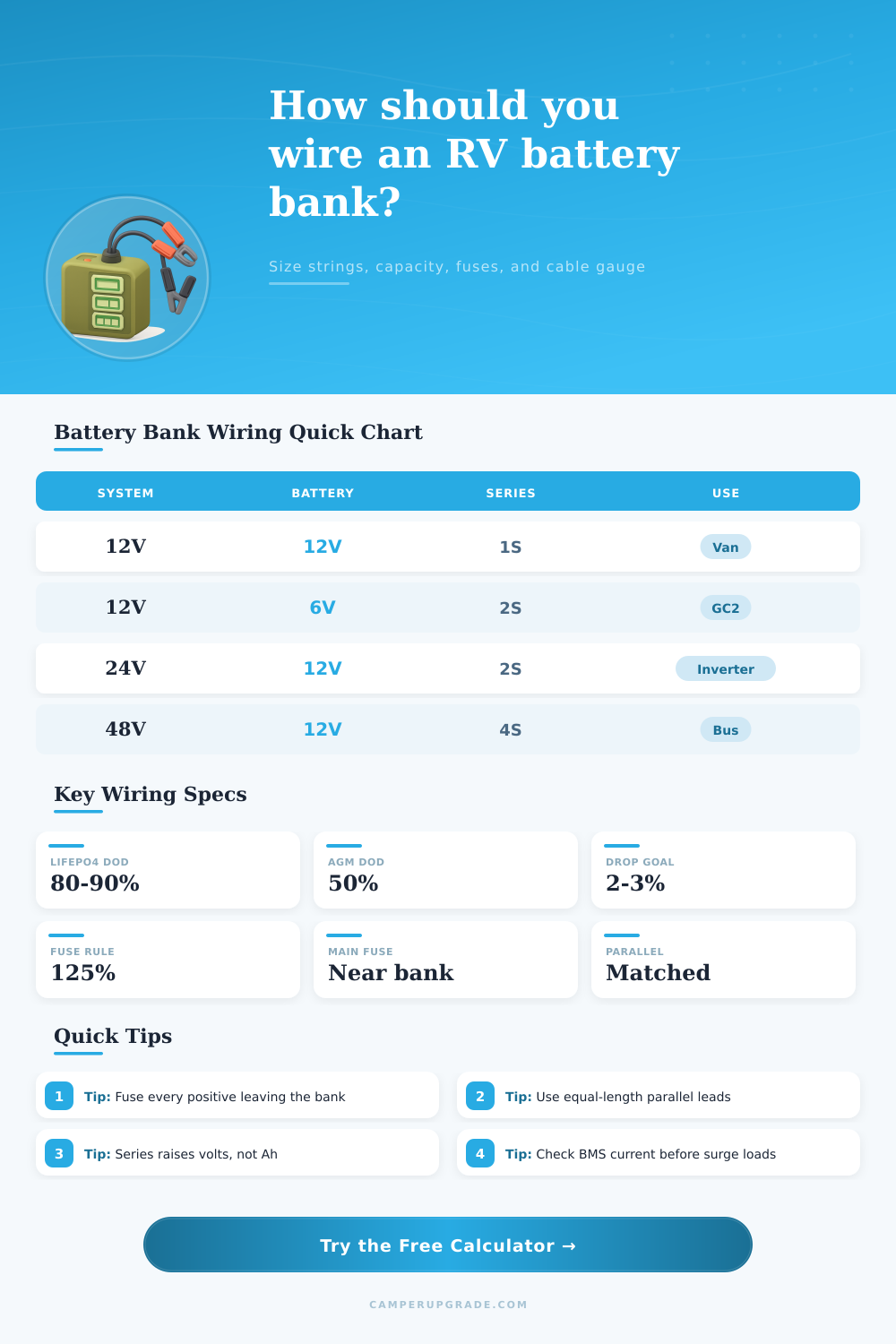
| 12V RV house bank | 2 in series per string | 1 per string | Parallel strings add Ah |
| 24V inverter bank | 4 in series per string | 2 in series per string | Half the current of 12V |
| 36V specialty bank | 6 in series per string | 3 in series per string | Less common in RVs |
| 48V large inverter bank | 8 in series per string | 4 in series per string | Lower cable current |
| More series batteries | Voltage increases | Ah stays the same | Match age and capacity |
| More parallel strings | Voltage stays the same | Ah increases | Balance cable lengths |
| Chemistry | Typical usable depth | Current planning note | RV wiring caution |
|---|---|---|---|
| LiFePO4 | 80-90% | Use BMS amp rating | Cold charging may be blocked |
| AGM lead acid | 50% | Voltage sag rises under surge | Vent compartment per maker |
| Flooded lead acid | 50% | Good surge, lower usable Wh | Needs venting and watering |
| Gel lead acid | 50-60% | Lower charge current limits | Avoid high-voltage charging |
| Mixed batteries | Not recommended | Weak battery limits bank | Do not mix chemistries |
| Parallel lithium | 80-90% | Each BMS shares current | Use matched cable paths |
| Cable size | Typical ampacity | Good RV use | Voltage-drop note |
|---|---|---|---|
| 6 AWG | 75A | Small DC subfeed | Short 12V runs only |
| 4 AWG | 95A | Medium charger feed | Check drop above 70A |
| 2 AWG | 130A | Small inverter | Often short 100A runs |
| 1/0 AWG | 170A | 1500W inverter range | Useful for 12V surge loads |
| 2/0 AWG | 195A | 2000W inverter range | Common main battery cable |
| 4/0 AWG | 260A | Large 12V inverter | Often needed for low drop |
| Calculated current | Common fuse | Typical device | Placement note |
|---|---|---|---|
| 40-60A | 60A or 80A | DC charger / subpanel | Fuse at battery positive |
| 80-110A | 125A or 150A | 1000W inverter | Match cable ampacity |
| 120-170A | 175A or 200A | 1500-2000W inverter | Use DC-rated fuse |
| 180-250A | 250A or 300A | 2000-3000W inverter | Use main disconnect |
| 260-350A | 350A or 400A | Large 12V inverter | Short, protected cable |
| 400A+ | Engineer design | Very large bank | Consider higher voltage |
| RV setup | Common wiring | Nominal storage | Typical main cable |
|---|---|---|---|
| Van with one 100Ah LiFePO4 | 1S1P at 12V | 1.2 kWh nominal | 2-4 AWG by load |
| Travel trailer GC2 pair | 2S1P at 12V | 2.7 kWh nominal | 2-1/0 AWG inverter |
| Boondock 400Ah lithium | 1S4P at 12V | 4.8 kWh nominal | 2/0-4/0 AWG |
| 24V fifth wheel inverter | 2S2P at 24V | 4.8 kWh nominal | 1/0-2/0 AWG |
| 48V bus conversion | 4S2P at 48V | 9.6 kWh nominal | 2-1/0 AWG |
| Truck camper AGM pair | 1S2P at 12V | 2.4 kWh nominal | 2 AWG short run |
In order for the RV battery bank to deliver the correct voltage to the inverter and the RV house load, the RV battery bank must contain enough energy to supply the needs of the RV when the engine is off, and it must protect the RV batteries from voltage spike that may occur when various appliance are turned on in the RV. If the RV battery bank is not wired correctly, there may be the need to replace the cables that carry the energy from the batteries to the inverter, there may be the need to add more batteries to the battery bank to supply the energy need of the RV, or the RV battery bank may experience voltage sags that prevent the inverter from supplying power to the RV appliances as needed. In order to create the RV battery bank, it is first necessary to decide at what voltage the battery bank will operate.
12 volts, 24 volts, or 48 volts? A higher voltage system allow for the same amount of power to travel through thinner wires, and it produces less heat then a lower voltage system. However, to create a higher voltage system, you will have to connect more batteries in series to reach the target voltage.
How to Choose and Wire an RV Battery Bank
Many RV owner will utilize the batteries that they already own to create their RV battery bank. However, these existing batteries may pose some problem to the RV battery bank if the inverter that is connected to the batteries requires a large amount of power or if the batteries are exposed to cold weather condition. It is, therefore, necessary to calculate the target voltage of the RV battery bank, calculate the voltage of each of the batteries that will be utilized, and to ensure that the chemistry of each of the batteries will allow for enough energy to be supplied by the RV battery bank to meet the needs of the RV.
One of the factor that will affect the number of batteries that will be required for the RV battery bank is the depth of discharge of each of the batteries. Lead-acid batteries (whether flooded, AGM, or gel batteries) have limited life if the depth of discharge drop to 50% of the battery’s capacity. In contrast, lithium iron phosphate batteries can endure a depth of discharge of 80% or 90% of the battery’s capacity, and will last for thousands of cycle before losing their charge.
Since the depth of discharge of these batteries can be much deeper than lead-acid batteries, fewer lithium iron phosphate batteries will be required to supply the energy need of the RV when sleeping overnight compared to lead-acid batteries. The depth of discharge of each battery also affects the amount of surge current that each battery string can handle before their internal protection circuit activate. Once you have determined the number of batteries for each series string and the number of battery bank string in parallel with one another, the battery bank must be wired with the proper protections and connections.
Each of the positive lead that leave the RV battery bank must contain a fuse. The fuse should be sized to protect the RV battery bank’s cables, not the inverter. The main fuse should be placed close to the RV battery bank because short circuits are more likely to occur near the RV battery bank, and the fault current will be higher near the RV battery bank.
The size of the RV battery bank’s cables must be determined based off the current that the battery bank will produce, the one-way distance of the RV battery bank to the RV appliances, and the percentage of the voltage that the battery bank will drop. A 2% voltage drop is typical for inverter power feeds to the RV appliances because the inverter will shut off if there is a voltage sag at the inverter’s terminals. Either the length of the positive and negative lead that connect the batteries in the RV battery bank should be the same length, or the connection from the RV battery bank from opposite corners of the battery bank may be used instead.
In addition to the considerations of the type of batteries that will be used in the battery bank, the environment in which the RV battery bank will be deployed will affect the performance of that battery bank. For instance, if the cable that carry the energy from the batteries is within the warm engine compartment of the RV, the battery bank will lose some of its ampacity. If the cable is within the RV behind the electrical panels, the battery bank will again lose some of its ampacity.
Additionally, the size of the main fuse for the RV battery bank and the size of the battery bank’s cables should be sized to allow for future expansion of the battery bank should the owner decide to purchase additional batteries for the RV battery bank. Finally, it is important to consider how the RV battery bank will be charged. For instance, if the RV is equipped with a 200-amp alternator that is connected to a 12-volt system, it is possible that the alternator will push more current into the RV battery bank than the batteries are capable of accepting.
However, if the RV alternator is wired to a 48-volt system, only a quarter of the current will be pushed into the battery bank. Additionally, the environment in which the batteries are deployed can affect their functioning. For example, if the RV is utilizing cold lithium iron phosphate batteries, the batteries may not accept the charge until they warm up.
Lastly, flooded lead-acid batteries may lose their capacity or even freeze if they are at a low state of charge. The goal is for the RV battery bank to meet the needs of the RV’s appliances while surviving the voltage spikes that those appliances create by being turned on. Each of the factor discussed above can help to the owner to reach that goal.
By using a calculator to determine each of these factor based on a single set of constraints for the RV battery bank, the RV owner can successfully create the RV battery bank that is needed.